How a Brittany Differs From a Small Munsterlander
Choosing between a Brittany and a Small Munsterlander can be tricky: both are affectionate, athletic pointing dogs, and both need more than a quick walk around the block. Their differences show up in size, coat, hunting style, and the kind of daily routine they thrive in. This guide compares the breeds so you can picture which one fits your home and outdoor life.
The main differences between a Brittany and a Small Munsterlander
Size, build, and coat
A Brittany is generally the more compact dog. It has a light, athletic build made for moving quickly through cover, and its coat is usually short to moderately feathered. A Small Munsterlander is typically larger and more substantial, with a longer coat and more obvious feathering on the ears, legs, and tail. Individual dogs vary, of course, so meeting the parents and adult relatives can give you a clearer sense of the size and coat you might see in a puppy.
The coat difference matters in everyday life, not just in a breed photo. A Brittany’s coat is usually simpler to brush, though burrs and grass seeds can still catch in its feathering after a day outside. The Small Munsterlander’s longer coat may need more frequent combing, especially behind the ears and around the legs, where tangles can form. Either dog needs a thorough check after hunting or hiking; a tidy coat does not prevent foxtails, ticks, or small cuts from hiding.
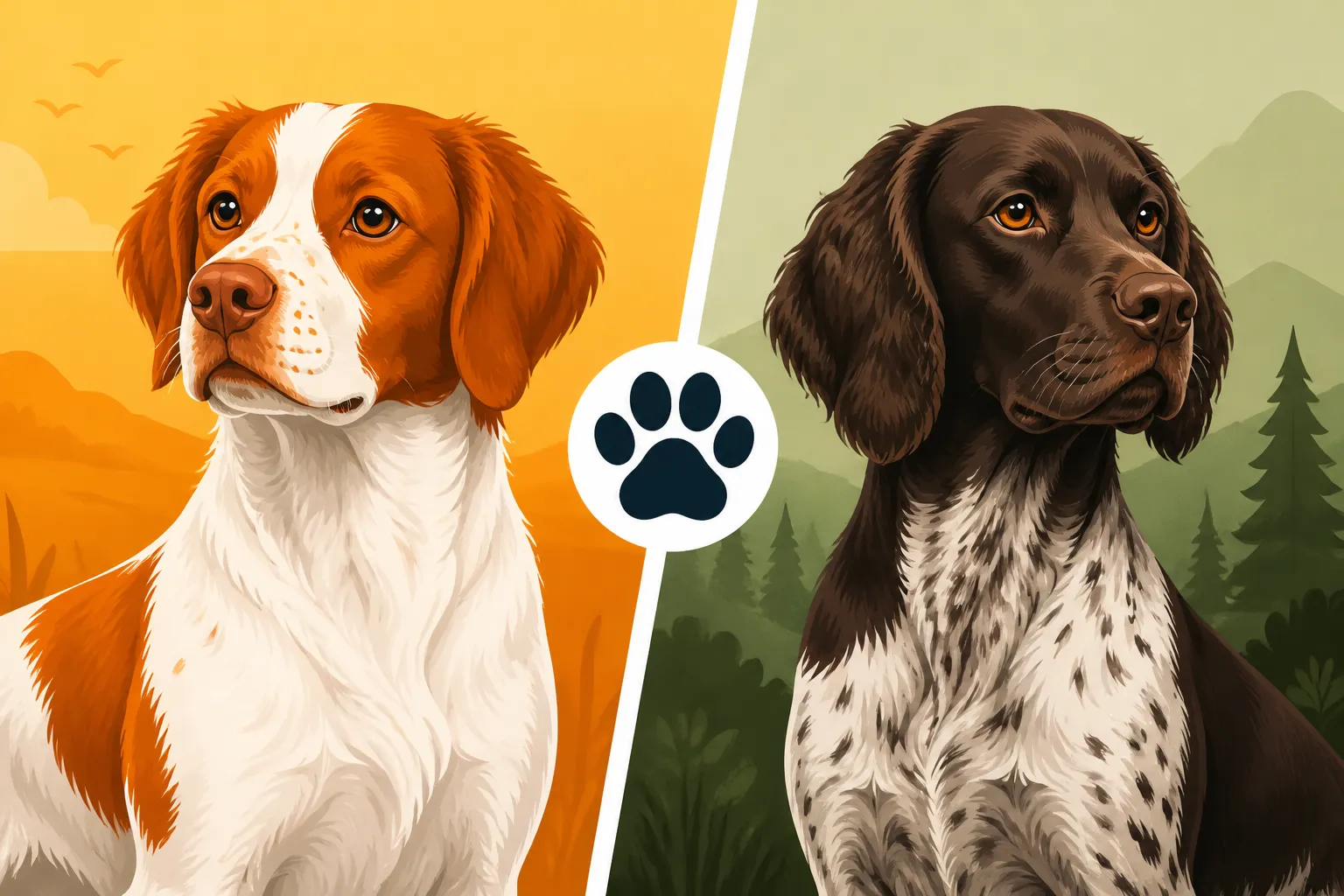
Color also makes the breeds easy to tell apart. Brittanys commonly appear in orange and white or liver and white, with patterns that can include ticking or roan. Small Munsterlanders are known for brown and white markings and may also have brown roaning. If you are comparing puppies, remember that color is a visual trait, not a reliable shortcut for predicting temperament, stamina, or hunting ability.
Background and what each breed was developed to do
The Brittany comes from the Brittany region of France, where it developed as a versatile hunting dog. It is a pointing breed: it locates game and indicates its position rather than simply flushing it from cover. Its history and working role help explain why many Brittanys are quick, energetic, and eager to search. For more background, see What the Brittany Was Bred to Hunt and Whether a Brittany Is a Versatile Breed.
The Small Munsterlander originated in Germany and was developed as a versatile hunting companion. It is also used for pointing, retrieving, and other tasks in the field. Owners often value its willingness to work in more than one setting, including on land and around water. That broad skill set does not mean every individual dog will arrive trained or automatically excel at every job; reliable performance still depends on genetics, early experience, and thoughtful training.
Both breeds can make affectionate companions, but neither should be chosen as a low-activity pet simply because it is a manageable size. Their working heritage tends to bring strong interest in scent, movement, and outdoor exploration. If you are new to Brittanys, The Brittany Is the Pointing Breed You Can Live With offers a useful look at how sporting instincts can fit into home life.
Quick comparison
| Trait | Brittany | Small Munsterlander |
|---|---|---|
| Country of origin | France | Germany |
| General build | Compact and lightly built | Usually larger and more substantial |
| Coat | Short to moderately feathered | Longer, denser, and more feathered |
| Common coat colors | Orange and white or liver and white | Brown and white, including roan patterns |
| Working background | Versatile pointing dog | Versatile hunting dog used for pointing and retrieving |
| Grooming emphasis | Check feathering and remove field debris | More regular combing to prevent tangles, plus field checks |
| Best-known practical distinction | Often easier coat upkeep and compact size | More coat maintenance and generally more dog to manage |
These are broad breed-level distinctions, not promises about any particular dog. A small, heavily feathered Brittany and a lighter-built Small Munsterlander can make the comparison less obvious at a glance. Health, temperament, and working style also differ between individual lines.
Hunting style, training, and exercise
Both need purposeful activity
A Brittany and a Small Munsterlander are not interchangeable with a casual companion breed that is content with a short stroll and a nap. They need regular exercise and opportunities to use their noses and brains. That could mean hunting, structured field training, scent work, retrieving games, or long outdoor outings with appropriate safety and supervision.
The important question is not only how much exercise you can offer, but what kind. A dog that runs for a long time without learning to settle may still be restless at home. Training, sniffing, and problem-solving help make exercise more satisfying. A Brittany that spends the day waiting for its owner to finish work may need a planned outlet, not just a burst of fetch at night. The same is true for a Small Munsterlander.
Their natural abilities can also create different expectations. A hunting home may want a dog with strong search, pointing, and retrieving instincts. A non-hunting household should be prepared to channel those instincts into suitable activities and teach clear household manners. For a closer look at the Brittany’s personality, read What a Brittany's Temperament Is Really Like.
Training should match the individual dog
Neither breed should be assumed to train itself. Both may be bright and responsive, but enthusiasm, distraction, maturity, and sensitivity vary from dog to dog. A puppy that is keen to chase birds or investigate every scent needs careful guidance, consistency, and age-appropriate practice. Short, positive sessions are often more productive than long drills that leave the dog frustrated or mentally checked out.
For a Brittany, harsh correction can be especially counterproductive if the dog is sensitive. A calm, clear approach helps preserve confidence while still setting boundaries. Small Munsterlanders also need patient, consistent training, particularly when building dependable recall and control around game. Training should build skills in stages: first in a quiet setting, then with gradually increasing distractions, rather than expecting a young dog to ignore a strong scent in the field after only a few lessons.
If you are choosing a puppy for hunting, ask breeders about the parents’ working ability, temperament, and the kind of homes their dogs thrive in. If you are looking for a companion, explain your actual routine rather than simply saying you want an “active” dog. A breeder who understands the line can help you think through whether that dog’s drive and energy fit your plans.
Consider your hunting and outdoor routine
A foot hunter who wants a compact dog may find the Brittany’s size appealing. But size alone does not determine how far a dog ranges, how it searches, or how readily it checks in. Those traits are influenced by breeding, training, experience, and the dog’s individual temperament. Likewise, a Small Munsterlander’s reputation as a versatile hunting companion should not be treated as a guarantee of a particular range or style.
Think through the conditions you actually encounter. Do you hunt upland birds, spend time near water, hike in thick cover, or mostly walk local trails? Will you be working one dog or several? Can you safely manage a larger dog in your vehicle and home? A dog that fits your real outings is usually a better match than one selected because of a general breed description.
If the Brittany is on your shortlist but you are weighing other sporting breeds, How a Brittany Differs From a German Shorthaired Pointer and How a Brittany Differs From a Springer Spaniel can help put its size and working style in context.
Daily life, grooming, and care
Coat care and field checks
The Small Munsterlander’s longer coat generally calls for more hands-on grooming. Regular brushing helps prevent mats, especially in feathered areas that rub against one another or collect burrs. If you hike through brush, check behind the ears, between the toes, around the belly, and under the tail when you get home. Do not assume a quick look at the back is enough; debris can be tucked out of sight.
A Brittany may need less routine combing, but it is not maintenance-free. Feathering can catch vegetation, and the dog’s ears, paws, and skin still need checking after outdoor adventures. Either dog may bring home ticks or grass awns, so make a simple post-outing routine part of the day. It is easier to find and remove a small burr while the dog is calm than after it has tightened into a knot.
For routine supplies such as a comb, brush, or dog-safe shampoo, owners may compare options through retailers such as Chewy, while taking care to choose products suited to their dog’s coat and skin. A retailer is not a substitute for veterinary advice when a dog has persistent itching, redness, odor, or a painful skin problem.
Food, weight, and activity
A dog’s food needs depend on age, body condition, health, and activity—not just breed name. A dog that hunts hard through a season may need a different feeding plan from a pet that enjoys daily walks and weekend outings. Watch body condition rather than relying only on the amount printed on a food bag: you should be able to feel the ribs without pressing hard, while the dog still has a visible waist when viewed from above.
Work with your veterinarian when adjusting food, especially for a growing puppy, an older dog, or one whose weight changes unexpectedly. If you purchase food from Chewy or another retailer, use the feeding guidance on the package as a starting point and make changes based on your dog’s condition and veterinary advice. Avoid abrupt diet changes where possible, since they can upset some dogs’ stomachs.
The breeds’ size difference may affect how much food an individual dog needs, but activity and metabolism matter too. A larger Small Munsterlander will often have different practical needs from a smaller Brittany, yet a highly active Brittany may need more energy-dense feeding than a less active dog. The useful comparison is the dog in front of you, not a blanket rule based on breed.
Living with one in a home
Both dogs can be close, affectionate companions, but a good home fit depends on what happens between outings. Can you offer daily engagement, teach a reliable settle, and prevent the dog from rehearsing unwanted habits such as counter-surfing, digging, or chasing household pets? A fenced yard can help with safe play, but it does not replace walks, training, or supervised activity.
The coat may also influence your housekeeping. A Small Munsterlander’s feathering can bring in more leaves, burrs, and moisture after outdoor time. A Brittany’s shorter coat may be quicker to brush, but it still sheds and can carry dirt into the house. Keep a towel and brush near the door or vehicle, and get the dog used to being handled around its feet and ears while it is young.
For either breed, plan ahead for the practical details: safe transport, time alone, access to exercise, and care during busy work weeks. If you shop for basics such as bowls, a crate, or grooming tools through Chewy, check that each item suits the adult dog’s size and your intended use. The right supply list helps, but the daily routine is what determines whether a high-energy hunting dog settles comfortably at home.
Choosing the right breed for your household
When a Brittany may be the better fit
A Brittany may suit you if you prefer a relatively compact sporting dog and want a coat that is often less demanding to maintain than a longer, more heavily feathered coat. It can be a rewarding choice for an active household that enjoys training, outdoor time, and the lively company of a dog with real hunting instincts. Its smaller build may also be easier for some people to manage in a car or a modest-sized home.
That said, compact does not mean low-energy. A Brittany still needs meaningful exercise, training, and a way to use its instincts. If your routine is mostly sedentary, or you expect the dog to entertain itself in the yard, the breed may be frustrating for both of you. Review Whether a Brittany Suits a First Time Owner if you are new to sporting dogs and want to think through the commitment.
When a Small Munsterlander may be the better fit
A Small Munsterlander may make sense if you want a larger, longer-coated versatile hunting dog and are prepared to spend more time on grooming. Its working background can appeal to people who want a dog involved in varied field activities, but that versatility comes with the same need for careful training and regular engagement. Make sure you are comfortable with the dog’s likely adult size and coat before committing to a puppy.
Ask the breeder about how dogs from that line behave in ordinary homes, not only in the field. Find out how they respond to other dogs, how much activity they need, and whether they settle indoors after exercise. Questions like these help distinguish a dog that suits your actual life from one that only sounds right in a breed description.
Questions to ask before deciding
Before choosing either breed, be honest about your week. If you hunt only a few weekends a year, what will your dog do the rest of the time? If you are not a hunter, which activities will give the dog an outlet for its nose, energy, and retrieving instincts? If the answer is “we’ll figure it out later,” take time to build a realistic plan first.
Meet adult dogs where possible and observe them in more than one setting. A dog working in a field may look very different from the same dog relaxing at home. Ask about health testing, temperament, socialization, and the breeder’s support after the puppy goes home. For a broader comparison within the Brittany breed, How a French Brittany Differs From an American One explains another distinction prospective owners often consider.
Ultimately, the better match is not determined by which breed sounds more impressive. It is the dog whose size, coat-care needs, working drive, and daily exercise requirements fit your household—and whose individual temperament suits the people who will live with it.
Disclaimer
This article is for general informational purposes only and does not constitute professional advice. Laws, prices and regulations vary by location and change over time. Consult a qualified professional for guidance on your specific situation.