What an Orange and White Brittany Looks Like
An orange and white Brittany can look almost entirely white at a distance, then show broad orange patches, fine speckling, or a soft roan pattern up close. That variation makes puppy photos and breed descriptions confusing, especially when coat color seems to change as a dog grows. This guide explains the patterns, markings, and coat details you can expect.
The orange and white Brittany at a glance
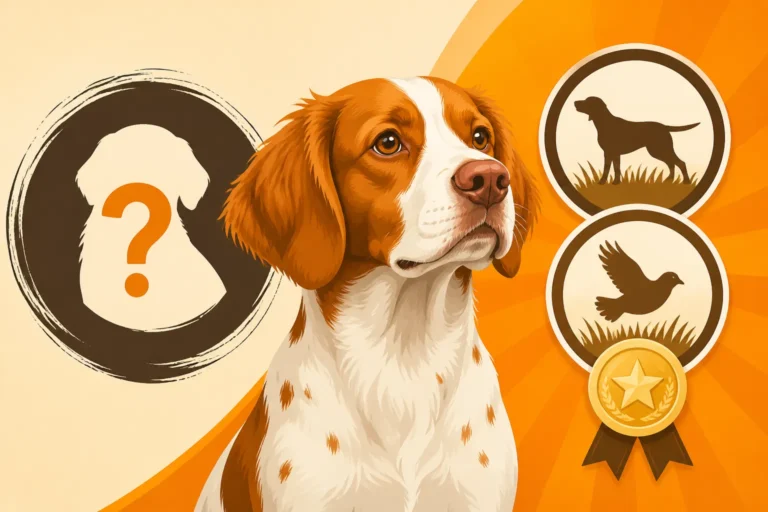
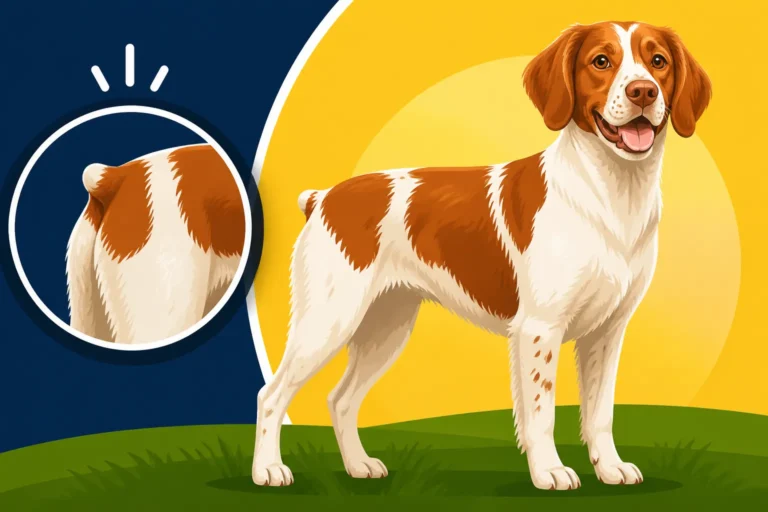
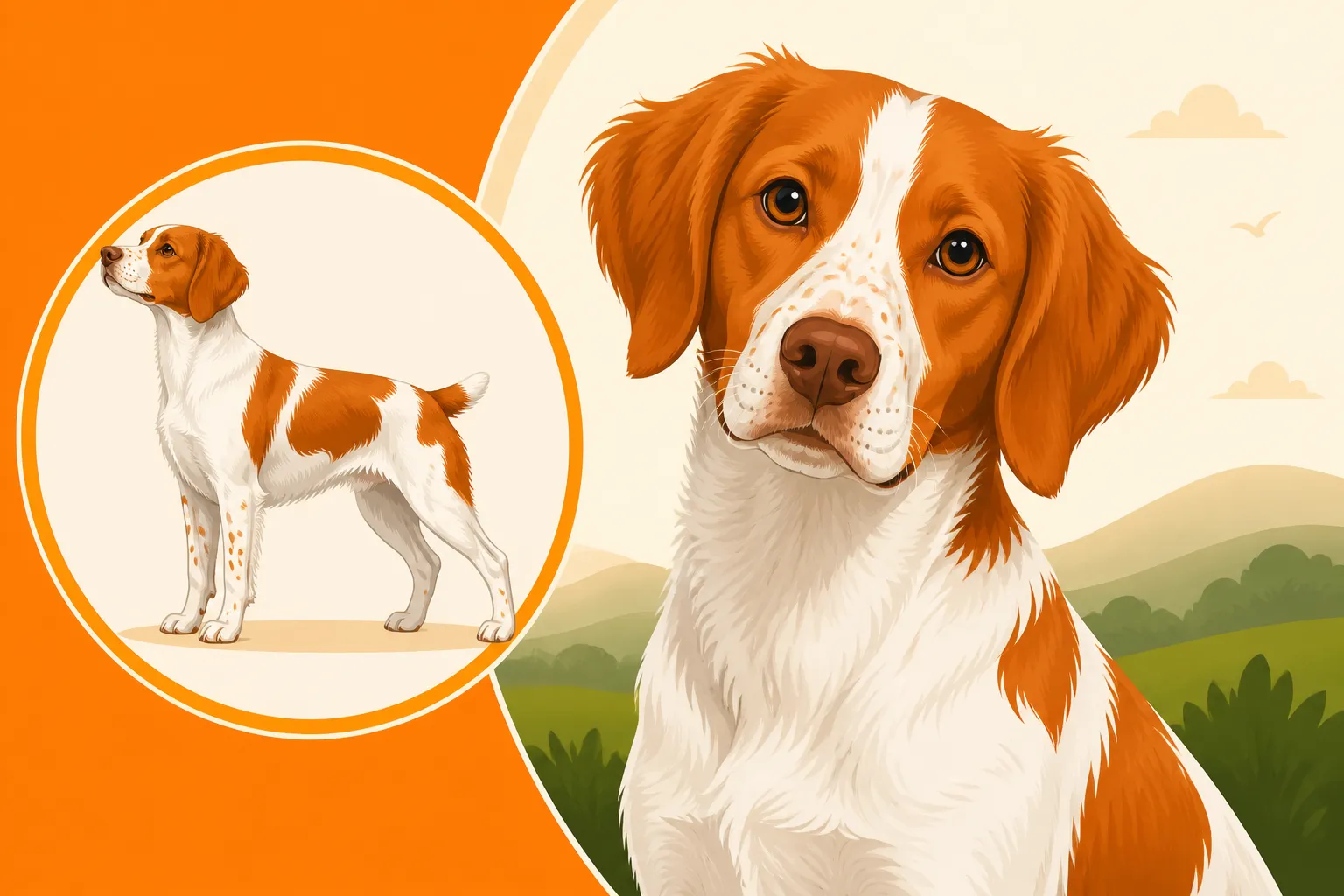
Orange and white is one of the familiar Brittany color combinations. It describes the dog’s coat colors, not a single fixed pattern: one Brittany may have large orange patches against a mostly white coat, while another looks softly speckled over much of its body. The coat is generally dense and may be flat or slightly wavy, with some feathering on the ears, chest, legs, and tail area.
| Feature | What you may see |
|---|---|
| Main colors | Orange and white |
| Pattern | Large patches, scattered markings, or roan |
| Fine speckles | Often called ticking |
| Coat texture | Flat or slightly wavy, with some feathering |
| Overall appearance | Highly variable from one Brittany to another |
Why no two orange and white Brittanys look exactly alike
The phrase “orange and white” tells you which colors appear, but not how they are distributed. A Brittany can have a mostly white body with orange across the ears, around an eye, or over the back. Another may have a large orange area covering much of its side, with white on the chest, legs, or face. The markings can be asymmetrical, too: one side may carry more color than the other.
Some coats look crisp and high-contrast, with clearly outlined patches. Others have many small colored hairs scattered through the white areas, creating a speckled or softly blended look. That variation is normal, and it is why a single photograph is not always a good guide to what an adult dog will look like.
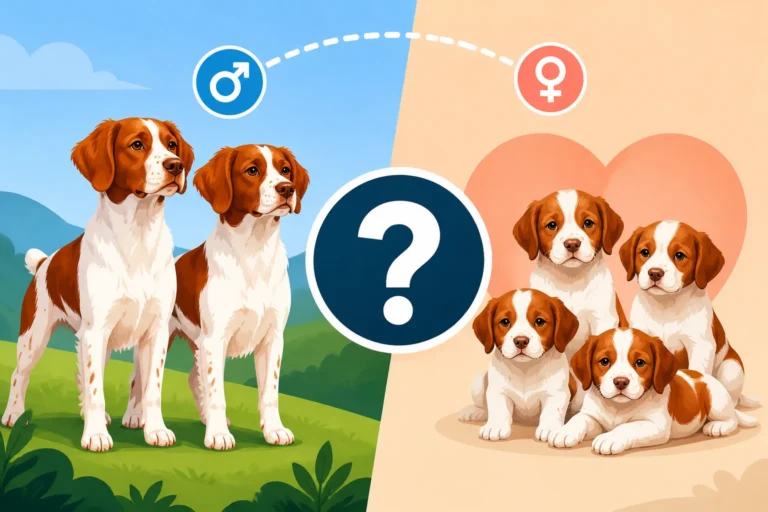
If you are comparing puppies in a litter, focus on the actual colors and pattern rather than trying to find a “perfect” arrangement. A narrow blaze, an orange ear, or uneven patches do not, by themselves, tell you what a puppy’s temperament, health, or hunting ability will be. For an overview of the breed’s recognized color possibilities, see Which Colors a Brittany Comes In.
What orange can look like in the coat
Orange markings can appear bright and warm, or softer and paler. The exact impression changes with natural light, the angle of a photograph, and whether the coat is clean, damp, or dusty after a walk. A dog photographed indoors may look more muted than the same dog standing outside in daylight.
The white areas can look clean white or seem a little cream-colored in certain light. That does not necessarily mean the dog has a different coat color. Shadows, reflected light, and the color of the background all affect how the coat reads. A wet coat can also look darker and flatter, while a dry, freshly brushed coat may show more texture and contrast.
When you are assessing a puppy from a breeder’s photos, ask to see several images taken in ordinary daylight. A close-up can show the markings around the face, while a full-body view gives a better sense of how the orange and white are distributed. If possible, look at photos of older relatives as well, keeping in mind that relatives can still have distinct patterns.
Orange patches, ticking, and roan patterns
The biggest visual difference between orange and white Brittanys is often the pattern, not the color itself. Some dogs have obvious blocks of orange and white; others have a blended appearance because colored hairs are mixed through pale areas. Terms such as “ticked” and “roan” help describe what you see, but everyday descriptions may not always use them consistently.
Large patches and smaller markings
A Brittany with large patches may have orange over the ears, part of the head, and a broad section of the back, with white across the chest and legs. Another may have a mostly white face with a small orange marking over one eye. There is no requirement that the markings form a neat mask or symmetrical saddle to make the dog recognizably orange and white.
The face can be especially individual. An orange blaze may run down the forehead, or white may divide orange areas around the eyes. The ears may be orange, partly orange, or marked differently from each other. These details are often what owners notice first, but they are only one small part of the dog’s overall pattern.
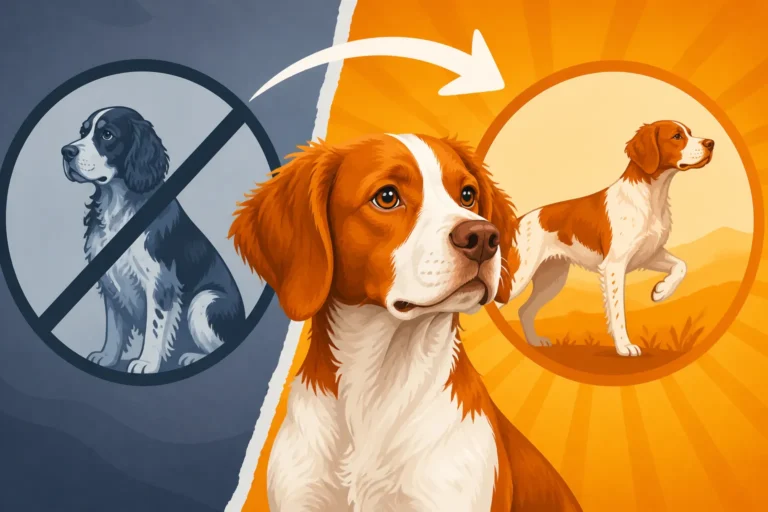
When looking at breed descriptions or registration information, remember that casual terms may describe appearance rather than a precise genetic pattern. If you want to understand how fine speckles fit into the coat, Whether Ticking Is Allowed on a Brittany explains that detail. A close look at the coat can reveal many tiny colored hairs that are hard to make out in a distant photo.
Understanding roan and ticking
Ticking refers to small spots or flecks of color within an area that otherwise appears white. From across a yard, a ticked dog may look nearly solid white in one area. Up close, the coat can show a delicate scatter of orange hairs. The amount of ticking varies, and it may be heavier on some parts of the body than others.
Roan describes a more blended impression, where colored and white hairs are mixed together across an area. In practical terms, owners may use “roan” and “ticked” loosely, especially when describing a dog in conversation. The important point is that these patterns can make an orange and white Brittany look less sharply divided than a dog with large, clean patches.
Pattern also affects how a dog photographs. Fine ticking can disappear in a low-resolution image, making the coat appear plain white. In bright sunlight, the same markings may stand out more clearly. If you are trying to identify a puppy’s pattern, look at the coat close up and in more than one kind of light rather than relying on a single image.
Do the markings change as a Brittany grows
A puppy’s coat can look different as it matures. Fine ticking may become easier to notice as the coat develops, and the overall impression can shift as the puppy grows out of its early coat. A pattern that looks sharply white in a young puppy may appear more blended later, especially if small orange hairs become more visible.
That does not mean the dog’s basic colors will suddenly become something else. An orange and white puppy generally remains orange and white, though the distribution and visibility of markings can look different with age, coat length, and lighting. Seasonal shedding and grooming can also change how much feathering is visible.
If you are wondering whether a puppy’s markings are likely to look exactly the same as an adult’s, it helps to compare puppy and adult pictures from the same family line. Even then, treat those images as examples, not a guarantee. For more detail on maturation and coat appearance, see Whether a Brittany's Color Changes as It Grows.
Coat texture and the way color appears
Color is only part of what gives an orange and white Brittany its look. Coat length, texture, feathering, and grooming all affect the outline of the dog and how the markings show. A Brittany is not a long-coated breed, but its coat may have more hair in some places than a quick glance suggests.
A practical coat, not a uniform blanket
The coat is usually flat or slightly wavy, with some feathering around the ears and on the legs and chest. The amount of feathering varies from dog to dog. One Brittany may have a neat, close-lying coat, while another has longer hair that catches leaves, burrs, and bits of field debris after an outing.
That coat texture can soften the edges of orange patches. Longer feathering may look pale or orange depending on which hairs are mixed together and how the hair falls. After a bath or a thorough brushing, the coat may lie differently and show a somewhat cleaner outline. A clipped or trimmed coat can also make the markings seem more sharply defined, though trimming does not change the underlying color.
If you are gathering basic grooming supplies, a suitable brush and comb are more useful than trying to style the coat into a particular shape. Some owners browse retailers such as Chewy for routine grooming tools, then choose based on the dog’s coat and what is comfortable to use. The priority is gentle, regular care, particularly around feathering that collects debris.
Keeping white areas looking clean
White fur can make dirt, grass stains, and dried mud more noticeable, especially on the chest, feet, and lower legs. That can be frustrating after a long walk when the dog’s coat looks fresh everywhere except the spots that touched wet ground. A quick brush or rinse of the dirty area may be enough; frequent full baths are not automatically necessary.
The orange markings can also hold visible field dust, and fine debris may hide in feathering. After walks or field time, check behind the ears, under the legs, and around the feet. Removing burrs carefully while they are still loose is easier than pulling at a tight knot later. For coat-specific guidance, How Often a Brittany Needs Brushing and How to Get Burrs Out of a Brittany's Coat cover common maintenance questions.
A retailer such as Chewy can be one place owners look for brushes, combs, or dog shampoo, but the right choice depends on the dog’s coat and skin. Use a product made for dogs, and ask your veterinarian for guidance if your Brittany develops persistent itching, redness, or irritation. A cosmetic concern like a grass stain is different from a skin problem that keeps returning.
Choosing an orange and white Brittany
People often notice coat color first when browsing litter photos, and it is fine to have a favorite look. Still, color is a poor shortcut for predicting whether a Brittany will suit your home or hunting plans. A thoughtful choice involves the dog’s health, temperament, background, and the breeder’s approach, as well as the markings you find appealing.
What color can and cannot tell you
Orange and white is an appearance, not a reliable indicator of a dog’s drive, energy, trainability, or affection. A heavily patched puppy is not automatically bolder than a lightly marked littermate, and a mostly white puppy is not inherently calmer. Individual temperament and early experiences matter far more than the arrangement of coat color.
The same is true of hunting ability. A coat may be easier to spot in some settings than another color, but that does not mean the dog is naturally a better or worse hunter. Breeding, training, fitness, and the individual dog shape performance. If you are comparing color with field ability, Whether Color Says Anything About a Brittany's Hunting offers a useful way to separate appearance from function.
Consider what you need from the dog day to day. A household looking for an active companion should ask about exercise needs, socialization, and the parents’ temperaments. A hunter should ask about the lines, training expectations, and the type of work the dog has been bred to do. Coat color can be part of your preference, but it should not carry the whole decision.
Questions to ask when viewing puppies
When speaking with a breeder, ask to see the puppy with its littermates and, when possible, the adult dogs. Photos help, but they cannot show how a puppy responds to people, handles new surroundings, or settles after play. Ask about health testing and the breeder’s plans for matching puppies to homes, rather than choosing solely by the most striking markings.
It is also reasonable to ask how the breeder describes the coat pattern. If a puppy is called orange and white, ask whether the coat has ticking or roan areas that may be more visible as it matures. A responsible breeder should be able to discuss the family’s appearance without claiming that a particular pattern guarantees health or ability.
Color terminology can be confusing when comparing breed references from different places. Some organizations and breed traditions describe acceptable colors differently, so be clear about which registry or standard a breeder follows. If you are considering a particular look because it may stand out in cover, remember that visibility depends on vegetation, distance, weather, and light. Whether an Orange Brittany Is Easier to See in Cover considers that practical question.
For routine care supplies, Chewy may be convenient for browsing items such as grooming tools, but a new puppy’s needs are best discussed with the breeder and veterinarian. If you are preparing for a puppy, make the decision around the dog’s overall fit first. The orange-and-white coat is a lovely feature, but it is just one part of the Brittany you will live with.
Disclaimer
This article is for general informational purposes only and does not constitute professional advice. Laws, prices and regulations vary by location and change over time. Consult a qualified professional for guidance on your specific situation.