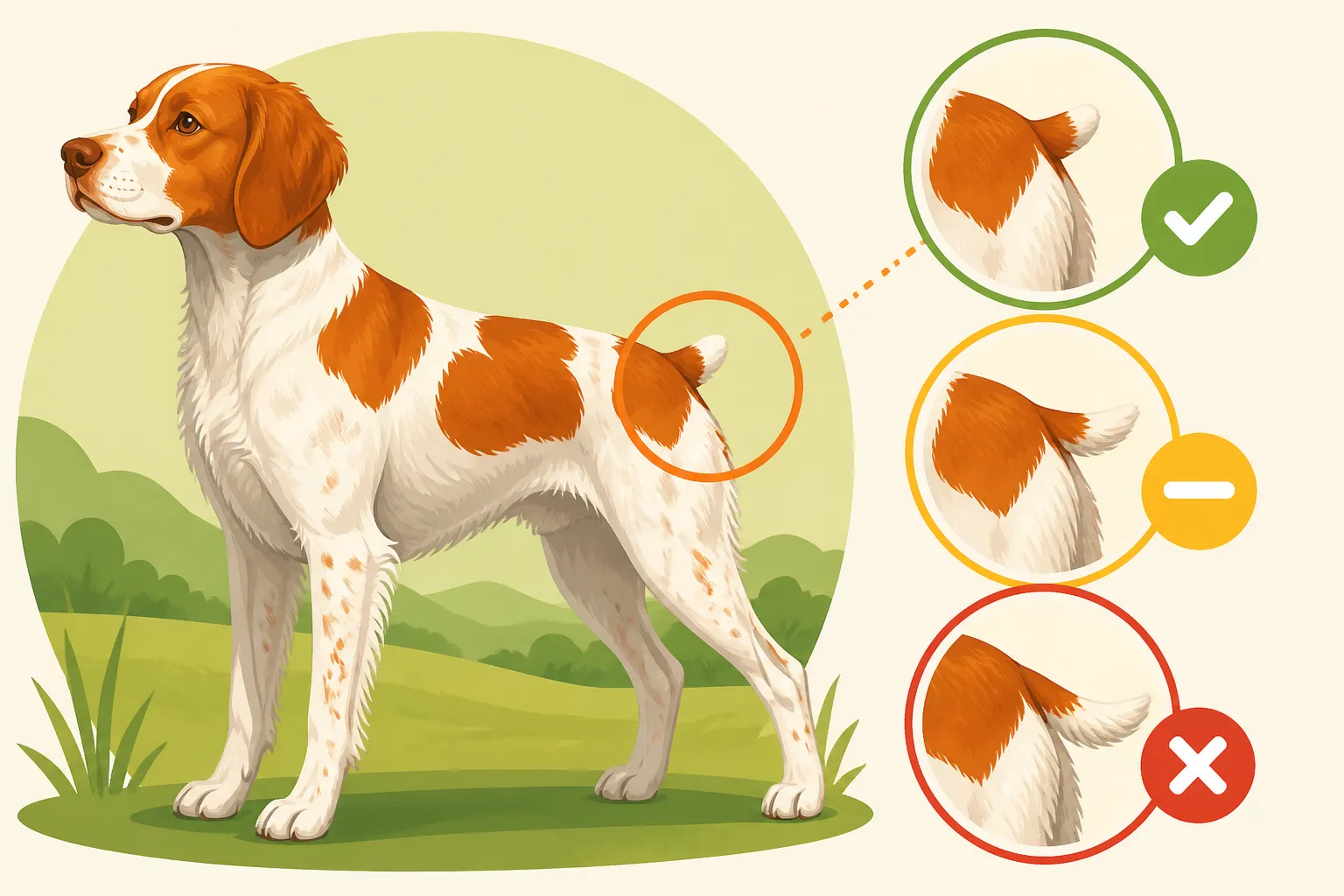
How Long a Docked Brittany Tail Should Be
A Brittany’s docked tail should not be judged by a single “perfect” look. The breed standard describes a tail no longer than four inches, whether naturally short or docked, but a puppy’s procedure, local rules, and the dog’s welfare matter more than appearance. Here’s how to understand the standard, what to ask a breeder, and when a tail needs veterinary attention.
What length should a docked Brittany tail be
The four-inch standard
The American Brittany standard allows a tail that is naturally short or docked, with a maximum length of four inches. That is an upper limit in the breed standard, not an instruction that every Brittany’s tail must be exactly four inches long. A dog may have a shorter tail and still fall within that description.
It can be easy to mistake this standard for a surgical measurement or a guarantee about how a puppy will look as an adult. It is neither. A standard describes the breed’s accepted appearance; it does not replace veterinary judgment, local law, or a careful discussion of whether a procedure should be done at all.
For background on natural and docked tails, see Whether a Brittany's Tail Is Docked. The distinction matters: a Brittany can have a naturally short tail, and a short tail alone does not tell you whether it was docked.
Why there is no single ideal-looking stump
Docked tails can look different from one another. The visible length and shape may vary with the puppy’s natural anatomy, the timing and method of the procedure, and healing. A neat, short tail on one dog is not necessarily a reliable template for another.
That’s why a photo, show-ring impression, or breeder’s description should not be treated as a precise medical standard. If you are considering a puppy, ask whether the tail is naturally short or was docked, and ask the breeder or veterinarian to explain the dog’s history. If you already have a Brittany, your veterinarian can assess whether the tail has healed normally and whether its length or shape is causing a practical problem.
The breed standard’s four-inch limit is useful context, but it should not encourage an owner to seek extra shortening purely for appearance. Tail surgery is a physical procedure, and the dog’s health and comfort come first.
Natural bobtail or docked tail
How to tell what you are looking at
A naturally short tail is present from birth. A docked tail has been shortened through a procedure. In a young puppy, or when you have limited background information, appearance alone may not make the difference obvious. Ask the breeder directly and request clear information about the puppy’s history rather than relying on guesswork.
A natural bobtail is not the same thing as a tail that was cut short. The genetic background of natural bobtails is a separate subject, and breeding decisions should be made with health and responsible breeding practices in mind. For more context, read How Many Brittanys Are Born Tailless and Which Gene Makes a Brittany Tailless.
If a seller describes a puppy as naturally tailless or naturally bobtailed, ask what they know about the parents and litter, and whether the claim is documented. A responsible breeder should be willing to explain what is known without presenting tail length as a substitute for broader health information.
What a breeder should explain
When you are choosing a Brittany puppy, ask whether its tail is naturally short or docked, who performed any procedure, and whether the puppy had any complications. The answers should be straightforward. If the breeder cannot tell you what happened, or dismisses reasonable questions about the puppy’s health, treat that as a reason to pause and learn more before committing.
You can also ask how the breeder approaches tail length in relation to the breed standard and the dog’s welfare. The standard permits a naturally short or docked tail up to four inches; it does not mean that docking is required. A breeder should be able to discuss the difference between what is permitted in a show standard and what is appropriate for an individual puppy.
For a broader look at tail variation and breed expectations, see Whether a Long Tailed Brittany Is Penalized and Whether an Undocked Brittany Can Be Shown. Those questions are related, but they are not the same as deciding whether a procedure is medically or ethically appropriate.
Docking, timing, and welfare
A breed standard is not a medical recommendation
People sometimes assume that because a breed standard mentions docked tails, docking must be necessary for every Brittany. That conclusion does not follow. A standard addresses appearance and eligibility within a particular breed context; it does not determine what is best for every dog.
If you are discussing a planned procedure with a breeder or veterinarian, ask why it is being considered, what alternatives exist, what risks apply, and how the puppy’s comfort and aftercare will be handled. Avoid making the decision solely to match a photo or a preferred look. A veterinarian can explain the medical considerations for the individual puppy and the rules that apply where you live.
Rules and accepted practices can differ by location, so do not assume that a procedure permitted in one place is permitted elsewhere. For a location-specific overview, see Whether Docking Is Banned Where a Brittany Owner Lives. Check with a local veterinarian or relevant authority before making plans.
Puppy docking and adult tail surgery are not the same
A puppy’s tail docking and surgery on an adult dog’s tail should not be treated as interchangeable procedures. An adult dog may need tail surgery for a medical reason, such as a serious injury or a problem that a veterinarian has diagnosed. That is different from shortening a healthy adult dog’s tail to make it resemble a breed-standard outline.
If your adult Brittany has a tail injury, persistent swelling, a wound, discharge, unusual sensitivity, or a sudden change in how the tail is carried, contact a veterinarian. Do not try to trim, bandage tightly, or otherwise alter the tail at home. Tail injuries can be painful, and the right care depends on what is causing the problem.
Recovery instructions should come from the veterinary team. If you need basic supplies for home care, a retailer such as Chewy may be one place to look, but use only items your veterinarian approves and follow their instructions. Supplies do not replace an examination, especially when there is bleeding, worsening pain, or an open wound.
Caring for a Brittany with a short tail
Watch healing rather than chasing a measurement
For a puppy that has recently had a tail procedure, follow the breeder’s and veterinarian’s care instructions closely. Check the area only as directed, keep the puppy’s bedding clean, and watch for concerning changes such as increasing redness, swelling, discharge, bleeding, or signs of pain. If anything seems to be getting worse, contact the veterinary clinic rather than waiting for it to resolve on its own.
Owners often worry about whether a healed tail looks “too long” or “too short.” Once healing is complete, the important everyday questions are whether the dog is comfortable and whether the tail has normal skin and movement for that individual. A veterinarian can assess concerns about healing or function. Appearance alone is not a reason to pursue additional surgery.
If your vet recommends a protective collar or other recovery item, Chewy may be a convenient place to check for suitable pet supplies. Confirm the correct type and fit with the clinic, since an ill-fitting item can create new discomfort rather than protect the area.
Tail length is only one part of the picture
A short tail does not, by itself, tell you how a Brittany will move, hunt, or behave. If you are curious about function, Whether a Brittany's Tail Affects Its Balance explores that question in more detail. For most owners, it is more useful to notice how their dog moves comfortably in daily life than to assume that tail length predicts athletic ability.
When adopting or buying a Brittany, keep tail questions in proportion. Ask about health history and care, but also consider the dog’s temperament, exercise needs, and fit with your household. A tail measurement cannot tell you whether a particular dog will suit your routine.
If a tail is injured or healing, prioritize veterinary guidance over advice from a sales listing or an online photo. Chewy can help with ordinary pet-care shopping, but questions about surgery, pain, infection, or healing belong with a veterinary professional.
Disclaimer
This article is for general informational purposes only and does not constitute professional advice. Laws, prices and regulations vary by location and change over time. Consult a qualified professional for guidance on your specific situation.