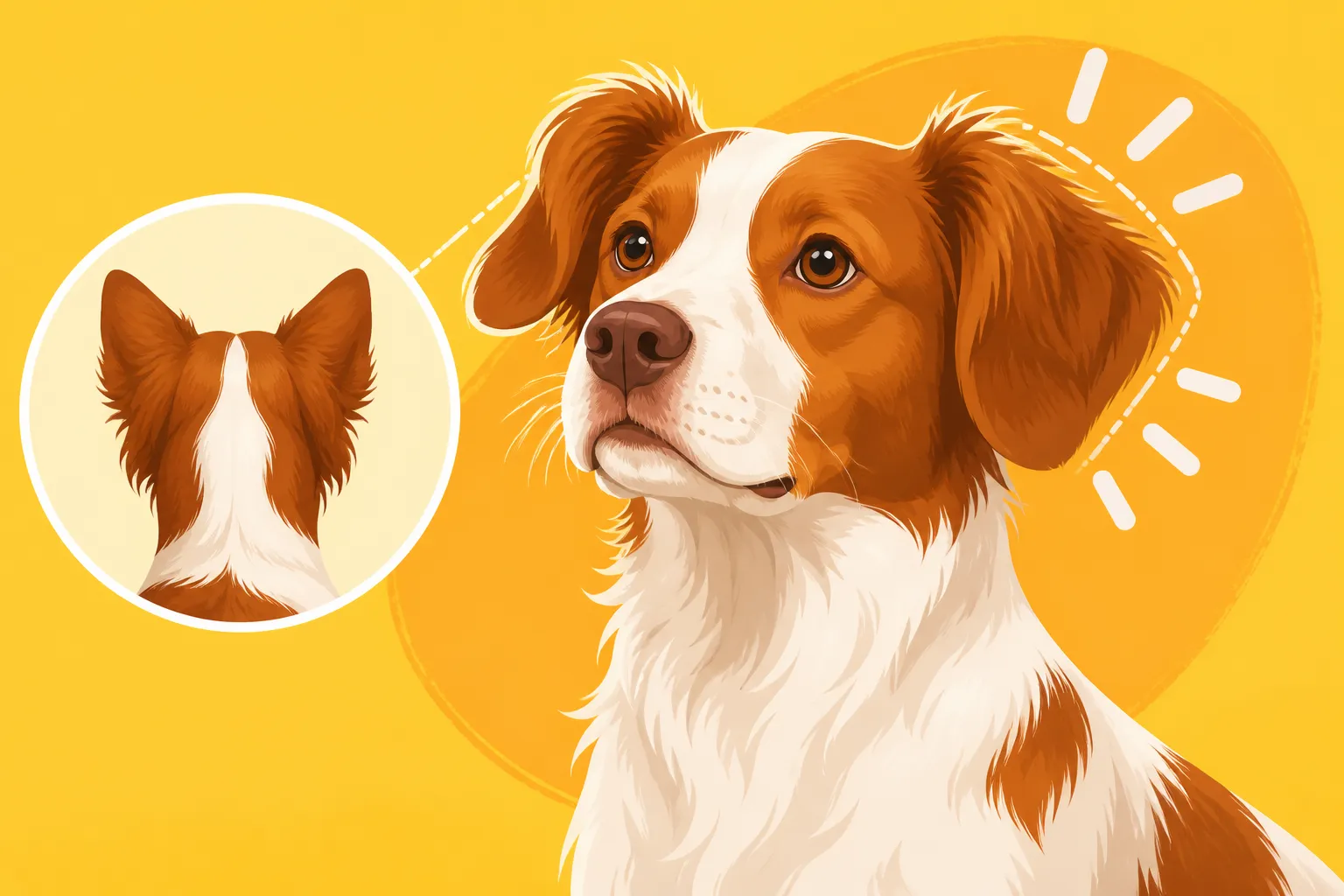
Why a Brittany’s Ears Are Set High
A Brittany’s ears sit high on the head, then fall close to the cheeks—a detail that helps give the breed its familiar alert expression. If you’re wondering whether that placement improves hearing, signals a health problem, or changes how you should clean your dog’s ears, the short answer is that ear set is mostly a feature of breed type, not a guarantee of better ear health.
What “high-set ears” means on a Brittany
Ear set describes where the ear begins
When a breed description says a Brittany has high-set ears, it refers to where the ear attaches to the head—not to the height of the ear tip. The ear leather hangs down, but its base begins relatively high on the skull. That placement contributes to the shape of the head and the dog’s overall expression.
The Brittany’s ears are typically described as short and triangular, with the tips lying close to the head. They’re not upright like a German Shepherd’s ears, and “high-set” doesn’t mean the dog should carry them permanently lifted away from the cheeks. A Brittany may raise or swivel its ears when alert, but the resting shape is generally folded.
It helps to separate three things people often mix up: ear set, ear length, and ear carriage. Set is the position of the attachment; length is how far the ear leather reaches; carriage is how the ear is held in a particular moment. A dog can have high-set ears that are longer or shorter than another dog’s, and its ears may move forward or back as its attention changes.
Why the placement matters to the breed’s appearance
The Brittany is a compact pointing dog, and its high-set, close-hanging ears are part of the breed’s characteristic head. Along with the broad skull, moderate muzzle, and attentive expression, they help distinguish a Brittany from other sporting dogs. The ears are not a decorative extra; they’re one part of a balanced outline.
Breed descriptions and conformation standards provide a shared way to describe that outline. They’re useful when comparing dogs, but they don’t mean every healthy Brittany will look identical. Individual dogs vary, and a pet’s ear shape alone is not enough to judge its health, hearing, or hunting ability. For background on the breed’s French name and history, see What Epagneul Breton Means.
The word “Spaniel” can also make the ear shape seem confusing. The American Kennel Club dropped “Spaniel” from the breed’s official name, but Brittanys remain pointing dogs, not flushing spaniels. Their ears don’t determine that job; their ancestry, instincts, training, and individual abilities matter far more. For more on the naming history, read Why the AKC Dropped Spaniel From the Brittany's Name in 1982.
High-set does not mean upright or unusually small
A common point of confusion is the difference between an ear that is set high and one that stands high. In a Brittany, the attachment may be high even though the ear itself folds down. A puppy’s ears can also look a little different as its head grows, so a brief inspection or a photograph is not a reliable way to assess breed type.
If you’re comparing your dog with a written description, look at the whole head rather than focusing only on the ear tip. Ask whether the ear begins high on the skull, falls naturally, and suits the dog’s proportions. If the ear suddenly changes position because of swelling, pain, injury, or persistent head-shaking, that is a health question rather than a conformation question.
Does a Brittany’s high ear set improve hearing
Ear position is only one part of hearing
A dog’s outer ears help collect and direct sound toward the ear canal. Their mobility lets a dog orient toward noises, and the shape of the pinna—the visible outer ear—affects how sound reaches the ear. But ear set by itself does not tell you how well an individual Brittany hears.
Hearing also depends on the ear canal, middle and inner ear, nerves, age, and overall health. A Brittany with well-placed ears can still develop an ear infection or hearing loss, while a dog whose ears look different from the ideal description may hear normally. If your dog is suddenly failing to respond to familiar sounds, seems disoriented, or reacts differently when approached from one side, ask a veterinarian to assess its hearing rather than guessing from its ear shape.
The Brittany’s strong field awareness can make it tempting to attribute its quick response to its high-set ears. In practice, a dog’s attention, training, scenting ability, and experience all affect what an owner sees outdoors. Ear position is one small part of anatomy, not a shortcut for predicting how well a dog will work.
High attachment does not prevent ear trouble
The visible ear flap is only the entrance to a more complex structure. A dog’s ear canal bends as it travels inward, and problems can develop below the part you can see. The position of the ear’s attachment does not make a Brittany immune to wax buildup, irritation, infection, or foreign material such as grass seeds.
Brittanys often spend time running through grass, brush, and wet cover. After an outing, burrs, debris, moisture, and small injuries may be easy to miss beneath the ear leather. That’s why a quick look and a gentle touch around the ear can be more useful than trying to judge risk by ear set. Learn more in Why a Brittany's Drop Ear Traps Water and Why a Brittany Gets Ear Infections.
Some owners assume that high-set ears should be less prone to infection than low-hanging ears. There’s no simple rule like that. Ear shape, airflow, moisture, allergies, skin conditions, and the dog’s own history can all play a role. If your Brittany has repeated ear problems, a veterinarian can help investigate the pattern instead of relying on appearance alone.
| Feature | What it describes | What it does not tell you |
|---|---|---|
| Ear set | Where the ear attaches to the head | Whether the dog hears well |
| Ear length | How far the ear leather extends | Whether the ear is infected |
| Ear carriage | How the ear is held at a given moment | Whether the attachment is unusually high |
| Ear health | The condition of the skin and ear canal | Whether the dog matches a breed ideal |
What to check on your Brittany’s ears
Look for changes, not just a particular shape
A healthy-looking ear is not necessarily perfectly clean, and a little wax may be normal. What matters is whether the ear looks and smells typical for your dog, and whether your Brittany is comfortable. Check both ears, since irritation can affect one side more than the other.
Notice changes in color, swelling, discharge, odor, and sensitivity. Watch your dog’s behavior too: repeated scratching, head-shaking, rubbing an ear against furniture, or holding one ear differently can be clues that something is bothering it. If the symptoms are new, persistent, or getting worse, contact your veterinarian.
Here’s a simple post-outing check: look at the outer ear and the skin just inside it, gently lift the ear flap, and check for visible debris or moisture. Don’t push a finger or cotton swab into the canal. If you spot a grass seed or other object lodged inside, leave removal to a veterinary professional rather than probing and risking injury.
For a more complete routine after field time, What to Check on a Brittany After Every Outing covers the rest of the dog as well, including areas where burrs, ticks, and small cuts can hide. Ear checks are especially useful after wet cover or tall grass, but they don’t need to turn into vigorous cleaning every time.
Know when cleaning is—and is not—needed
Routine cleaning depends on your individual dog. Some Brittanys have ears that stay comfortable with occasional checks; others may need a veterinarian-recommended routine because they produce more wax or have a history of infection. Overcleaning can irritate sensitive skin, so don’t clean on a fixed schedule simply because the ears look folded.
If your veterinarian recommends an ear cleaner, follow the product directions and your vet’s instructions. A gentle, dog-specific cleaner may be suitable for routine care, but a medicated product or a product intended for another purpose may not be. If you’re comparing options, Chewy can be one place to review labels for pet ear-care products; confirm that the product fits your veterinarian’s advice rather than choosing based on a “deep cleaning” claim.
Avoid household remedies, oils, or leftover medication unless your veterinarian specifically recommends them. Don’t use cotton swabs down the ear canal, and don’t pour cleaner into an ear that is painful, very red, swollen, or producing discharge before getting veterinary guidance. Cleaning an infected or injured ear without knowing what’s wrong may worsen discomfort or make an examination harder.
Owners often ask whether trimming or plucking ear hair will prevent infections. Hair management is not a universal fix, and removing hair can irritate some dogs. Ask your veterinarian to assess your Brittany’s ears before making a grooming change. For more detail, see How Often a Brittany's Ears Should Be Checked, Whether a Brittany's Ears Should Be Dried After Water, and Whether Plucking a Brittany's Ear Hair Stops Infections.
Recognize symptoms that need veterinary attention
A persistent bad smell, dark or unusual discharge, swelling, significant redness, or pain when you touch the ear deserves attention. So does repeated head-shaking or scratching that continues after you’ve checked for visible debris. Those signs can have different causes, and it takes an examination to tell whether the problem is infection, irritation, a foreign body, or something else.
Seek prompt veterinary advice if your dog seems very uncomfortable, has a sudden head tilt, loses balance, or develops a rapidly swollen ear flap. A swollen flap can follow vigorous shaking or scratching and should not be treated as a simple cosmetic change. Don’t wait for the ear to “air out” if your Brittany appears ill or is in pain.
When you call the clinic, describe what you’ve noticed, when it began, whether one or both ears are affected, and whether your dog has been swimming or running through heavy cover. If you have already used a cleaner or medication, tell the veterinarian what it was. That information can help the clinic decide what examination or next step is appropriate. For symptom examples, read Signs a Brittany's Ear Is Infected.
How ear set fits into choosing and caring for a Brittany
Use breed descriptions as a guide, not a health test
If you’re choosing a puppy, the ears are one feature to notice alongside temperament, structure, health history, and the breeder’s care practices. A high-set, folded ear is part of the familiar Brittany outline, but a photo cannot tell you whether a puppy will have healthy ears throughout life. Ask about the parents’ health and how the breeder raises the litter, and meet the dogs when possible.
For an adult Brittany or rescue dog, focus on comfort and function rather than whether its ears look exactly like a show illustration. A dog may have slightly different proportions and still be a happy companion or capable hunting partner. Likewise, a dog that matches the breed outline still needs ordinary preventive care and attention to changes.
The Brittany is the smallest of the versatile pointing breeds, but its compact build doesn’t mean it needs less attention after a day outdoors. A careful ear check can fit naturally into the same routine as checking paws, coat, and eyes. More about the breed’s size and place among sporting dogs is in The Brittany Is the Smallest of the Versatile Pointing Breeds.
Build a calm, practical ear-care routine
For many households, a useful routine is simple: check the ears after outings, dry the outer ear gently if it is wet, and clean only when needed or advised by a veterinarian. Keep the experience calm. If your Brittany pulls away, cries, or becomes tense, pause rather than forcing an inspection that could make future handling harder.
You can help a puppy become comfortable with gentle ear handling by briefly lifting the ear flap, rewarding calm behavior, and stopping before the puppy gets overwhelmed. The goal is not to make a young dog tolerate deep cleaning. It is to make ordinary checks feel familiar, so you can notice a problem without a struggle.
If your veterinarian recommends a particular cleaner and you’re trying to find it, Chewy may be useful for checking product details and ingredient labels. Bring the exact product name or label to your clinic if you’re uncertain whether it is appropriate. A retailer’s product description can help with shopping, but it does not replace a veterinary recommendation for a dog with symptoms or a history of recurring infections.
Keep wellness visits part of the plan, too. A routine exam gives your veterinarian a chance to check the ears and discuss any recurring concerns, even when your Brittany seems comfortable at home. For broader preventive-care context, see How Often a Brittany Needs a Wellness Exam.
A Brittany’s high-set ears are best understood as a defining piece of its head and expression—not as a promise of better hearing or protection from infection. Learn what is normal for your own dog, check for changes after outdoor adventures, and ask your veterinarian about persistent symptoms or cleaning questions. If you’re selecting a puppy, consider ear shape alongside the rest of the dog, not as a stand-alone measure of health or quality.
Disclaimer
This article is for general informational purposes only and does not constitute professional advice. Laws, prices and regulations vary by location and change over time. Consult a qualified professional for guidance on your specific situation.