Whether a GPS Collar Is Worth It on a Brittany
One of the most heart-stopping moments for any Brittany owner is when your beloved dog disappears over a rise or plunges into thick cover, its bird drive overriding everything else. The fear of losing them, even for a few minutes, can be agonizing, especially when you know how far and fast these enthusiastic hunters can range. This guide will help you understand if a GPS collar is a worthwhile investment for you and your Brittany, exploring its benefits, practical considerations, and ultimately, whether it provides the peace of mind and safety you need.
The Unique Challenges of Tracking a Brittany
Brittanys are remarkable dogs, known for their boundless energy and incredible hunting instincts. These very qualities, however, can make them particularly challenging to keep track of in the field, leading to moments of genuine panic for their owners.
Their Instinct to Range and Hunt
Brittanys were bred to cover ground. American Brittanys, especially, are known for their expansive range, often working hundreds of yards away from the hunter. This isn't a flaw; it's what they're designed to do – find birds efficiently over large areas. This inherent desire to quarter widely means they can quickly become out of sight, and sometimes out of earshot, especially in undulating terrain or dense woodlands. A French Brittany might hunt a bit closer, but even they can get caught up in the thrill of the chase. Owners often grapple with the question of How Many Yards an American Brittany Runs Out versus How Many Yards a French Brittany Works, and either way, it's a significant distance to cover when your dog is out of sight.
Imagine walking through a vast cornfield or across a prairie with your Brittany; one minute they're a vibrant orange-and-white blur, and the next, they've vanished into the tall stalks or dipped into a gully following a hot scent. Their intense focus on the hunt means they might not always check in as frequently as you'd like, completely absorbed in their work. This is when the anxiety starts to creep in, and you begin calling their name with increasing urgency, hoping for that familiar orange flash to reappear.
Cover and Terrain Obstacles
The places Brittanys excel at hunting – thickets, dense brush, wooded creek beds, and tall grasses – are often the very environments that make visual tracking nearly impossible. What looks like a clear field from a distance can quickly become a maze of obstacles that swallows a dog whole. The sound of their bell or beeper collar might carry for a bit, but even that can be muffled by heavy cover, wind, or the crackle of your own footsteps.
Think about hunting pheasants in a thorny rose hedge or quail in a dense prairie grass field. Your Brittany plunges in, nose to the ground, working the scent. The sound of their tail wagging furiously against the brush might be the last you hear before they vanish. If they get on a running bird, they can cover a remarkable distance in a very short time, carrying them far beyond your line of sight. Navigating such terrain yourself to follow can be slow and arduous, especially if you're trying to stay quiet and not flush birds prematurely.
The Brittany's Drive to Pursue
Once a Brittany gets "birdy," their focus is almost singular. Their drive to find, point, and retrieve game is incredibly strong, sometimes leading them to push boundaries they wouldn't otherwise. If a bird flushes wild, or if they encounter a rabbit or deer, that instinct to pursue can kick in, taking them even further from your position. While a well-trained Brittany should eventually check back in, or ideally be steady to wing and shot, even the best-trained dogs can sometimes get momentarily lost in the excitement, especially if they are young or particularly high-strung.
This isn't about disobedience; it's about powerful, innate instincts. A Brittany isn't trying to ignore you; it's responding to hundreds of years of selective breeding for hunting. They operate on a different sensory plane in the field, often oblivious to your frustrated calls because their ears are tuned to the rustle of wings or the subtle scent of game. This intense focus, while admirable, can be a major source of worry if you can't visually or audibly confirm their location.
How GPS Collars Work and Their Benefits for Brittany Owners
Considering the challenges of keeping tabs on an active, wide-ranging Brittany, GPS collars have emerged as a powerful tool. They offer a layer of security and information that can profoundly change your experience in the field.
Real-Time Tracking and Geofencing
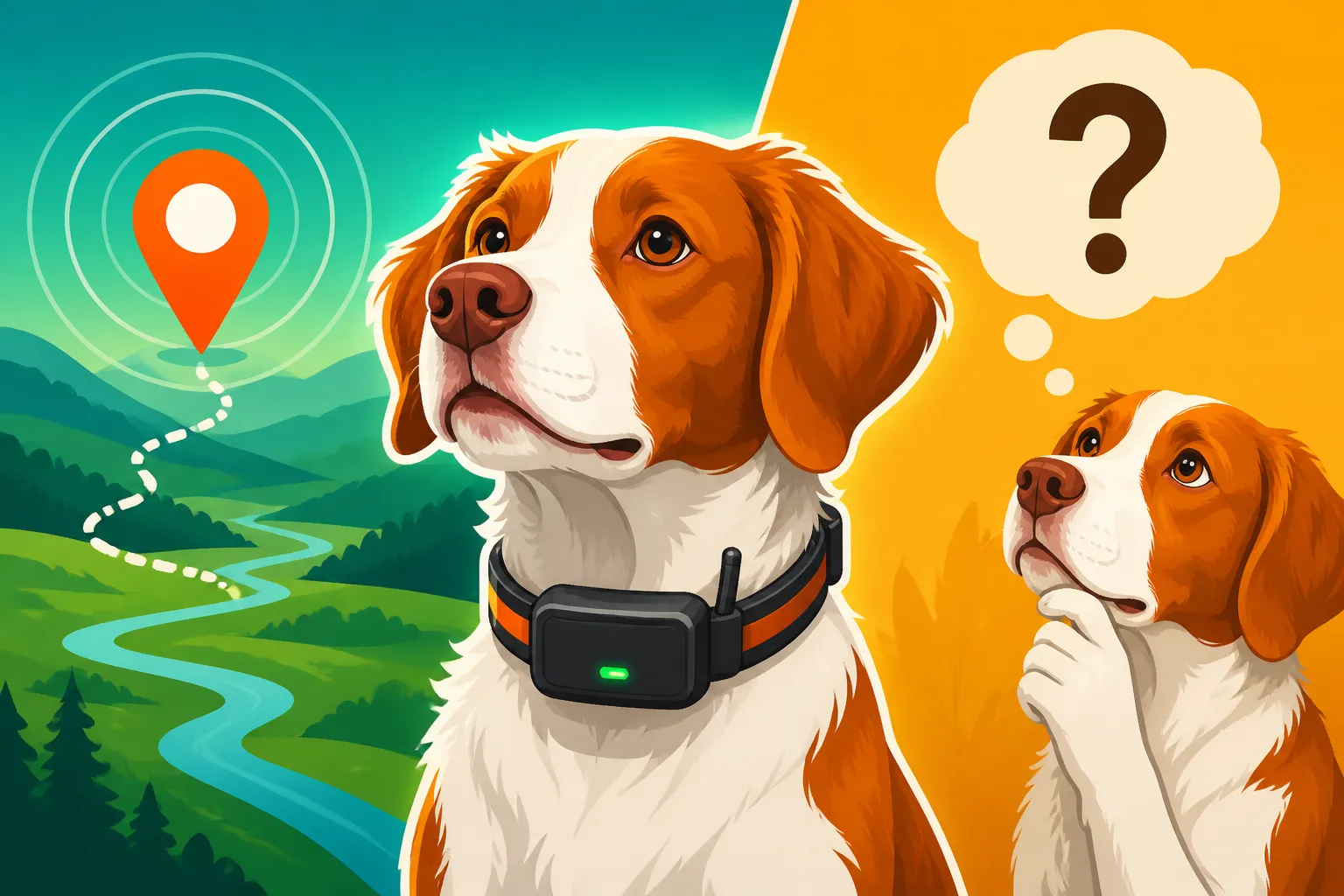
The primary benefit of a GPS collar is, of course, knowing your dog's exact location in real-time. This isn't just a vague estimation; many modern units offer pinpoint accuracy, showing you not only where your Brittany is, but often which direction they're moving and how fast. This data is transmitted to a handheld device or a smartphone app, putting their location right at your fingertips. Imagine the relief of seeing a dot on a map that tells you your dog is holding a steady point deep in a thicket, rather than frantically calling into the wind.
Beyond simply seeing their location, many GPS systems include geofencing capabilities. This allows you to set virtual boundaries, and if your Brittany crosses them, you receive an immediate alert. This can be incredibly useful for training a young dog to understand range limits or for keeping an eye on an older dog that might wander too far. It's an invisible leash that provides boundaries without restricting their freedom to hunt. This feature can be a game-changer for those concerned about Whether a Brittany Escapes a Fence or strays too far during a hunt.
Safety and Peace of Mind
The mental burden of worrying about your dog getting lost or injured can detract significantly from the enjoyment of a hunt. A GPS collar mitigates this stress by providing constant reassurance. If your Brittany goes on point out of sight, you can walk directly to them without guesswork. If they get disoriented, run into unexpected hazards, or even get injured, you can find them quickly. This rapid response capability is not just about convenience; it can be life-saving.
Furthermore, these collars provide peace of mind even when you're not actively hunting. If your Brittany is running in your backyard or at a dog park, a GPS collar can alert you if they leave a designated safe zone. For active breeds like Brittanys, who always seem to be looking for an adventure, this extra layer of security can make a world of difference. Knowing you can locate them quickly means less time spent in frantic searches and more time enjoying their companionship.
Data for Training and Understanding Your Dog
Beyond just location, many advanced GPS collars record data that can be invaluable for training and understanding your Brittany's hunting style. You can see their average range, how consistently they quarter, their speed, and even how long they hold a point. This objective data allows you to analyze their performance and identify areas for improvement. Are they running too wide in certain cover? Are they missing birds by not working into the wind effectively?
This data isn't just numbers; it's a powerful feedback loop. You can use it to refine your training techniques, understand your dog's instincts better, and tailor your hunting strategy. For example, if you notice your American Brittany consistently ranging wider than you prefer in dense woods, you can use that information to practice closer handling drills. It helps you see the hunt through their eyes, so to speak, and become a more effective hunting partner. This insight can even influence your choice of dog food, perhaps nudging you toward a performance blend from a company like Ollie, known for its high-quality ingredients, to ensure they have the sustained energy for their demanding work.
Practical Considerations When Choosing a GPS Collar
While the benefits of GPS collars are clear, choosing the right one for your Brittany involves weighing several practical factors, from the technology itself to the ongoing costs.
Battery Life and Durability
A GPS collar is only useful if it's working when you need it most. Brittanys are high-energy dogs, and a long day in the field means the collar needs to last. Look for models with extended battery life, ideally capable of running for many hours, if not a full day or more, on a single charge. Nothing is more frustrating than having your collar die right when your dog goes out of sight. Think about those long, chilly mornings during duck season or extended pheasant hunts; you need reliability.
Durability is equally critical. These collars are going into harsh environments: thick brush, mud, water, and varying temperatures. They need to be rugged, waterproof, and built to withstand the knocks and scrapes that come with an active hunting dog. Check for robust construction, secure clasps, and materials that can hold up to repeated exposure to the elements. You don't want a flimsy collar that breaks the first time your Brittany barrels through a blackberry patch.
Subscription Costs and Connectivity
Most GPS collars require a subscription service to transmit data, similar to a cell phone plan. These costs can vary significantly, so it's essential to factor them into your overall budget. Some plans offer monthly, yearly, or multi-year options, with different tiers of features or coverage. It's important to understand what's included and if there are any hidden fees. This is part of the broader question of What a GPS Collar Costs a Brittany Owner and can be a significant recurring expense.
Beyond cost, consider the connectivity. Does the collar rely on cellular service, satellite, or a proprietary radio frequency? Cellular-based systems are great in areas with good coverage but can be useless in remote wilderness areas. Satellite systems often have broader coverage but can be more expensive. Proprietary systems, like those used in some hunting-specific GPS devices, create their own network between the handheld unit and the collar, offering excellent reliability in the field, even without cell service. Match the technology to the type of terrain and remoteness where you typically hunt your Brittany.
Weight, Comfort, and Fit for an Active Brittany
While the technology is advanced, the collar still needs to be comfortable for your Brittany to wear all day. An ill-fitting or heavy collar can cause chafing, irritation, or even impede their movement. Brittanys are typically medium-sized dogs, so a bulky, heavy collar designed for a much larger breed might be uncomfortable or even dangerous if it snags on something.
Ensure the collar fits snugly but comfortably around their neck, allowing two fingers to slip underneath. Test it for weight and balance; it shouldn't shift excessively during vigorous activity. Consider the materials against their skin, especially if they have sensitive skin. A dog focused on hunting shouldn't be distracted by an uncomfortable piece of gear. You want them focused on the birds, not fidgeting with their collar.
Weighing the "Worth It" Factor for Your Specific Needs
Deciding if a GPS collar is "worth it" truly comes down to your personal hunting style, your dog's temperament, and your tolerance for risk. There's no single answer, but by considering these factors, you can make an informed decision for you and your Brittany.
Hunting Style and Environment
Your hunting habits play a huge role in the value proposition of a GPS collar. Do you primarily hunt in vast, open spaces where your Brittany is often out of sight, or do you stick to smaller, more confined coverts? If you're a walking hunter covering large swaths of prairie or dense woods, a GPS collar can be an invaluable tool for keeping track of a wide-ranging American Brittany. For someone hunting tight grouse cover where their dog is almost always within bells-range, the necessity might be less pronounced.
Consider the typical terrain and cover. If you regularly hunt in areas with thick brush, deep ravines, or dense forest where visibility is low, a GPS collar offers a significant advantage. It allows you to navigate directly to your dog, saving precious time and reducing stress. However, if you're hunting in open agricultural fields where your Brittany is generally visible, or if you have a French Brittany that naturally hunts a bit closer, you might feel less of an urgent need for one. Remember to always consider the safety of your dog in the field, as they can sometimes pick up The Injuries a Brittany Picks Up in the Field.
Training Level and Recall Reliability
The level of training your Brittany has achieved and the reliability of their recall are crucial factors. A perfectly trained Brittany with an ironclad recall might rarely get lost, but even the best dogs can have an off day or encounter an irresistible scent. A GPS collar can act as a safety net, not a substitute for training. It's for those moments when training momentarily fails, or when your dog truly loses its bearings.
If your Brittany is still young and learning, or if their recall isn't 100% reliable, a GPS collar can provide immense peace of mind. It allows you to give them more freedom to develop their hunting skills without the constant fear of losing them. On the other hand, if you've put in years of diligent training, like many who aim for advanced titles, you might feel a GPS collar is more of a redundancy than a necessity. However, even seasoned hunters often opt for GPS for their most reliable dogs, understanding that accidents happen and that technology can supplement even the best training.
The Cost vs. The Consequence of Loss
Ultimately, the "worth it" factor often boils down to a cost-benefit analysis. A good quality GPS collar system represents a significant upfront investment, plus ongoing subscription fees. When you tally up What a GPS Collar Costs a Brittany Owner over its lifetime, it can be substantial. However, what is the cost of losing your dog? Not just the emotional devastation, which is immeasurable, but also the practical costs of extensive searches, potential rewards, or even the cost of replacing a trained gun dog.
Consider the absolute worst-case scenario: your Brittany gets lost, injured, or wanders onto a dangerous road. The ability to quickly locate them can prevent tragedy. When you look at the emotional toll and potential financial burden of a lost dog, the investment in a GPS collar often pales in comparison. Many owners feel that the peace of mind and the added layer of safety are invaluable. Moreover, having pet insurance from providers like Healthy Paws can help cover unexpected vet bills from field injuries, adding another layer of security to your hunting adventures. While a GPS collar helps prevent losing your dog, insurance helps cover the costs if they do get into trouble, like needing treatment for Cruciate Tears in a Brittany.
| Feature | Traditional Beeper/Bell Collar | GPS Collar (Hunting Specific) | GPS Collar (Pet/Activity Specific) |
|---|---|---|---|
| Primary Function | Audible location | Precise location, activity tracking, sometimes e-collar functions | Real-time location, activity monitoring, geofencing |
| Range | Audible range (varies with conditions) | Miles, line-of-sight often not required | Varies, usually within cellular coverage, often nationwide |
| Connectivity | Sound waves | Proprietary radio signal from handheld unit | Cellular network, Wi-Fi, Bluetooth |
| Real-time Tracking | No, only audible confirmation of movement/point | Yes, exact location on map | Yes, exact location on map (app based) |
| Geofencing | No | Some advanced models might have limited range alerts | Yes, common feature |
| Battery Life | Very long (weeks to months for bells, days for beepers) | Moderate to long (10-40 hours typically) | Shorter (1-5 days typically) |
| Cost | Low (bells: $10-30, beepers: $50-150) | High ($300-$1000+ for system) | Moderate ($50-$250 for device) |
| Subscription Required | No | Usually no, but mapping software updates might be extra | Often yes, for cellular data |
| Durability | High | Very high, built for hunting | Varies, some rugged, some more for everyday wear |
| Best For | Always knowing general location, especially in dense cover | Serious bird hunters, vast landscapes, competitive field trials | Everyday pet owners, walkers, travelers, escape artists |
For many Brittany owners, the answer is a resounding "yes." The peace of mind, enhanced safety, and valuable training data that a GPS collar provides far outweigh the initial investment and ongoing costs. When your Brittany is doing what they love best – ranging wide and hunting hard – a GPS collar ensures they can do so safely, and you can enjoy the hunt without a knot of worry in your stomach. While you're at it, stocking up on essential supplies like quality dog food and training tools from a reliable source like Chewy can help ensure your Brittany is always ready for the field.
Disclaimer
This article is for general informational purposes only and does not constitute professional advice. Laws, prices and regulations vary by location and change over time. Consult a qualified professional for guidance on your specific situation.