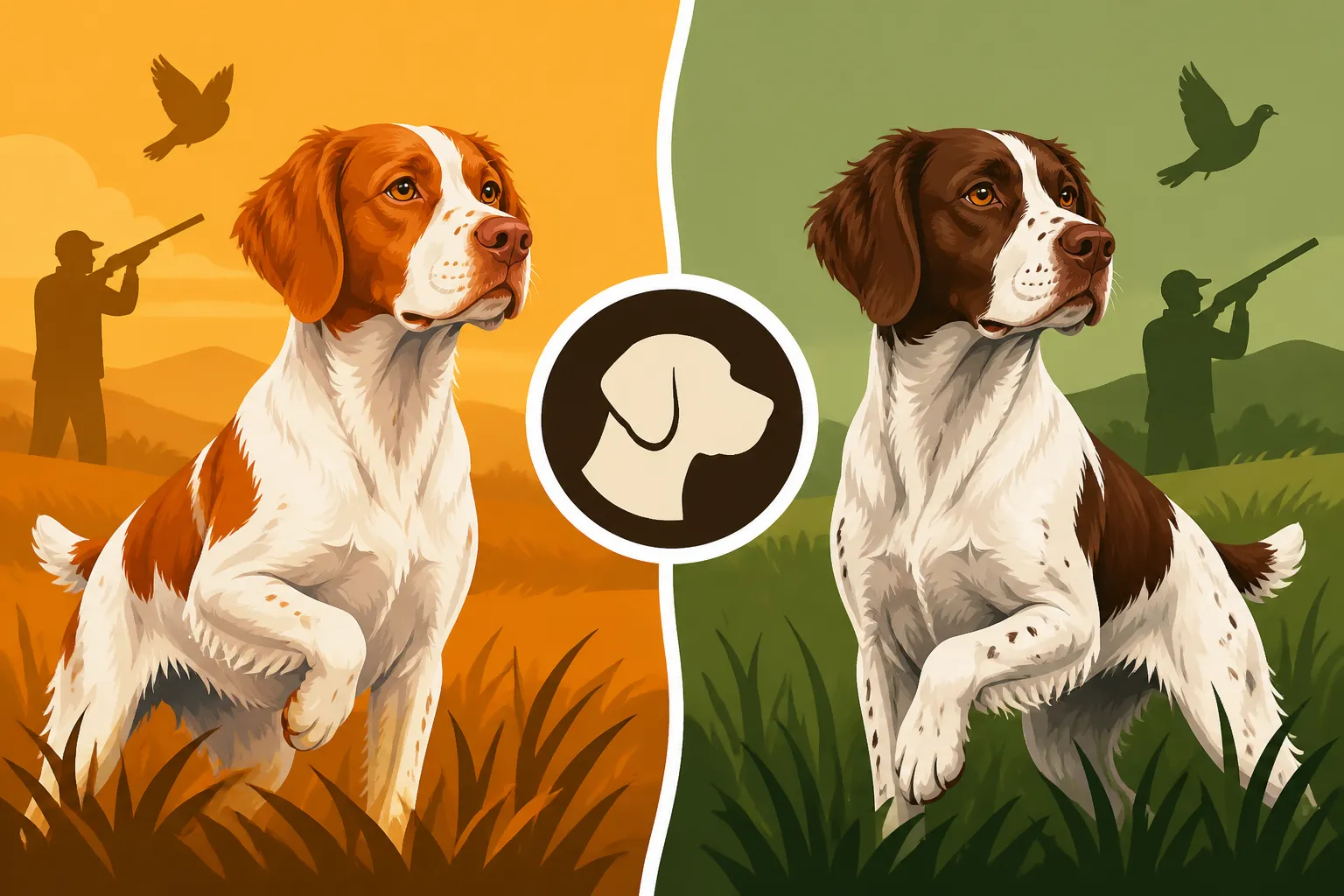
Whether Color Says Anything About a Brittany’s Hunting
A liver-and-white Brittany can hunt with just as much drive as an orange-and-white one, and a striking coat is no guarantee of a good bird dog. Color can catch your eye, but it does not tell you whether a Brittany will range, point, retrieve, or work willingly. This guide separates coat appearance from the traits that matter in the field.
What a Brittany’s coat color can and cannot tell you
Color is an appearance trait, not a hunting report card
Brittanys are commonly seen in orange-and-white and liver-and-white coats, with patterns that may look clear or roan. Their appearance is part of the breed’s charm, and it is understandable to wonder whether one color is more closely linked to a particular kind of hunting dog. But coat color itself does not tell you how a dog uses its nose, responds to training, or searches cover.
A dog’s hunting behavior comes from a much broader mix of inheritance and experience. Family traits, the breeder’s selection choices, early exposure to birds, confidence, health, training, and the opportunities the dog gets to hunt all matter. A puppy’s markings do not reveal whether it will naturally point, how far it will range, or whether it will be steady around gunfire.
That distinction is useful when you are comparing puppies. It is easy to attach meaning to a visual feature: perhaps the boldest orange puppy seems more energetic, or the darkest liver puppy looks more serious. Those impressions may describe what you see in a moment, but they are not reliable predictions of adult hunting ability. Ask about the parents’ behavior and working history instead. For a basic overview of the breed’s accepted appearances, see Which Colors a Brittany Comes In.
Why color may seem connected to performance
Sometimes people do notice a pattern between appearance and hunting style. A breeder may produce mostly one color while also selecting for particular working traits, so dogs of that color in that kennel can appear to share a style. That does not mean the color caused the style. It may simply reflect the dogs chosen for that breeding program and the traits their owners value.
Picture two breeders: one prioritizes dogs that range widely in open country, while another prefers a closer-working dog suited to hunting on foot in thicker cover. If each program has a consistent coat-color pattern, a buyer might start associating color with range. But the meaningful difference is the breeding and selection behind the dogs, not the pigment in their coats.
The same caution applies to show and field backgrounds. A dog’s coat might be common in a particular family or breeding program, but color cannot tell you whether a dog comes from a line selected for field work. To understand the broader discussion, read Whether Show and Field Brittanys Have Split and Why the Brittany Kept Its Working Ability. The pedigree, relatives’ performance, and breeder’s goals are more useful clues than the coat.
The traits that matter more when choosing a hunting Brittany
Look at family behavior and the breeder’s goals
When you are considering a puppy, ask what the breeder is trying to produce. “Good hunting dog” can mean different things to different people. One hunter may want a wide-ranging dog for open prairie; another may want a closer-working companion for walking through smaller cover. A breeder should be able to describe the kind of work their dogs are intended to do and explain how the parents fit that goal.
Ask about both parents, and, where possible, other close relatives. Have they hunted? What kind of birds and terrain have they worked? How do they behave around people, unfamiliar places, and ordinary household life? A parent’s field performance does not guarantee that every puppy will perform the same way, but it gives you more relevant information than coat color does.
Also ask how the breeder evaluates puppies. Do they observe confidence, curiosity, recovery after a surprise, willingness to explore, and response to new surfaces or sounds? Puppy observations are not a final forecast, but a careful breeder can explain what they have seen without promising that a particular puppy will become a finished gun dog. If you are comparing backgrounds, Which Brittany Line to Buy for Wild Birds can help frame the questions you ask.
Consider the kind of hunting you plan to do
A Brittany’s style should fit your own hunting habits. A dog that naturally searches a large area may suit someone who hunts broad country and is comfortable handling a dog at a distance. A closer-working dog may be easier to keep in contact with when walking through dense cover or hunting alone. Neither style is automatically better; the right match depends on where and how you hunt.
Ask a breeder how the parents work in terrain similar to yours. A dog accustomed to open ground may need careful handling and training to adapt to tight cover, while a close-working dog may not naturally search as broadly as you hoped. Those differences are more informative than whether the dog is orange, liver, roan, or heavily marked.
The Brittany’s background as a versatile hunting dog is part of why individual style matters. Its work can include finding birds, pointing, and cooperating with a handler, but no single coat pattern identifies how strongly those behaviors will appear. For context on the breed’s purpose, see What the Brittany Was Bred to Hunt and Whether a Brittany Is a Versatile Breed. If you are deciding between types, How a French Brittany Differs From an American One may also help you think about range and hunting preferences—but, again, color alone does not settle that question.
Coat color, visibility, and practical field safety
Your dog’s visibility matters more than its natural markings
A coat that looks vivid in the backyard may be much harder to pick out in tall grass, brush, or changing light. Orange-and-white coloring does not make a dog automatically easy to track, and a liver-and-white coat is not necessarily a disadvantage. The dog’s position, the cover, the weather, and the angle of the light all affect how clearly you can see it.
Hunters often use high-visibility equipment to make a dog easier to locate. A properly fitted blaze-orange vest can help distinguish the dog from its surroundings, regardless of its natural coat. If you are comparing options through a retailer such as Chewy, focus on fit, freedom of movement, visibility, and whether the vest is appropriate for the cover and conditions where you hunt. A vest that rubs under the legs or restricts shoulder movement is not a good fit just because its color is bright.
A visible collar, identifying information, and a reliable way to keep track of your dog can also help in the field. Chewy may be one place to compare basic field accessories, but check that any collar or vest suits your dog’s size and intended use. A dog’s coat can help you recognize it at a glance, but equipment and attentive handling are the practical safeguards.
Coat maintenance is separate from hunting ability
Color may affect what you notice after a hunt. Burrs, mud, plant debris, and small cuts can be more apparent against some coat patterns than others, while a thick or feathered coat can hide debris regardless of color. Make a routine of checking the ears, feet, armpits, belly, and feathering after time in cover. That habit is more dependable than assuming a certain coat makes problems easier to spot.
If you use a vest, check under it after the outing for dampness, rubbing, or trapped debris. A dog that comes home muddy or wet may need a rinse and a thorough drying, especially around the ears and skin folds. Grooming tools and field-care supplies can be found through retailers such as Chewy, but the key is choosing items that suit your dog’s coat and using them consistently.
Good field care can help you notice issues early, but it does not make a dog a better or worse hunter based on color. A confident dog with a strong working background may still need training, conditioning, and sensible recovery time. For a practical routine after time in cover, see What to Check on a Brittany After Every Outing.
How to judge a Brittany puppy without relying on color
Use observations as clues, not guarantees
When visiting a litter, look at each puppy as an individual. Notice which ones explore, recover after a new sound or surface, engage with people, and settle after activity. Do not choose only the boldest puppy because it looks like a future field star, or dismiss a quieter puppy because it is liver-and-white or has less dramatic markings. A short visit is only a snapshot.
Ask the breeder what they have observed over time. A thoughtful answer might describe one puppy as more independent, another as people-focused, and a third as quick to explore new surroundings. Those observations are useful when matched to your experience and goals, but they are not guarantees of future range, pointing style, or gun steadiness.
It also helps to ask what kind of support the breeder offers after the puppy goes home. A breeder who asks about your hunting plans and talks honestly about training needs is often more useful than one who makes sweeping claims about a puppy’s future based on appearance. You want a realistic conversation about fit, not a promise that a particular color comes with a certain level of talent.
Ask better questions than “Which color hunts best?”
A more useful set of questions focuses on the dog’s background and your own plans:
- What kind of hunting were the parents bred and used for?
- How do the parents work in terrain and cover similar to mine?
- What are the strengths and challenges seen in close relatives?
- How does the breeder assess puppies’ confidence and curiosity?
- What early bird exposure or training has been provided?
- What kind of range and handling style should I expect from this family?
- What health, temperament, and ongoing support information can the breeder provide?
These questions do not remove uncertainty. Every puppy develops as an individual, and no breeder can guarantee exactly how a dog will work in every setting. But they move the decision toward relevant evidence and away from a coat-based guess.
If you are new to bird work, it is worth learning what pointing behavior looks like and how it develops rather than expecting a puppy to demonstrate finished skills. Whether a Brittany Points Naturally offers a useful starting point. Then consider the time, consistency, and professional guidance you may need to build reliable field behavior.
A simple comparison to keep the decision grounded
| What you notice | What it may tell you | What it does not prove |
|---|---|---|
| Orange-and-white or liver-and-white coat | The dog’s visible coloring and pattern | Hunting drive, nose, range, or trainability |
| Roan or clear markings | How the coat pattern appears | Whether the dog will point or retrieve |
| A breeder’s consistent coat color | A pattern in that breeding program | That color causes a particular hunting style |
| Parents with field experience | Relevant background and examples of working behavior | That every puppy will perform exactly like them |
| A puppy’s confidence during a visit | A short-term behavior worth discussing | Finished adult temperament or hunting ability |
| High-visibility field gear | A practical way to improve visibility | A substitute for handling, identification, or safe field habits |
When choosing a Brittany, let color be a preference rather than a prediction. Choose the coat you enjoy looking at, then make the important decisions based on the breeder’s goals, family traits, your hunting plans, and the training you are prepared to provide. A liver-and-white dog is not less capable because of its color, and an orange-and-white dog is not automatically a natural. The work comes from the whole dog and the partnership you build together.
Disclaimer
This article is for general informational purposes only and does not constitute professional advice. Laws, prices and regulations vary by location and change over time. Consult a qualified professional for guidance on your specific situation.