How Much Shorter a French Brittany Is
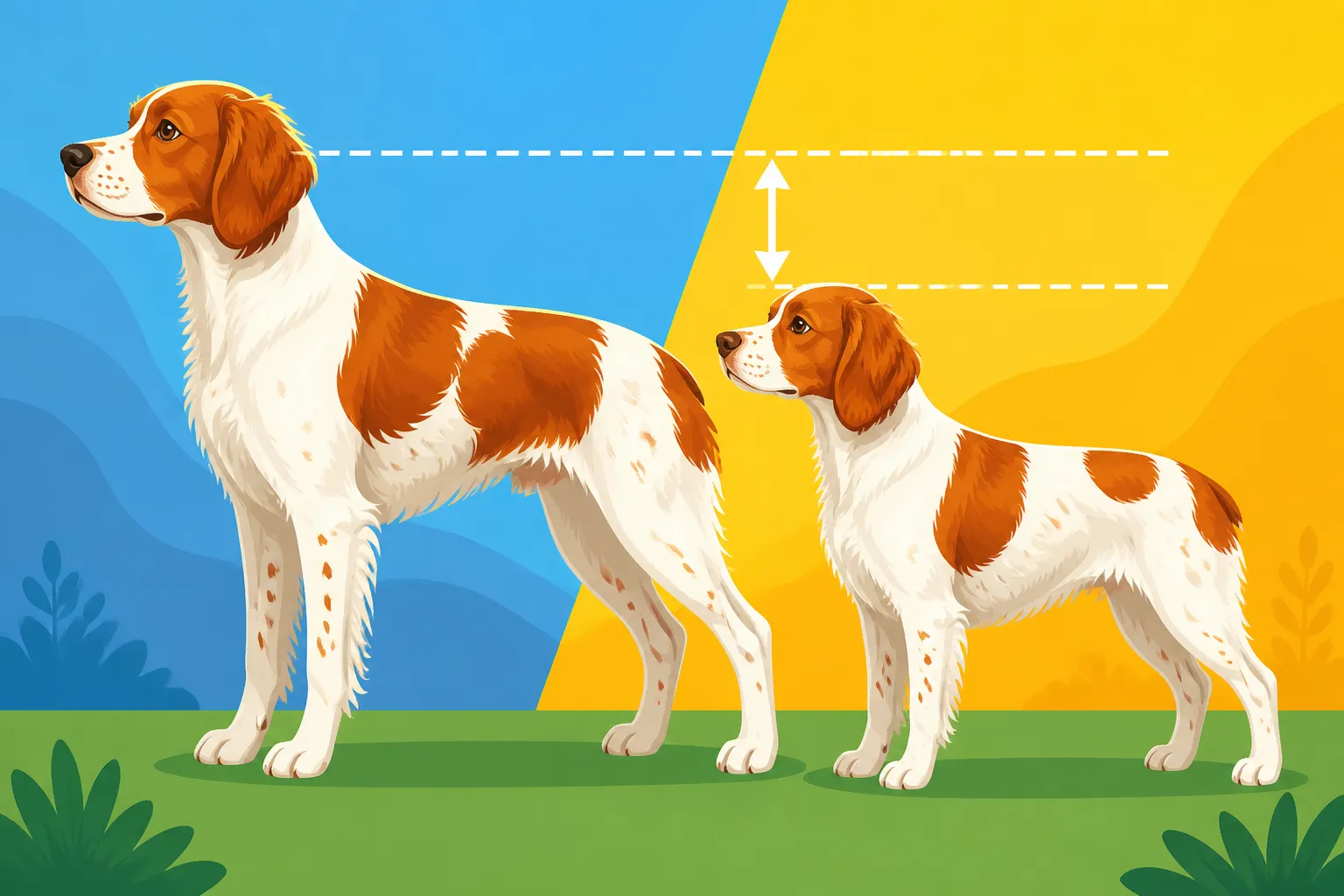
A French Brittany is not automatically shorter than an American Brittany. Their recognized height ranges overlap closely, and some French Brittanys are as tall as, or taller than, many American Brittanys. The apparent size difference often comes down to the individual dog’s sex, build, and breeding line—not a dependable gap between the two types.
How much shorter is a French Brittany
In practical terms, there is no fixed number of inches by which a French Brittany is shorter. The French Epagneul Breton standard describes a dog in roughly the same height range as the American Brittany standard. Both standards include dogs around the 18-to-20-inch mark at the shoulder.
The exact figures depend on which registry’s standard you are comparing. The French standard gives separate ranges for males and females, while the American standard sets a height range for the breed. That difference in how the standards are written can make comparisons seem more precise than they really are.
| Comparison | Height range at the shoulder | What it means |
|---|---|---|
| American Brittany standard | 17.5 to 20.5 inches | A broad range that includes both smaller and larger dogs |
| French male standard | About 18.5 to 20.1 inches | Falls largely within the American range |
| French female standard | About 18.1 to 19.7 inches | Also overlaps substantially with the American range |
These are standard ranges, not a promise about the height of every dog. A particular French Brittany may be shorter than a particular American Brittany, but another pair may be nearly the same height—or have the French dog standing taller. If you’re asking because you want a smaller dog, the label alone is not a reliable way to choose one.
The ranges overlap more than the labels suggest
The French measurements are given in centimeters, so converting them into inches can make the difference look more dramatic than it is. A few centimeters amount to only a small change in height. For example, a French Brittany near the middle of its standard range is still broadly comparable in height to an American Brittany near the middle of its range.
A standard also describes an acceptable range for a breed, not the height you should expect from every puppy. Two littermates can mature to different sizes. Even dogs with similar shoulder height can look noticeably different if one has more bone, a broader chest, or a heavier coat.
That overlap is why simple statements like “French Brittanys are shorter” can mislead prospective owners. If size is important to your living situation or handling comfort, ask about the actual adult height and build of the puppy’s parents and relatives. The broader comparison is covered in How a French Brittany Differs From an American One.
Height is only one part of how big a dog feels
A dog’s shoulder height is not the same as its overall footprint. A compact, sturdy dog may feel heavier and more substantial than a taller, lighter-built dog. Body length, chest depth, muscle, and weight all affect how large a Brittany seems when walking beside you or fitting into a vehicle.
For that reason, compare more than a breeder’s estimate of height. Ask how much the parents weigh, whether they are light or substantial in build, and how their size fits the work they do. A dog’s weight can vary with sex, muscle, conditioning, and body condition, so it is best interpreted alongside its frame. How Much a Brittany Weighs explains why weight alone does not tell the whole story.
Why French and American Brittanys can look different
“French Brittany” is a common term in the United States for the Epagneul Breton associated with French breeding and registration. American Brittanys are bred within American lines and systems. Those histories and breeding choices can influence the way individual dogs look, but they do not create a guaranteed height difference between every dog of each type.
The name can add to the confusion. The Brittany is associated with the French region of Brittany, while “French Brittany” is often used in the United States to distinguish one type or lineage from the American Brittany. It is not a simple size category. For more background on the terminology, see What Epagneul Breton Means and Whether a French Brittany Is a Separate Breed.
Breeding goals affect appearance, but not in a uniform way
Breeders select dogs for traits they value, which can include hunting style, temperament, movement, and conformation. Over time, different breeding traditions may produce dogs that people perceive as having a certain look. But there is variation within both American and French lines, and a general impression is not a measurement.
You may meet a French Brittany with a compact outline and an American Brittany with a similar frame. You may also meet an American dog that is smaller than a French one. Both can be within the accepted height ranges for their respective standards. Lineage may give you context about a dog’s background, but it cannot substitute for asking about the actual parents.
If you are considering a puppy, request measured information where possible, rather than relying on phrases like “small French type” or “big American type.” A breeder’s description can be useful, but it is still an estimate—especially while a puppy is growing.
Build and proportions can change the visual impression
A slightly shorter dog can look larger if it has a deeper chest or heavier bone. A taller dog may look more delicate if it is lean and fine-boned. Coat feathering can add visual volume around the legs and ears, while posture and movement can make a dog appear longer or more compact.
Photos are particularly easy to misread. A puppy photographed close to the camera can look oversized beside a person, and camera angle can hide the difference between shoulder height and body length. If you are evaluating an adult dog from a distance, ask for a standing side view with a familiar object or person nearby for scale.
Temperament and hunting style should also be considered separately from height. A dog’s working range, pace, and closeness to its handler are not determined by its shoulder measurement. If your main concern is how a dog will suit your walking pace, Which Brittany Type Suits a Foot Hunter Better may help you think through the more relevant questions.
How to measure a Brittany accurately
If you already have a Brittany and want to know how tall it is, a careful measurement at home is more useful than estimating from photos. The standard measurement is taken at the highest point of the shoulder, called the withers—not at the top of the head.
Measure at the withers
Ask the dog to stand squarely on a level, firm surface. Its front feet should be under its shoulders, and it should be standing naturally rather than leaning forward or stretching its neck upward. A relaxed stance gives a more dependable measurement than trying to measure while the dog is sitting or shifting around.
Place a flat object, such as a book or carpenter’s level, across the top of the shoulders. Keep it level, then measure straight down to the floor. A soft tape measure can work, but it may bend along the dog’s back and produce a less accurate result. If your dog is wiggly, having another person offer a treat or calmly steady the dog can make the process easier.
Take the measurement more than once. If the results differ, reset the dog’s stance and check that the measuring object is level. It is normal for a home measurement to be approximate; if you need a formal measurement for a competition or registry purpose, follow that organization’s instructions.
Measure a puppy with patience
Puppies grow quickly, so a measurement is only a snapshot. A puppy that seems small at one age may fill out as it matures, and height does not necessarily increase in a smooth, predictable way from week to week. Avoid making a long-term size decision based on one early measurement.
Instead, ask the breeder about the parents’ adult heights and weights, and look at mature relatives if you can. That information gives useful context, but it still cannot guarantee exactly how a puppy will develop. Nutrition, health, sex, and individual variation all play a role in the adult dog’s final build.
If you are tracking growth, record the date and measurement rather than trying to interpret every small change. For practical equipment, size by the body part that matters: use chest and neck measurements for a harness, and compare the dog’s length and height with the manufacturer’s guidance for a bed or crate. When browsing harnesses on Chewy, check the product’s own sizing directions instead of assuming that a French or American label predicts the right fit.
What to consider if you want a smaller Brittany
If you hope a French Brittany will be a smaller, easier-to-handle dog, it is worth separating that preference from the breed label. Some French Brittanys may be compact, but the height standards do not make them reliably shorter than American Brittanys. Choosing by actual adult relatives and the individual dog’s build is a better starting point.
Ask breeders about real adult measurements
Ask for the parents’ measured heights and weights, and ask whether those measurements are typical of their close relatives. A breeder may be able to describe the size of previous puppies as adults, which can provide additional context. If you are considering a rescue, ask for the dog’s current measurements and weight, while remembering that weight can change with health and conditioning.
It also helps to explain why you want a smaller dog. If lifting the dog into a vehicle is the concern, weight and body shape may matter more than a small difference in shoulder height. If you are concerned about fitting a dog into a home, think about resting space, exercise needs, and how the dog behaves indoors—not just its standing measurement.
For equipment, measure before ordering. A harness should fit the individual dog’s chest and neck; a crate needs enough room for the dog to stand, turn around, and lie down comfortably. If you are comparing crate options on Chewy, use the listed product measurements and your dog’s body measurements rather than choosing based on the words “French Brittany.” A dog bed bought through Chewy should likewise be selected by the dog’s sleeping posture and length, not its lineage label.
Look beyond height when choosing a type
A good match depends on more than whether a dog is an inch shorter. Consider energy level, training needs, temperament, hunting goals, and whether the dog’s typical working style suits your household. A smaller Brittany still needs appropriate exercise and engagement; compact size does not make the breed low-energy by itself.
If the main reason you are drawn to a French Brittany is the expectation that it will hunt closer, be calmer, or fit a particular lifestyle, discuss those qualities separately with the breeder or rescue. Ask what the parents are like in the field and at home, and how the breeder describes the line. Those details are more useful than assuming height predicts behavior.
For people comparing registrations as well as size, it is also sensible to ask what paperwork accompanies the dog and which organization registered its parents. Whether a French Brittany Is Registered by the AKC covers that distinction, while How Tall a Brittany Stands provides a broader look at height across the breed.
Disclaimer
This article is for general informational purposes only and does not constitute professional advice. Laws, prices and regulations vary by location and change over time. Consult a qualified professional for guidance on your specific situation.