Which E Collar Suits a Brittany
Finding the right e-collar for your Brittany can feel like navigating a minefield. There's so much conflicting information out there, and you just want what's best for your loyal hunting partner without resorting to harsh methods. This guide will help you understand what makes an e-collar suitable for a Brittany, ensuring you can train effectively and safely, bringing out the best in your dog.
Understanding E-Collars for Your Brittany
When people hear "e-collar," often the first thing that springs to mind is a negative image of a harsh, archaic "shock collar." And honestly, that's a valid concern given the history and misconceptions surrounding these tools. However, modern e-collars, when used correctly, are far from the abusive devices some perceive them to be. For a Brittany, a breed known for its intelligence, sensitivity, and boundless bird drive, understanding the nuances of an e-collar is crucial.
What an E-Collar Actually Does and Doesn't Do
Let's clear the air right away: a modern, high-quality e-collar doesn't "shock" your dog in the painful, high-voltage sense you might imagine. Instead, they deliver a mild static stimulation, similar to the static electricity you might feel when touching a doorknob after shuffling your feet on carpet. The key is that this stimulation is adjustable across a wide range of levels, from a barely perceptible tingle to a more noticeable nudge. The goal is communication, not correction born of pain. Many collars also offer vibrate and tone-only options, allowing for a stepped approach to communication.
The real magic of an e-collar lies in its ability to provide clear, consistent communication even at a distance. When used by a knowledgeable handler, it becomes an extension of your voice and leash, helping to reinforce commands and establish boundaries without raising your voice or resorting to physical force. It's about getting your dog's attention, especially when they're highly distracted by a scent or a bird, not about punishing them for being a dog. Remember, a Brittany's drive is incredible, and sometimes that drive makes them "deaf" to your voice.
Why a Brittany Owner Might Consider an E-Collar
Brittanys are fantastic dogs, brimming with energy, intelligence, and a powerful instinct to hunt. However, these very traits can sometimes make them challenging to train, especially when it comes to off-leash reliability in the field. They range wide, especially American Brittanys, and their focus on birds can be absolute. This is where an e-collar can become an invaluable tool for ensuring safety and effective communication. Imagine your Brittany, deep in cover, suddenly catching a scent and pushing too far ahead. Your voice might not carry, or they might be so absorbed they simply don't hear you.
An e-collar provides a way to get their attention gently but firmly, no matter the distance or distraction. This can be critical for recall, preventing them from running into dangerous situations like roads or private property, or from busting birds prematurely. It allows you to maintain control and reinforce commands like "Whoa" or "Here" in environments where a long leash just isn't practical. For a dog that can really stretch its legs, like a Brittany, the peace of mind that comes from knowing you have a reliable way to communicate across hundreds of yards is immense. Think about How Far an American Brittany Ranges—you need a tool that can keep up with that kind of ground speed. Similarly, even if you have a French Brittany that tends to How Close a French Brittany Hunts, sometimes that bird drive can still override their natural inclination to stay near.
Key Features to Look for in a Brittany E-Collar
Choosing an e-collar isn't a "one size fits all" situation, especially for a specific breed like the Brittany. You need to consider their unique physical attributes, their energetic hunting style, and their inherent sensitivity. Selecting the right collar means looking beyond just the price tag and delving into the specifics of its design and functionality.
Range and Signal Reliability
For a breed like the Brittany, known for its expansive search pattern and incredible speed in the field, a strong and reliable signal range is non-negotiable. You're not just training in your backyard; you're often in thick cover, rolling terrain, or open fields where your dog might be out of sight quickly. A collar with a range of at least half a mile, and preferably closer to a mile or more, gives you the necessary reach. Don't underestimate how quickly a focused Brittany can cover ground, and how easily hills, trees, or dense brush can interfere with a weaker signal.
Beyond sheer distance, consider signal reliability. Does the collar boast robust antenna technology? Is it less susceptible to interference? There's nothing more frustrating, or potentially dangerous, than pressing your remote button only to find your dog's collar hasn't received the command because of a patchy signal. Look for brands with a reputation for consistent performance in varied outdoor conditions. Many reputable gun dog training brands specialize in collars that prioritize this reliability in demanding environments.
Stimulation Levels and Customization
This is arguably the most critical feature for a Brittany, given their famously "soft" nature. Brittanys are incredibly intelligent and eager to please, but they can also be quite sensitive to harsh corrections. A good e-collar for a Brittany will offer a very wide range of stimulation levels, starting at extremely low, barely perceptible settings. You need the ability to find your dog's "working level"—the lowest possible setting that gets their attention without causing fear or discomfort. This is often just a subtle twitch of an ear or a glance back at you.
Look for collars that offer both "momentary" (a quick, single pulse) and "continuous" (a stimulation that lasts as long as you hold the button, up to a set maximum) options. Continuous stimulation, when used appropriately at a very low level, can be excellent for steadying a dog on point or reinforcing a "Whoa" command. The ability to fine-tune these levels, often with a rheostat dial that allows for seamless adjustment, is far superior to collars with just a few preset levels. Your Brittany deserves a nuanced approach, not a blunt instrument, especially when considering How Sensitive a Brittany Is to Correction and to avoid What a Brittany Does When It Is Corrected Too Hard.
Durability and Waterproofing
Your Brittany is a working dog, built for the elements. Their e-collar needs to be just as tough. Field conditions are rarely pristine – think mud, rain, snow, tall grass, thick brush, and sometimes even a plunge into a duck pond. A collar that isn't fully waterproof (not just water-resistant) is an accident waiting to happen. Look for receivers that are IPX7 rated or better, meaning they can be submerged in water without damage.
The remote transmitter also needs to be durable, able to withstand drops, bumps, and the occasional exposure to moisture. Rubberized casings, sturdy buttons, and a design that's easy to handle with gloves on are all beneficial. Remember, you'll be relying on this equipment season after season, so investing in a well-built, robust system from a known manufacturer will save you headaches and expense in the long run. Don't forget to check the strap material as well; something that stands up to burrs and snags will be much appreciated.
Size and Fit for a Brittany
Brittanys are medium-sized dogs, typically weighing between 30-40 pounds, but they're incredibly athletic. You don't want a bulky, heavy collar that impedes their movement or causes discomfort, especially during long days in the field. Look for a receiver that is relatively lightweight and compact, sitting snugly but comfortably on your dog's neck. The collar strap itself should be adjustable to ensure a perfect fit, preventing rubbing or slipping.
Proper contact with the skin is paramount for the e-collar to work effectively. Most collars come with different lengths of contact points (probes) to accommodate varying coat lengths. Brittanys have a medium-length coat with feathering, so you'll want to ensure the contact points are long enough to make consistent contact through their fur without being so long that they cause irritation or pressure sores. Check the fit regularly, especially when your Brittany is actively running and hunting, to ensure it remains secure and effective.
Types of E-Collars and Their Suitability for Brittanys
The world of e-collars offers a surprising variety, each designed for slightly different purposes. Understanding these distinctions will help you pinpoint the best fit for your Brittany's specific needs, whether you're focused on basic obedience or advanced field work.
Basic Training E-Collars
These are often entry-level models, typically featuring a good range (often up to 1/2 mile), multiple stimulation levels, and sometimes vibrate and tone functions. They are primarily designed for improving obedience commands like "sit," "stay," and a reliable recall in environments with moderate distractions. For a Brittany, a basic training e-collar can be an excellent starting point, especially if you're new to using one and your primary goal is to establish solid foundational control in slightly more open environments than your backyard.
However, consider the limitations. While they are usually more affordable, they might lack the extreme durability or advanced features needed for consistent, rigorous hunting conditions. The range might be sufficient for a dog that stays closer, but for a wide-ranging American Brittany, you might find yourself wishing for more reach in dense cover. The number of stimulation levels might also be less precise than advanced models, which could be a concern for a sensitive Brittany. Still, for many owners whose Brittanys are primarily companions with occasional casual field work, a well-chosen basic trainer can be perfectly adequate and a great tool to have. You can often find reliable basic models on sites like Chewy, alongside other training essentials like long leads and bird dummies.
Advanced Sporting Dog E-Collars
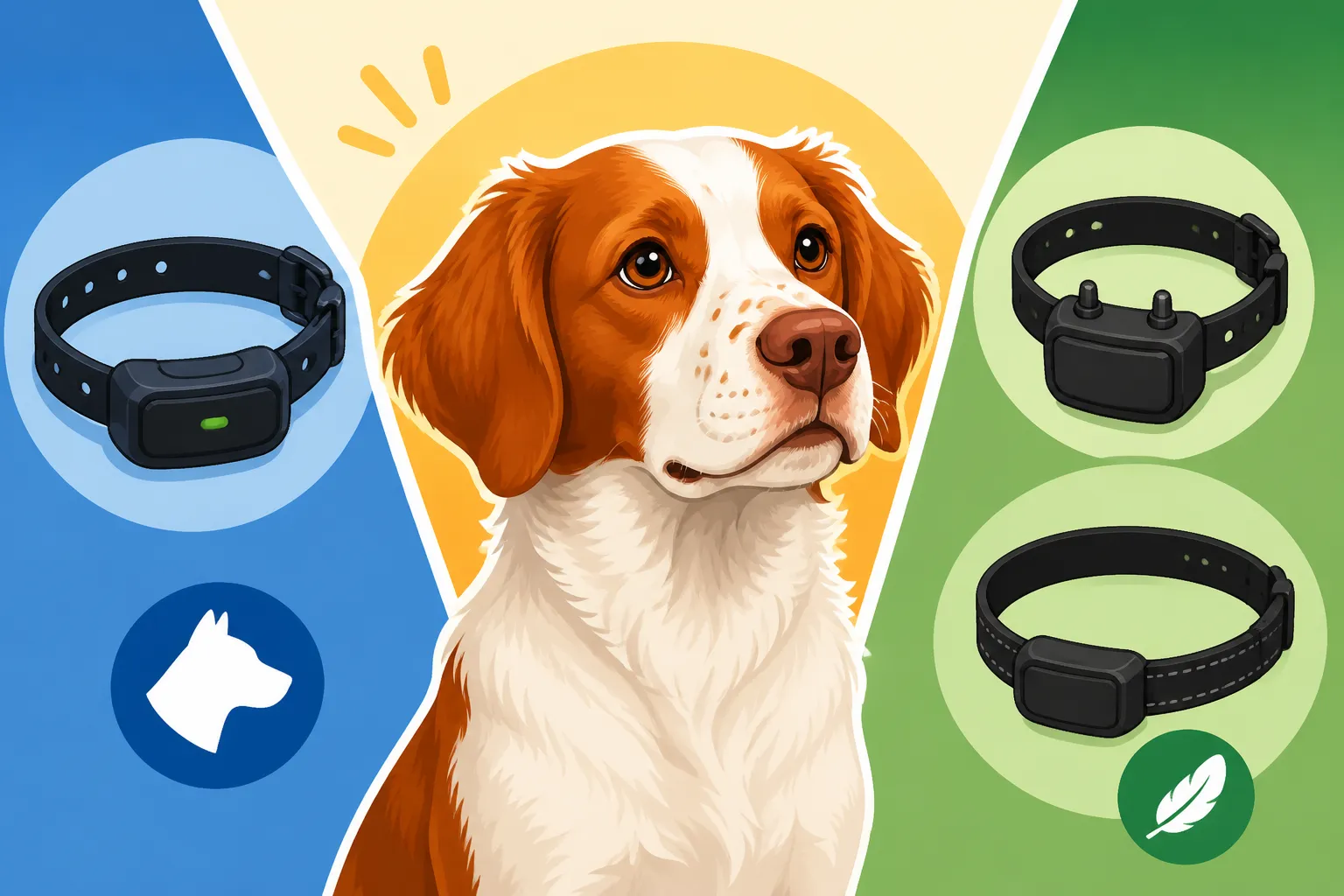
This is where the serious field work capabilities come into play. Advanced sporting dog e-collars are built with the demands of hunting and field trials squarely in mind. They boast extended ranges (often a mile or more), exceptionally robust, waterproof construction, and highly nuanced stimulation levels, often with rheostat dials for seamless adjustment. Many also feature multi-dog compatibility, allowing you to control several dogs from a single remote, which is a huge plus if you run a brace of Brittanys.
Beyond basic stimulation, these collars often integrate GPS tracking functionality. Imagine your Brittany making a long cast into dense pheasants cover. With a GPS-enabled e-collar, not only can you communicate with them, but you can also pinpoint their exact location on your handheld remote, even if they're out of sight. This is a game-changer for safety and efficiency in the field. Popular brands in this category include Garmin and SportDOG, which are renowned for their reliability and features tailored to gun dog owners. While the investment is higher, the capabilities and peace of mind these systems offer make them invaluable for dedicated hunters. If you're wondering What a GPS Collar Costs a Brittany Owner, it's certainly more than a basic e-collar, but many seasoned handlers consider it an essential piece of gear.
Remote Trainers vs. Bark Collars
It's crucial to understand that remote trainers (the e-collars we're discussing) are distinctly different from bark collars. A remote trainer is an interactive communication tool, allowing you to initiate stimulation, tone, or vibrate signals as needed to reinforce commands. It requires an active handler. You are in control of when and how the feedback is delivered, making it a training device.
Bark collars, on the other hand, are designed to detect barking and automatically deliver a correction (usually vibration, tone, or static stimulation) without handler intervention. While they have their place for nuisance barking, they are not suitable for field training or general obedience with a Brittany. Their automatic nature removes the crucial timing and context that make remote trainers effective. For a Brittany in the field, you need precise, timely communication from you, the handler, to guide their behavior, not an automated response to an environmental trigger. Focus solely on remote trainers for your active training and hunting needs.
| Feature | Basic Training E-Collar | Advanced Sporting Dog E-Collar |
|---|---|---|
| Typical Range | Up to 1/2 mile | 1/2 mile to 1 mile+ (often multi-mile) |
| Stimulation Levels | ~10-20 levels, often stepped | 100+ levels, often rheostat dial for precise adjustment |
| Vibration/Tone | Usually included | Always included, often with customizable tones |
| Waterproofing | Often water-resistant or splash-proof | Fully waterproof (IPX7+ receiver, water-resistant remote) |
| Durability | Moderate, suitable for light-duty use | High, built for harsh field conditions and impact |
| GPS Tracking | Rarely | Often integrated for dog tracking and mapping |
| Multi-Dog Support | Sometimes 1-2 dogs | Standard (up to 20 dogs on some systems) |
| Battery Life | Good, often several days | Excellent, built for extended field use |
| Brittany Suitability | Good for home obedience, light field work | Ideal for serious hunting, field trials, demanding conditions |
| Cost | Lower entry point | Higher investment, but often justifiable for serious users |
Training Principles for Using an E-Collar with a Brittany
Using an e-collar successfully with a Brittany isn't about simply strapping it on and pushing buttons. It's a nuanced process that requires patience, consistency, and a deep understanding of your dog's temperament. Remember, the goal is to enhance communication, not to instill fear. For a breed like the Brittany, known for its intelligence and sensitivity, a thoughtful approach is paramount.
Starting Slow and Low
The absolute golden rule when introducing an e-collar to your Brittany is to start at the lowest possible stimulation level. We're talking about a level so low that you can barely feel it on your own neck. The first step is to find your dog's "working level"—the lowest setting at which they acknowledge the stimulation with a subtle reaction, like an ear twitch, a head tilt, or simply looking around. It should never be a yelp, a jump, or a panicked response. This is their way of saying, "Hey, I felt that!"
Integrate the e-collar with commands your Brittany already knows. For example, when practicing "Come" on a long line, give the verbal command, gently tug the line, and simultaneously apply the low-level stimulation. As your dog responds and comes to you, immediately praise them lavishly. This pairing helps your Brittany associate the stimulation not with punishment, but with an attention-getting cue that precedes a known command and leads to a positive outcome. Consistency is key here. Keep sessions short and positive; remember How Long a Brittany's Training Session Should Be should be focused and not drawn out.
Integrating with Positive Reinforcement
An e-collar is not a substitute for positive reinforcement; it's a tool to enhance it. For a Brittany, a breed that thrives on praise and interaction, the e-collar should be seen as a way to clarify commands and get their attention when distractions are high, allowing you to then reward their correct response. Never use the e-collar as a primary teaching tool for new commands. Instead, teach new commands thoroughly with treats, praise, and traditional methods first. Once your Brittany reliably understands a command, you can then introduce the e-collar to reinforce it in more challenging environments.
Think of it this way: the e-collar is your whispered suggestion when your voice can't reach, or when your Brittany is utterly captivated by a bird scent. It’s a gentle reminder to recall or whoa, allowing them to make the correct choice, which you then generously reward. A Brittany, with their eager-to-please nature, will quickly learn to respond to the e-collar's prompts to earn your approval. This approach respects Why a Brittany Is Called Soft and ensures their enthusiasm for training remains intact, fostering a stronger bond between you and your dog.
The Importance of Professional Guidance
While this guide provides a solid foundation, learning to use an e-collar effectively is a skill that benefits immensely from hands-on guidance. If you're new to e-collar training or are encountering specific challenges with your Brittany, seeking out a professional gun dog trainer or an obedience instructor with extensive experience in e-collar conditioning is highly recommended. A good trainer can help you:
- Find the correct working level: They have an experienced eye for subtle dog reactions.
- Develop a clear training plan: Tailored to your Brittany's specific needs and your hunting goals.
- Master timing and consistency: Crucial for effective e-collar use.
- Troubleshoot issues: Such as a dog that seems resistant or confused.
They can also help you understand the nuances of the equipment itself. While you might initially wonder What a Professional Gun Dog Trainer Charges for a Brittany, the investment in professional guidance can save you from making costly mistakes, prevent undue stress for your dog, and ultimately lead to a much more reliable and well-behaved hunting partner. A qualified trainer will prioritize your Brittany's well-being and help you use the e-collar as the humane and effective communication device it's designed to be. Investing in quality training, perhaps even with a multi-sport-friendly insurance like Healthy Paws, can help ensure your Brittany stays safe and sound, whether at home or in the field, minimizing the risk of injuries that could lead to vet bills down the line.
Disclaimer
This article is for general informational purposes only and does not constitute professional advice. Laws, prices and regulations vary by location and change over time. Consult a qualified professional for guidance on your specific situation.