What a Brittany Does When It Is Corrected Too Hard
It's incredibly frustrating when you're trying your best to teach your sweet Brittany something new, only to have them completely shut down or act out in a way that feels totally baffling. You might think you're being clear, but if your Brittany isn't responding, or worse, is shrinking away, it's a sign that your corrections might be too strong for their sensitive soul. This guide will explore exactly how Brittanys react to harsh corrections and, more importantly, how to foster a training environment where they can truly thrive.
Understanding the Brittany's Sensitive Nature
If you've spent any time around Brittanys, you'll probably hear people talk about them being "soft." This isn't a derogatory term, nor does it imply weakness. Instead, it's a crucial characteristic that informs how we should approach their training. Ignoring this fundamental aspect of their temperament can lead to a lot of heartache for both you and your dog.
Why "Soft" Isn't Weakness, But a Training Cue
When we say a Brittany is "soft," we mean they are incredibly sensitive to both physical and verbal corrections. Unlike some more stoic working breeds that might shrug off a firm "no" or a quick leash pop, a Brittany can be deeply affected by such approaches. This isn't because they're fragile or delicate; it's because their entire being is geared towards cooperation and pleasing their people. They truly want to understand what you're asking, and a harsh correction can be deeply confusing and upsetting to them. Think of it as having a finely tuned instrument – you wouldn't bang on a violin to make a beautiful sound. Similarly, a Brittany responds best to a light, skilled touch.
Their "softness" is actually a huge asset in training when understood correctly. It means they often only need the lightest of cues or the gentlest of reminders to stay on track. They pick up on subtle changes in your voice, your body language, and even your mood. This makes them wonderfully biddable and eager students, provided you communicate in a way they can process without fear. If you find yourself wondering Why a Brittany Is Called Soft, it really boils down to this exquisite sensitivity and desire to avoid conflict.
The Impact of Negative Associations on Learning
Imagine trying to learn a new skill, and every time you made a mistake, someone yelled at you or gave you a painful jab. How motivated would you be to continue? This is precisely what happens when harsh corrections are used with a Brittany. Instead of clarifying what you do want, negative associations are formed with the act of learning itself, the specific command, or even with you, the trainer.
For example, if you're working on retrieving and your Brittany fumbles a bird or doesn't bring it straight back to hand, and you respond with a sharp physical correction or an angry tone, what does the dog learn? They don't necessarily learn to retrieve better; they might learn that retrieving is a scary experience. They might start to avoid the bird, or even avoid coming to you when you have the bird. These negative associations are powerful and can completely shut down a dog's willingness to participate in training. They can also create an atmosphere of anxiety, making it harder for your Brittany to focus and learn efficiently. The goal of training is to build positive pathways in their brain, reinforcing desired behaviors, not to create a minefield of fear around every potential mistake.
Immediate Reactions to Harsh Correction
The moment a Brittany perceives a correction as harsh, their immediate reaction can be telling. These aren't acts of defiance, but rather involuntary responses to stress, fear, or confusion. Recognizing these signs is crucial for any owner committed to humane and effective training.
Shutting Down: The "Deer in Headlights" Response
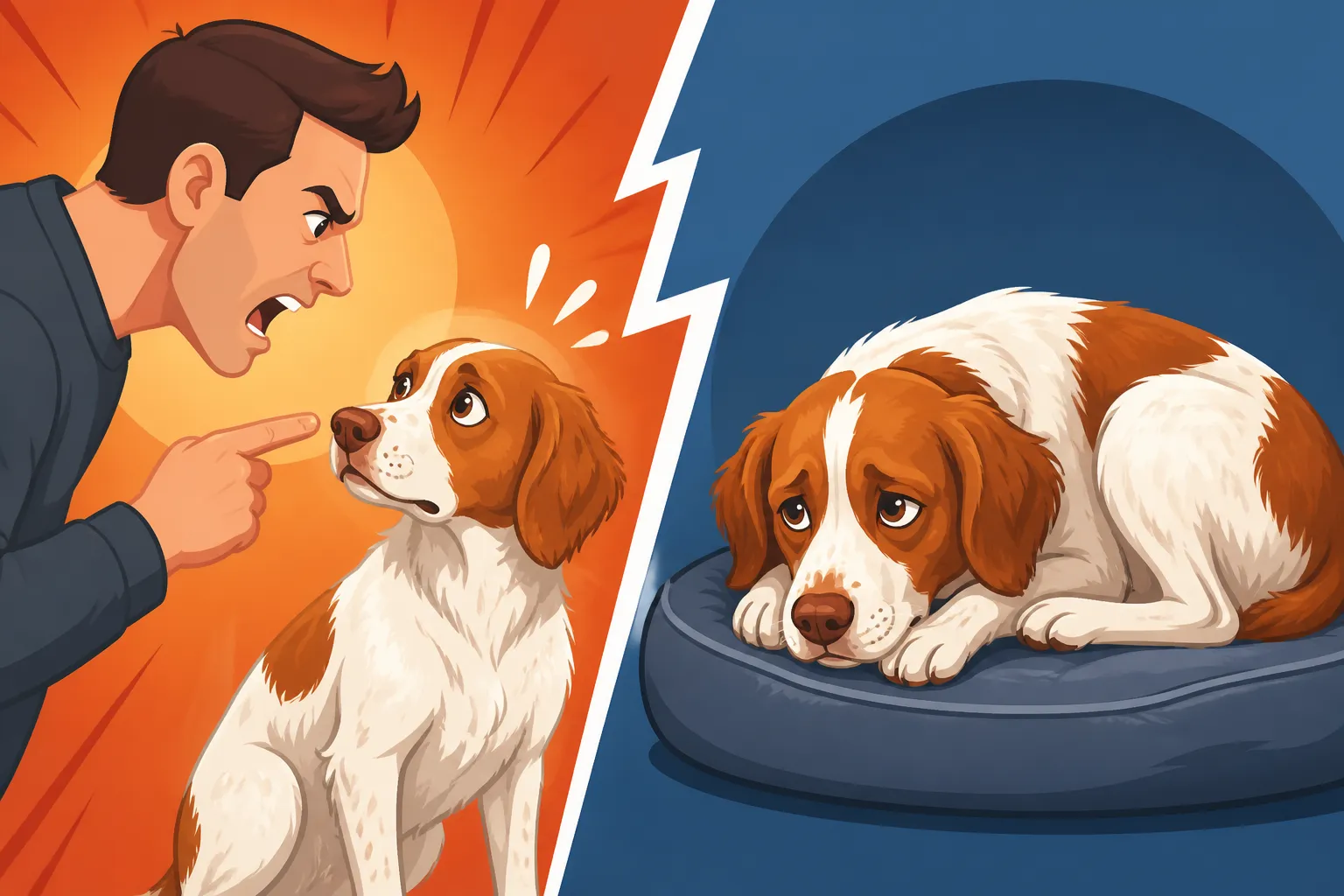
One of the most common and heartbreaking reactions of a sensitive Brittany to harsh correction is to simply shut down. This isn't stubbornness; it's an internal freeze response, much like a "deer in headlights." Your dog might:
- Refuse to move: They might stand stock-still, even if you try to encourage them.
- Avoid eye contact: They'll look away, turn their head, or completely avert their gaze, trying to make themselves seem smaller and less threatening.
- Cower or crouch: Their body language will become submissive, their tail tucked, ears back, and their posture low to the ground.
- Stop responding to cues: Commands they previously understood might be ignored, not out of disobedience, but because their brain is overwhelmed and focused on self-preservation.
- Go "blank": They might seem to just stare into space, their usual spark completely extinguished.
This shutdown happens because the correction has crossed a threshold, overwhelming their capacity to cope or understand. They're not processing information; they're feeling fear or intense discomfort. It's a clear signal that the pressure is too high. If you want to know What Happens When You Shout at a Brittany, a shutdown is often a direct result, rendering them unable to learn or engage. Pushing harder at this point will only deepen the shutdown and create a stronger negative association.
Submissive Urination or Defecation
While less common with a mild correction, a truly harsh or frightening correction can trigger submissive urination or defecation. This is not a deliberate act of soiling the floor or "spite." It's an involuntary physiological response to extreme fear and stress. When a dog is utterly overwhelmed and feels threatened, their body can react by releasing bladder or bowel control as a display of profound submission and appeasement.
If your Brittany responds this way, it's a stark indicator that they perceive the situation as highly dangerous or terrifying. Punishing this behavior further would be incredibly detrimental, as it would only intensify their fear and confusion. Instead, it calls for an immediate halt to whatever correction method was used and a complete re-evaluation of your training approach. It signifies a profound breakdown in trust and comfort.
Avoidance and Escape Behaviors
A Brittany that consistently experiences harsh corrections will often develop avoidance or escape behaviors. Their primary goal becomes to get away from the source of discomfort, which is often you or the training setup. This can manifest in several ways:
- Bolting: If off-leash, they might simply run away, seemingly without a care in the world, but often it's an escape mechanism. This directly impacts their reliability and safety.
- Refusal to approach: When called, they might hesitate, refuse to come, or approach very slowly and with trepidation. Their once eager recall might vanish.
- Hiding: They might try to squeeze behind furniture, under tables, or into other small spaces when they anticipate a correction or are asked to train.
- "Deafness": They might seem to suddenly go "deaf" to commands, especially if those commands have previously been associated with unpleasant corrections. This is a coping mechanism to avoid engagement.
- Excessive sniffing or grooming: These are often "displacement behaviors," actions a dog performs when they are stressed or conflicted, trying to self-soothe or diffuse tension.
These behaviors are a dog's way of saying, "I don't feel safe, and I want out of this situation." They erode the bond and make effective training impossible, as the dog is always looking for an exit strategy rather than engaging with you. How Long a Brittany Remembers a Bad Session might surprise you; these negative experiences can stick for a very long time.
Long-Term Behavioral Consequences
The immediate reactions to harsh corrections are just the tip of the iceberg. Over time, consistent use of these methods can profoundly alter a Brittany's personality, their relationship with you, and their overall well-being. These long-term consequences are why positive, trust-based training is not just a preference, but a necessity for this sensitive breed.
Loss of Trust and a Damaged Bond
Perhaps the most significant and heartbreaking long-term consequence of harsh corrections is the erosion of trust between you and your Brittany. Brittanys thrive on partnership. They are devoted companions who genuinely want to please and work with their people. When corrections are harsh or unpredictable, that foundational trust is shattered.
Your Brittany begins to see you not as a benevolent leader or a fun companion, but as a source of potential discomfort or pain. This shifts the relationship from one of mutual respect and affection to one based on fear and avoidance. They might still obey commands, but it will be out of compulsion, not eager cooperation. The joyous enthusiasm that makes Brittanys such wonderful partners in the field and at home can disappear, replaced by a tentative, anxious interaction. A damaged bond can be incredibly difficult to repair, impacting every aspect of your life together. You'll notice they might not seek you out for cuddles or seem as engaged when you enter a room. They might even become guarded, making it harder for you to gauge Whether a Brittany Reads Your Mood.
Development of Fear and Anxiety
Consistent exposure to harsh corrections creates a state of chronic stress for your Brittany. This isn't just unpleasant; it's detrimental to their mental and emotional health. Over time, this chronic stress can manifest as generalized fear and anxiety:
- Generalized anxiety: Your Brittany might become perpetually nervous, even when not in a training situation. They might pace, pant excessively, or appear restless.
- Fear of specific people or situations: If a particular family member uses harsh methods, the dog might develop a fear of that individual. Similarly, specific training environments or even certain commands could become triggers for anxiety.
- Noise phobias: Increased anxiety can sometimes lead to the development or worsening of noise phobias, such as fear of thunderstorms or fireworks.
- Resource guarding: In some cases, a fearful dog might start guarding resources (food, toys, resting places) more intensely, as a desperate attempt to control their environment and avoid potential threats.
- Physical symptoms: Chronic stress can also lead to physical issues, like digestive upset, excessive shedding, or a weakened immune system.
These are profound changes that steal joy from your dog's life and make them a shadow of their potential happy, confident self. A Brittany experiencing fear and anxiety cannot truly relax, learn, or enjoy being a part of your family.
Aggression Born of Fear
While Brittanys are generally known for their sweet and tractable dispositions, any dog, if pushed too far and continually subjected to fear-inducing methods, can resort to aggression. This is crucial to understand: this isn't true aggression in the sense of a dominant or malicious dog, but rather fear-based aggression.
A dog that feels continually threatened and has no other way to escape or communicate its distress might eventually snap, growl, or even bite. They're not trying to be "bad"; they're desperately trying to create distance and stop the perceived threat. This could look like:
- Growling: A warning signal when they feel trapped or cornered.
- Snapping: A quick lunge with the mouth, often without making contact, another warning.
- Biting: A last resort when all other signals have been ignored and they feel their life is in danger.
This is a tragic outcome and a clear indicator that the training methods have been deeply damaging. It highlights the critical responsibility we have as dog owners to use methods that build confidence and trust, not fear and reactivity. If a Brittany gets to this point, professional intervention is absolutely necessary, but it will be a long road to rehabilitation, focusing heavily on rebuilding trust and positive associations. Whether a Brittany Sulks is a mild reaction; aggression is an extreme, dangerous one.
Shifting to Positive, Effective Training Methods
Understanding the potential pitfalls of harsh corrections is the first step; the next is embracing training methods that actually work with your Brittany's sensitive and intelligent nature. Positive reinforcement isn't just kinder; it's profoundly more effective, building a confident, joyful, and eager canine partner.
The Power of Positive Reinforcement
Positive reinforcement is the cornerstone of effective and humane dog training, especially for a Brittany. It's simple: when your dog performs a desired behavior, you reward them, making that behavior more likely to happen again. This creates a clear communication channel, where your Brittany understands exactly what you want, and learns that engaging with you and training is a rewarding experience.
Here’s why it’s so powerful:
- Builds Confidence: Instead of fearing mistakes, your Brittany learns that trying new things and getting it right leads to good things. This makes them bold and eager learners.
- Enhances Motivation: Who wouldn't want to work for something they enjoy? Treats, praise, favorite toys, or a quick game of fetch all become powerful motivators. You can find many excellent training treats and toys on platforms like Amazon that will keep your Brittany engaged.
- Strengthens the Bond: Positive interactions create a positive association with you. Your Brittany sees you as the source of good things, deepening trust and affection.
- Clarity: It focuses on teaching the right behavior, rather than simply punishing the wrong one. This is much less confusing for your dog.
Imagine teaching your Brittany "sit" by rewarding them with a tasty morsel every time their rear touches the ground. They quickly learn "sit" means "get a treat!" This is far more effective and enjoyable than waiting for them to not jump, and then correcting them. Whether you're working on basic obedience or advanced field skills, positive reinforcement is the way to go. Consider tools like a clicker to precisely mark the exact moment your Brittany does something right; it's a game-changer for clear communication.
Redirection and Management Strategies
Beyond positive reinforcement, smart training involves redirection and management. These strategies help prevent your Brittany from practicing unwanted behaviors, which in turn reduces the need for any kind of correction at all.
- Redirection: When your Brittany starts to do something you don't want, redirect their attention to an appropriate alternative. For example, if your puppy is nipping at your hands, immediately offer them a suitable chew toy instead. If they're jumping on guests, redirect them to a "sit" and reward that. This teaches them what to do rather than just what not to do. It's all about guiding them toward acceptable outlets for their natural behaviors.
- Management: This involves setting up your environment so your Brittany is less likely to make mistakes in the first place.
- Crating: A crate can be a safe den, preventing destructive chewing or house-soiling when you can't actively supervise.
- Leashing: Keeping your Brittany on a leash indoors or in a secure outdoor area prevents them from bolting or chasing things they shouldn't.
- Puppy-proofing: Just like child-proofing, remove tempting items from reach (shoes, electronics, delicate décor) to prevent chewing incidents.
- Exercise: A tired Brittany is a well-behaved Brittany. Ensure they get enough physical and mental exercise to prevent boredom-driven mischief. How Long a Brittany's Training Session Should Be is important to consider – short, positive sessions are better than long, frustrating ones.
By proactively managing their environment and redirecting inappropriate behaviors, you create a successful learning pathway, minimizing frustration for everyone.
Seeking Professional Guidance
Sometimes, despite our best efforts, we encounter challenges that require a little extra help. If you're struggling with a particular behavior, feeling overwhelmed, or if your Brittany is exhibiting signs of fear, anxiety, or aggression (even mild forms), don't hesitate to seek professional guidance.
It's crucial to find a certified professional dog trainer who exclusively uses positive reinforcement, force-free, and fear-free methods. Look for credentials such as CPDT-KA (Certified Professional Dog Trainer – Knowledge Assessed) or KPA-CTP (Karen Pryor Academy Certified Training Partner). A good trainer will:
- Assess your Brittany individually: They'll understand your dog's specific temperament and learning style.
- Educate you: You'll learn why your Brittany is doing what they're doing and how to communicate effectively.
- Provide practical tools and strategies: They'll offer step-by-step guidance tailored to your situation.
- Support the human-animal bond: Their methods will prioritize building trust and respect, not breaking it.
Be wary of trainers who promise quick fixes, use terms like "pack leader" or "dominance theory," or recommend methods involving pain, intimidation, or fear (e-collars on high settings, choke chains, prong collars, alpha rolls, leash corrections). For those looking for structured online programs, a platform like BAXTER & Bella offers comprehensive puppy and dog training courses that are fully rooted in positive reinforcement, which can be a fantastic resource, especially for new owners. Remember, Whether a Brittany Suits a First Time Owner often comes down to the owner's willingness to learn and adapt positive training methods.
Building a Strong, Trusting Relationship
Ultimately, the most effective "correction" for a Brittany comes from having a strong, trusting relationship. When your dog sees you as a reliable, fair, and fun partner, they want to work with you. This bond is built on consistent positive interactions, clear communication, and mutual respect.
Here are ways to nurture that bond:
- Consistent Positive Reinforcement: Make positive reinforcement a cornerstone of your daily life, not just during formal training sessions. Reward good behavior spontaneously.
- Play and Quality Time: Engage in activities your Brittany loves. Fetch, hiking, swimming, or just cuddling on the couch—these shared experiences deepen your connection. Brittanys are active dogs; regular exercise is key to their happiness and your bond.
- Fairness and Predictability: Be consistent with your rules and expectations. A predictable environment helps your Brittany feel secure and understand what's expected of them.
- Patience and Empathy: Understand that your Brittany is a living, feeling being. They have good days and bad days, just like us. Approach their learning with patience and empathy, remembering that their "mistakes" are often opportunities for you to teach more clearly.
- Gentle Handling: Always use gentle hands, a soft voice, and positive body language. Avoid sudden movements or loud noises that could startle them. A Brittany thrives when they feel safe and loved.
A strong bond makes your Brittany eager to please and resilient in the face of new challenges. They'll be more inclined to offer desired behaviors and recover more quickly from any minor missteps because they trust you implicitly. This approach embodies the spirit of The Brittany Is the Smallest Pointing Breed You Can Live With, allowing them to flourish as both hunting partners and beloved family members. Their inherent desire to be close to you and engage is part of How Affectionate a Brittany Is.
| Aspect | Harsh Correction Outcomes | Positive Reinforcement Outcomes |
|---|---|---|
| Immediate Response | Shutting down, cowering, submissive urination, avoidance | Eagerness, engagement, motivation, clear understanding |
| Long-Term Impact | Fear, anxiety, aggression, broken bond, reluctance to train | Confidence, strong bond, reliable performance, joyful learning |
| Learning Process | Confusion, stress, negative associations | Clarity, enjoyment, strong positive associations |
| Relationship | Fear-based, distrustful, distant | Trust-based, cooperative, affectionate |
| Dog's Well-being | Chronic stress, nervousness, potential behavioral issues | Happier, more confident, emotionally stable dog |
Disclaimer
This article is for general informational purposes only and does not constitute professional advice. Laws, prices and regulations vary by location and change over time. Consult a qualified professional for guidance on your specific situation.