Whether a Brittany Mix Keeps the Bird Drive
A Brittany mix may inherit a strong interest in birds, but the Brittany half of its ancestry does not guarantee a pointing dog or a reliable hunting partner. The other breed, the individual dog’s temperament, early experiences, and training all matter. This guide explains what “bird drive” can look like in a mix, how to assess it, and how to nurture it safely.
What bird drive means in a Brittany mix
Bird interest is not one single trait
People often use “bird drive” as if it were a single switch: either a dog has it or doesn’t. In practice, it describes several related behaviors. A dog may notice birds, follow their scent, search cover, freeze or point when it finds one, chase when the bird moves, or retrieve after a flush. Those behaviors can appear in different combinations.
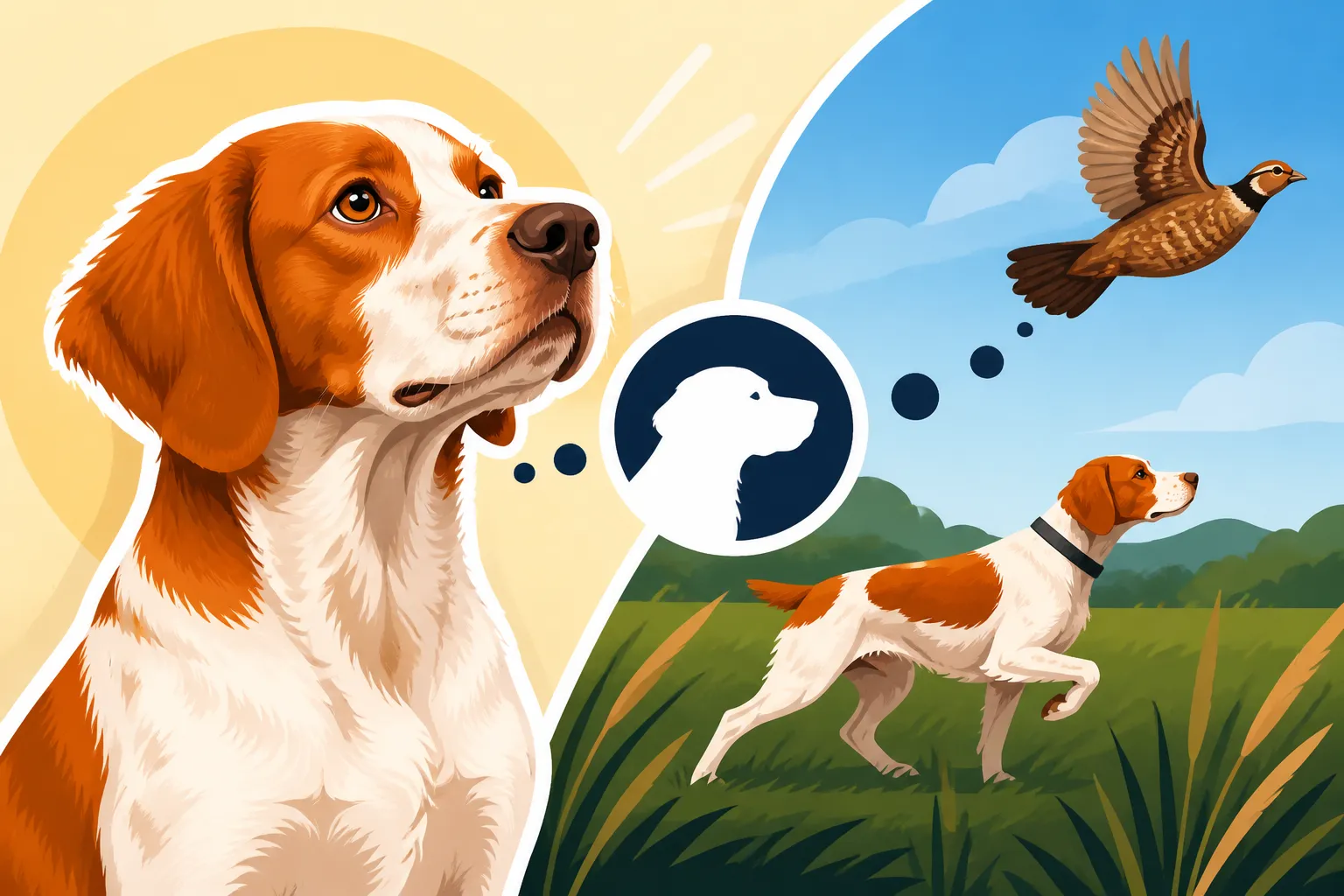
A Brittany was developed as a pointing gun dog, so its heritage can contribute a strong interest in finding and locating game birds. That is different from simply chasing pigeons in a park. A dog that bolts after every fluttering thing may have a high chase instinct but little of the searching, scenting, or pointing behavior a hunter hopes to see. For background on the breed’s purpose, see What the Brittany Was Bred to Hunt.
It also helps to separate “birdy” behavior from a finished hunting skill. A dog that scents a quail and pauses is showing a promising instinct, not necessarily a trained point. A dog that retrieves a tennis ball might enjoy carrying objects without wanting to retrieve a bird. In a mix, these distinctions matter because the traits may not all come from the Brittany side—or may not be present in the same degree.
The other breed can shape the outcome
A Brittany crossed with another pointing breed may have a different mix of search, scenting, range, and pointing tendencies than a Brittany crossed with a companion breed. A retriever cross might be especially interested in carrying and bringing things back, while a hound cross could be highly motivated to follow scent. A herding-breed mix might notice movement intensely but express that interest through stalking or chasing.
These are tendencies, not guarantees. Two dogs from the same litter can behave quite differently. Even a puppy whose parents both hunt may grow into a dog that prefers tracking squirrels, chasing leaves, or staying close to its person rather than searching for birds. Mixed-breed ancestry is also not always fully known, especially for a rescue dog, so a dog’s behavior is more useful than a guess about its family tree.
The word “Brittany mix” can describe a wide range of dogs. It tells you that Brittany ancestry may be present; it does not tell you how much of that ancestry the dog carries or which traits were passed down. A thoughtful assessment looks at the dog in front of you rather than relying on its label.
What to look for in a dog’s behavior
Notice more than chasing
If you want to understand a Brittany mix’s bird drive, watch how it responds to birds and bird scent in several safe settings. Does it notice birds at a distance? Does it investigate where they were, use its nose, and search rather than simply sprinting after movement? Does it pause, become still, or direct its attention toward a likely hiding place? These small details may tell you more than an excited chase.
Look for patterns over time. A dog may be distracted by geese at a pond but show a more considered search in a grassy area. Another may become intensely interested in pigeons yet lose focus as soon as they fly away. Neither reaction alone settles the question of whether the dog has useful hunting potential. Calm observation on leash, away from roads and wildlife-sensitive areas, is safer and more informative than letting the dog run loose to see what happens.
Pointing behavior is especially easy to misread. A dog might freeze briefly because it is startled, focused on a sound, or waiting for a cue. A natural point usually involves sustained attention toward a scent source, though the exact behavior can vary by dog. Even a promising pause does not mean the dog will hold point around people, flushes, or gunfire without training. For comparison, Whether a Brittany Points Naturally explains why instinct and trained reliability are not the same thing.
Consider retrieve, range, and focus separately
A dog’s search range can be as important to a hunter as its interest in birds. One Brittany mix may work close, checking in frequently, while another may range farther and need structured recall work. Neither style automatically means stronger bird drive. Range is influenced by inherited tendencies, confidence, the landscape, and what the dog has learned works.
Retrieving is another separate piece. Some dogs naturally pick up and carry toys or bumpers; others locate birds enthusiastically but have little interest in bringing anything back. A dog that drops a ball at your feet has not necessarily learned to retrieve game, and a dog that does not retrieve a toy is not automatically unsuitable for bird work. See Whether a Brittany Retrieves Naturally for more on how retrieving instinct can show up.
You can take notes during walks or play sessions: what attracts the dog, whether it uses its nose, how quickly it returns attention to you, and what happens when an object moves or disappears from view. Avoid turning every outing into a test. Repeatedly startling or pressuring a sensitive dog can make it wary, and a single session in an unfamiliar place can give a misleading picture.
| Behavior you notice | What it may suggest | What it does not prove |
|---|---|---|
| Chases a bird as it flies | Interest in movement or prey | Pointing ability or steady hunting behavior |
| Searches where a bird scent may be | Interest in scent and investigation | Reliable search pattern or trained field skills |
| Pauses and focuses toward cover | Potential pointing instinct or concentration | A trained, sustained point |
| Carries toys or bumpers | Interest in holding and carrying objects | A finished retrieve to hand |
| Ranges away from you | Confidence, curiosity, or independence | Better bird drive or suitability for every hunter |
How to encourage bird interest responsibly
Start with safe, low-pressure foundations
For a puppy or young dog, build attention, recall, and comfort in new environments before expecting polished field behavior. Short, upbeat outings in suitable places allow a dog to explore without becoming overwhelmed. Reward the dog for checking in, coming when called, and calmly engaging with you. Those skills help whether the dog becomes a hunting companion or simply enjoys scent games and outdoor adventures.
Do not force a dog to approach live birds, and do not use a loud gunshot to “see what happens.” A frightening introduction can create lasting fear. Gun introduction is a gradual process that should be handled with care, ideally with guidance from an experienced pointing-dog trainer who can read the dog’s reactions. The separate guide How to Introduce a Gun to a Brittany covers why the process should never be rushed.
You can also give a dog appropriate outlets at home. Hide-and-seek games with treats, scent trails, and supervised searches for a toy encourage nose work without putting wildlife or the dog at risk. If you are gathering basic enrichment supplies, Chewy can be one place to look for food puzzles or durable toys, but the activity matters more than any particular item. Keep sessions short and end while the dog is still engaged.
Use birds and fieldwork thoughtfully
If you want to develop a dog for hunting, work with someone experienced in bird dogs and local rules. Training birds, access to suitable land, and safe handling all require planning. A trainer can help distinguish a dog that is curious from one that is showing a developing search or point, and can adjust the work to the dog’s confidence and age.
Early bird exposure should be controlled and positive. The goal is not to make the dog chase every bird until it is exhausted. Instead, a trainer may help the dog encounter birds in a setting where its natural response can emerge without unnecessary pressure. The pace should suit the dog. If it startles, avoids the area, or becomes frantic, take a step back rather than pushing through.
For some owners, a formal hunting program is not the goal. That is fine. Scent work, retrieving games, hiking on leash, and structured exercise can be satisfying ways to channel a Brittany mix’s energy. For ideas about how early bird experiences fit into development, see How a Brittany Finds Its First Bird and Whether a Brittany Should Chase Early On. Chewy may also carry scent-game toys or treat-dispensing equipment, but keep wildlife encounters separate from casual backyard play.
Choosing expectations that fit your dog
A mix can be a bird dog, but it may not hunt like a Brittany
Some Brittany mixes develop strong bird-finding ability and enjoy working alongside a handler. Others show only a mild interest in birds, or express their instincts in ways that do not fit a particular kind of hunting. A dog can still be a wonderful companion without pointing, retrieving, or ranging in the way you pictured.
Think about what you need from the dog. If your priority is a dependable hunting partner, evaluate the individual dog’s behavior and training potential, not only its appearance or breed label. If your priority is an active family dog, moderate bird interest may be easy to accommodate with exercise and enrichment. A high-drive dog may need more structured activity, boundaries around wildlife, and reliable recall practice.
A Brittany mix can also be a good candidate for activities beyond hunting. Nose work, tracking, and some dog sports offer structured outlets for curiosity and energy. The best fit depends on the dog’s body, temperament, confidence, and ability to settle afterward. The article Whether the Brittany Is a Versatile Breed offers useful context on the breed’s range of working abilities, while any mix should be assessed as an individual.
Make decisions from evidence, not assumptions
If adopting, ask what the dog has actually done around birds, rather than whether someone thinks it “has Brittany in it.” Helpful details include whether it searches with its nose, how it responds to movement, whether it can disengage when called, and whether it has shown fear around loud or unfamiliar sounds. If the history is unknown, allow time for the dog to settle before drawing conclusions. Stress in a new home can hide or exaggerate behavior.
If buying a puppy, ask about both parents’ temperaments and working behavior, and be clear about your goals. A breeder may be able to describe the parents’ search style, pointing, retrieve, and response to training. Still, no one can promise that every puppy will develop the same abilities. For a mix from a rescue or shelter, careful observation and a qualified trainer’s assessment may provide more useful guidance than uncertain ancestry.
Above all, keep the dog safe while you learn. Use a leash or long line where appropriate, respect wildlife and local access rules, and do not allow chasing near roads or livestock. Chewy can help with practical basics such as leashes, long lines, and enrichment toys, but equipment is no substitute for supervision and training. A Brittany mix may inherit bird drive, but patience and realistic expectations are what help you discover how that instinct fits into your life.
Disclaimer
This article is for general informational purposes only and does not constitute professional advice. Laws, prices and regulations vary by location and change over time. Consult a qualified professional for guidance on your specific situation.