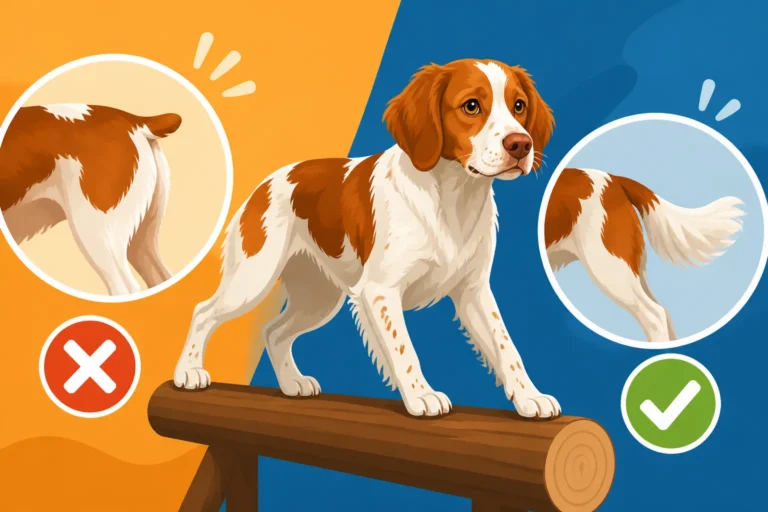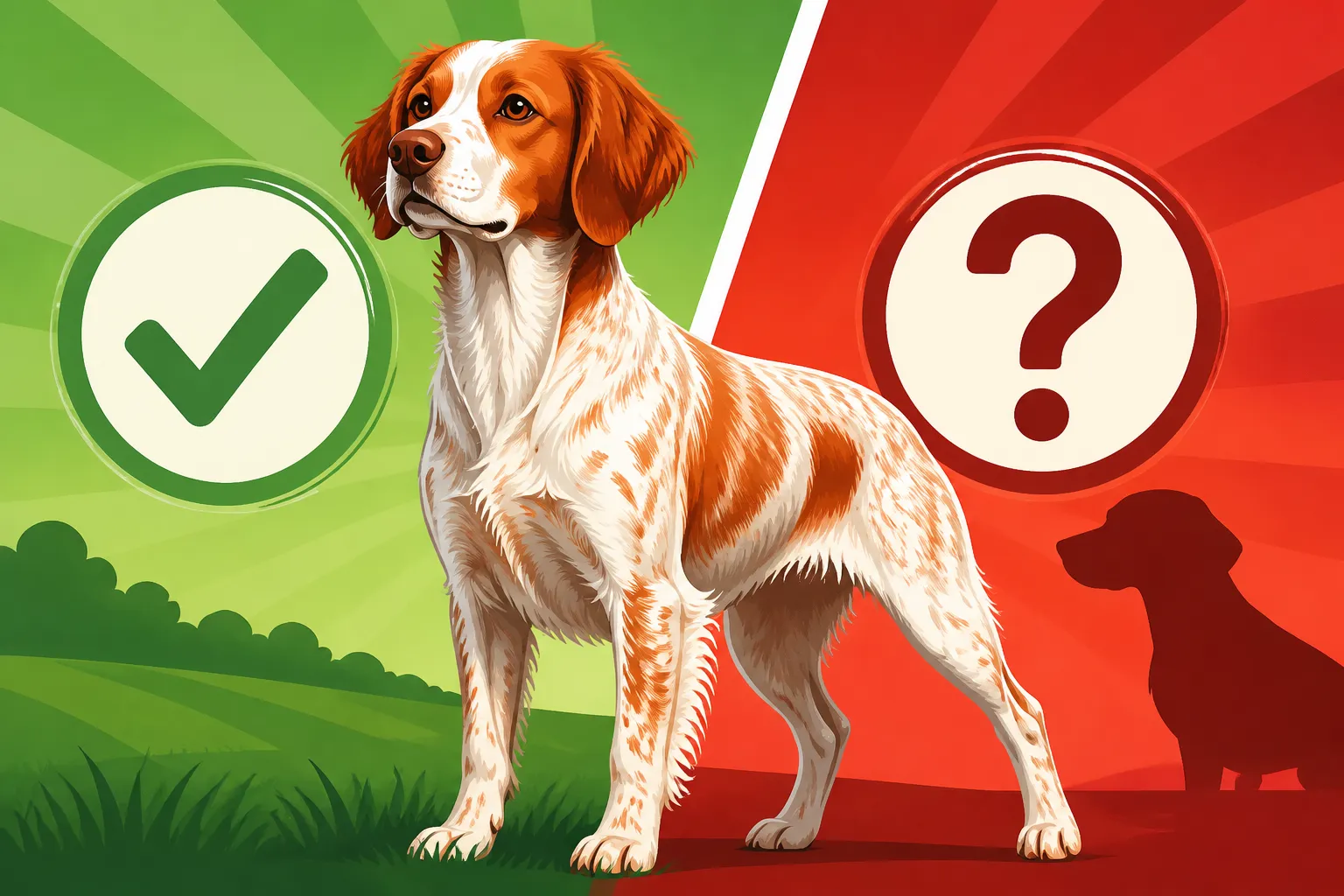
Whether a Roan Brittany Is Standard
A Brittany’s coat can look almost white from a distance, then show a fine mix of orange or liver hairs up close. That can leave puppy buyers wondering whether “roan” is an accepted color or a sign their dog falls outside the breed standard. Here’s how the term is used, how roan differs from ticking and patches, and what it means for an American Brittany’s appearance.
Is a roan Brittany accepted by the breed standard?
Yes. Under the American Kennel Club Brittany standard, orange and white or liver and white coats may be either clear or roan. Roan is an accepted coat pattern, not a separate color that makes a Brittany less of a Brittany.
The distinction that often causes confusion is that “roan” describes how colored and white hairs appear together. It doesn’t mean that a dog is a single, uniform shade. Two Brittanys can both be described as orange roan and still look noticeably different: one may have a pale, finely blended appearance, while another has richer color or more obvious white patches.
What the standard means by roan
In a roan area, white hairs and colored hairs are intermingled. From a few steps away, the mixture may look like a soft, even color. Up close, you can often see individual white hairs among the orange or liver ones.
A roan Brittany can still have distinct white areas. For example, a dog might have a roan body with a white blaze, white chest, or white legs. Roan does not require every part of the coat to be mixed, and the amount of roaning can vary from one dog to another.
The accepted color combinations are orange and white, and liver and white. Orange roan and liver roan are common ways people describe a coat with those colors blended together. For a broader look at the recognized coat palette, see Which Colors a Brittany Comes In.
Does roan mean the dog is tricolor?
No. Roan and tricolor describe different coat patterns. A roan Brittany has white and colored hairs intermingled in one or more areas. A tricolor Brittany has an additional pattern of orange markings on a liver-and-white coat.
This can be confusing when a puppy has several colors or when markings are subtle. A pale orange marking on the face or legs may be easier to see as the dog grows. But simply having roaning, or having a few colored areas on a mostly white coat, does not automatically make a dog tricolor.
The AKC standard allows tricolor Brittanys, though it describes the pattern as less desirable than the standard orange-and-white or liver-and-white colors. That is a show-ring preference, not a statement about a dog’s health, temperament, or hunting ability. For a closer look at the distinction, read Whether a Tricolor Brittany Is Standard.
| Coat description | What it generally looks like | How it relates to the American Brittany standard |
|---|---|---|
| Orange and white | Orange areas with white areas that may be clear or roan | Accepted |
| Liver and white | Brownish liver-colored areas with white, which may be clear or roan | Accepted |
| Orange roan | Orange hairs mixed with white hairs in one or more areas | Accepted |
| Liver roan | Liver-colored hairs mixed with white hairs in one or more areas | Accepted |
| Tricolor | Liver and white with additional orange markings | Accepted, though less preferred in the standard |
| Black and white | Black areas combined with white | Not an accepted color under the AKC Brittany standard |
How roan differs from ticking, patches, and solid-looking color
Breed descriptions use terms that sound similar but refer to different appearances. “Roan,” “ticking,” and “patch” are not interchangeable labels, and everyday descriptions from breeders or owners may be less exact than the wording used in a show standard.
If you are trying to describe a puppy’s coat, look at the pattern across the coat rather than relying on one small area. A few colored hairs on a white foot, for instance, do not tell you whether the dog is roan overall. The location, density, and distribution of the hairs all matter.
Roan versus ticking
Roan usually refers to a more blended mixture of white and colored hairs across an area. Ticking refers to smaller colored spots or flecks in white areas. A Brittany may have ticking without having an extensively roaned coat, and it may have a roaned area alongside patches of clear white.
The difference can be hard to judge in a young puppy. A small spot of color might become more noticeable as the coat develops, while a closely mixed area may look different depending on the lighting and the length of the hair. If the terminology matters for a show entry or a breeder’s record, ask the breeder to describe the coat and compare it with the written standard rather than guessing from a single photograph.
The word “ticking” can also be used casually to describe any small colored flecks, even when someone is not trying to make a formal distinction. That’s one reason two people may look at the same Brittany and use different everyday descriptions. For more on this coat detail, see Whether Ticking Is Allowed on a Brittany.
Roan versus solid patches
A patch is a more clearly defined area of color. A Brittany might have a large orange or liver patch on its back, for example, with a separate white area next to it. In a roan area, the color is more finely mixed through the white rather than forming one sharply outlined block.
Many coats combine the two appearances. A dog may have a distinct liver patch on its back and roaning on its legs, or an orange roan body with a clear white chest. These combinations are part of why coat descriptions can sound complicated: a single dog may have several different patterns in different places.
When looking at a puppy, don’t assume every patch or fleck has the same meaning. Note where the white areas are, where the colored hairs are concentrated, and whether the color appears blended or clearly bounded. If you are comparing a puppy with a breed description, What an Orange and White Brittany Looks Like and What a Liver and White Brittany Looks Like can help you think through the base color as well as the pattern.
What roan can look like as a Brittany grows
A puppy’s coat may not look exactly the same as it does after the adult coat develops. Changes in hair length, density, and the amount of visible feathering can make the roan pattern seem more or less obvious. That doesn’t mean the dog has changed into a different color category.
Photos can add to the confusion. Bright sunlight may make white hairs stand out, while shade can make a roan area look darker and more uniform. A wet coat often appears darker than a dry one, and a close-up photograph can make individual hairs look like a much denser pattern than you would notice in person.
Why the coat can look different in photographs
A picture taken outdoors at midday may show a roan patch as pale and finely speckled. The same dog photographed indoors may look darker, especially if the coat is shaded or damp. Phone cameras also adjust brightness and color automatically, which can shift the apparent balance between white and orange or liver.
This matters when comparing littermates or evaluating a puppy from a breeder’s photos. Ask for pictures in ordinary natural light and, if possible, a view of the whole dog as well as a close-up of the coat. A close-up helps you see the hairs; a full-body view shows how the patches and roaned areas fit together.
If you’re choosing a puppy, treat photographs as a helpful guide rather than a final verdict on the precise coat description. The breeder can usually explain what they see in person and how they describe the puppy’s color. For a related discussion of puppy coat development, read Whether a Brittany's Color Changes as It Grows.
Does a roan coat affect health or hunting ability?
Roan is a coat pattern, not a measure of a Brittany’s health or working ability. A roan dog is not automatically healthier, less healthy, more athletic, or more suited to hunting than a clear orange-and-white or liver-and-white dog.
For a hunting home, the more useful questions concern the dog’s temperament, training, health background, and the goals of its breeding. For a companion home, consider whether the Brittany’s energy level and needs fit your household. Coat color may be one of the first things you notice, but it cannot tell you whether a puppy will be a good match for your family or lifestyle.
A breeder should be able to discuss more than color: the parents’ health screening, the puppies’ early socialization, and the type of home each puppy may suit. If you are comparing dogs, The Brittany Is the Smallest of the Versatile Pointing Breeds offers context about the breed, while Which Questions to Ask a Brittany Breeder can help you prepare for a conversation with a breeder.
Choosing and describing a roan Brittany
If someone calls a Brittany roan, they are usually describing the mixed appearance of white and colored hairs. That can be a perfectly ordinary, standard-accepted look in an orange-and-white or liver-and-white dog. The label itself does not tell you whether the dog is show-quality, and it certainly does not determine whether the dog will make a capable companion or hunting partner.
For everyday purposes, it is enough to describe what you see clearly: orange roan, liver roan, roaned legs, or a roan body with white patches. If you need a formal description for a show entry, registration record, or breeder discussion, use the relevant organization’s terminology and confirm the details with someone familiar with that standard.
Questions to ask a breeder
If a puppy is advertised as roan and you want to understand the description, ask the breeder to point out which areas are roaned and which are clear white or solid patches. That is often more helpful than asking for a single label, especially when a coat has several patterns.
You can also ask whether the breeder’s description is based on the AKC standard or another organization’s standard. Breed descriptions and judging rules can differ across registries and countries, so avoid assuming that a term has exactly the same significance everywhere. If you are considering showing the dog, check the standard and entry requirements that apply to the event you plan to enter.
Most importantly, don’t let a coat-color label distract you from the questions that matter for a healthy, well-matched dog. Ask about health screening, the parents’ temperaments, and the puppy’s upbringing. A roan Brittany can be a lovely example of the breed, but the pattern is only one small part of choosing the right dog.
Is roan a reason to pay more or less?
Roan by itself should not be treated as proof that a Brittany is more valuable or less valuable. Coat color preferences can influence what individual buyers like, but color alone does not establish quality, soundness, or working potential.
Be cautious if a seller presents roan as a rare feature that guarantees special qualities. A coat pattern cannot promise a particular temperament, hunting style, health outcome, or show result. Ask for clear information about the dog and its background instead of making a decision based on a dramatic color description.
In short, a roan Brittany is within the accepted color patterns for an American Brittany when the coat is orange and white or liver and white. The key is understanding that roan means mixed colored and white hairs, while ticking and solid patches describe different details of the coat. When the description has to be precise, compare the dog with the applicable breed standard and ask the breeder to explain what they see.
Disclaimer
This article is for general informational purposes only and does not constitute professional advice. Laws, prices and regulations vary by location and change over time. Consult a qualified professional for guidance on your specific situation.