Whether a Brittany Points the Family Cat
It’s a common scenario, isn't it? You bring home that adorable Brittany puppy, full of boundless energy and an undeniable instinct for all things bird, and then you look at your beloved, somewhat aloof family cat. A wave of anxiety washes over you: will my intrepid little hunter see Mittens as just another pheasant to point, or worse, to chase? This guide will delve deep into the fascinating, sometimes fraught, relationship between a Brittany Spaniel and the family cat, helping you understand their natural instincts and how to foster a peaceful multi-species household.
Understanding the Brittany's Instincts: Pointing vs. Prey Drive
Brittanys are remarkable dogs, bred for centuries to work in the field, finding and pointing game birds. This lineage imbues them with powerful instincts that are beautiful to behold in their intended environment, but can be a bit bewildering when translated to the living room. Understanding the nuances of these instincts is key to managing their interactions with other household pets.
The Core Instinct: Pointing
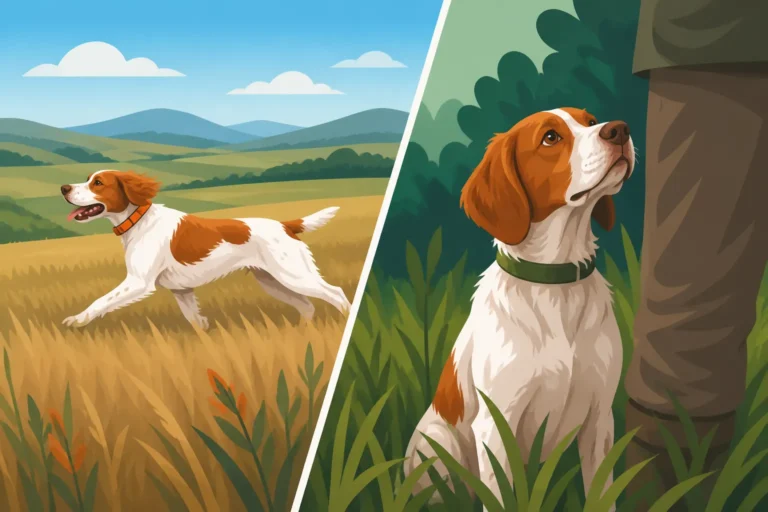
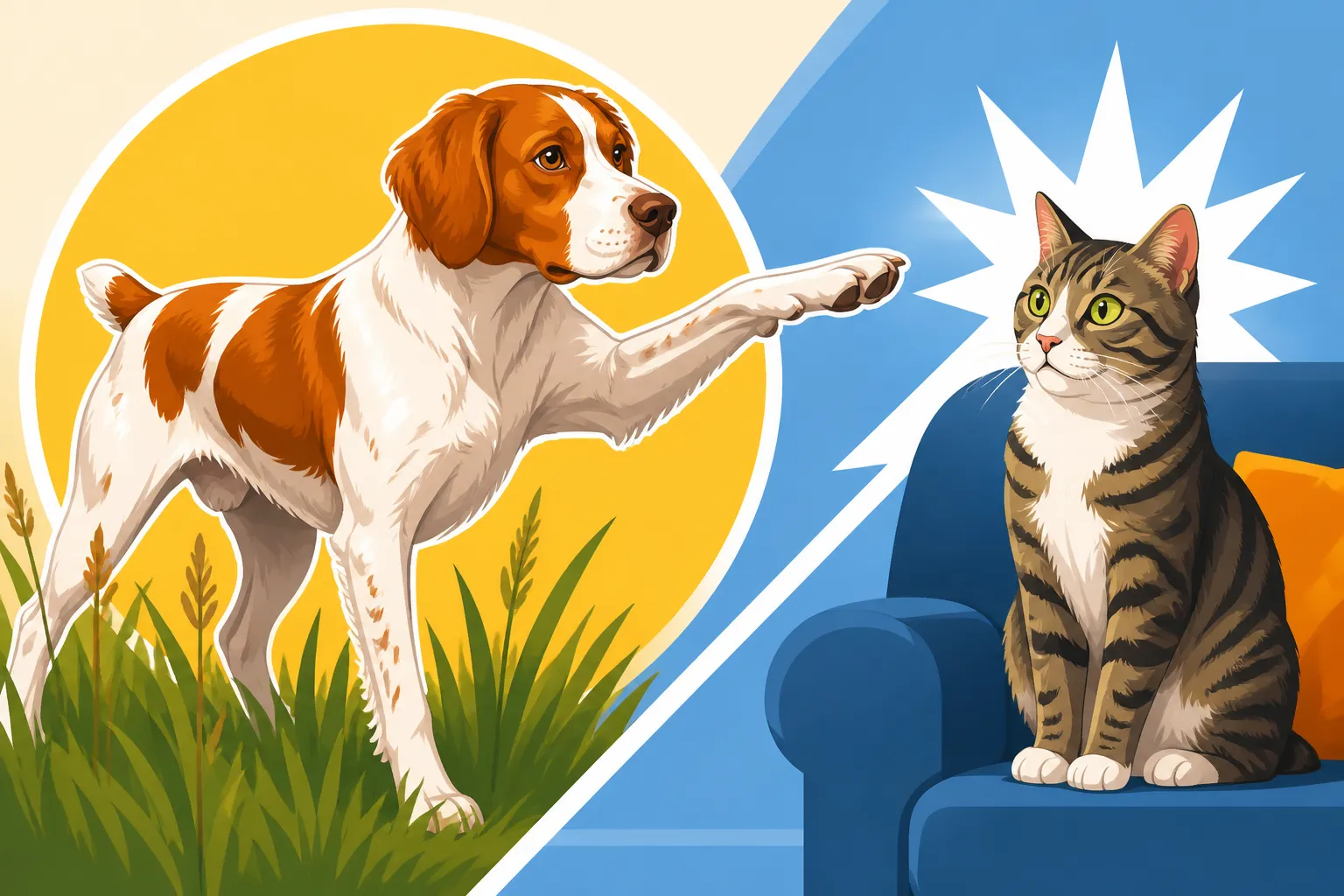
At its heart, pointing is a freeze. It's an instinctive behavior where a dog, upon detecting the scent or sight of game, will suddenly stop, often with one paw raised, nose directed towards the quarry, and tail stiff or slowly waving. It's a way for the dog to silently communicate to its human partner, "Hey, there's something here!" For a hunting dog, this is not an aggressive act; it's a highly refined method of locating and indicating. A Brittany's pointing instinct is incredibly strong. They can point everything from a flushing pheasant to a butterfly flitting across the yard, or even a dust bunny rolling under the couch. It’s an alert, a moment of intense focus, rather than an intent to attack.
This instinct can manifest in subtle ways even outside of the field. You might see your Brittany "point" a leaf blowing across the lawn, or freeze with an intense stare at a squirrel up a tree. The key is recognizing that this is their brain's natural response to novel or interesting stimuli, especially those that move quickly or emit an intriguing scent.
The Role of Prey Drive
While closely related to pointing, prey drive is a distinct, and often more impactful, instinct when it comes to living with small animals like cats. Prey drive is the inherent desire to pursue, capture, and sometimes kill smaller creatures. It’s the full sequence of hunting behavior: search, stalk, chase, grab, and sometimes, dispatch. While pointing is primarily about locating game, prey drive encompasses the action taken afterward. Brittanys, as sporting dogs, possess a moderate to high prey drive. They are wired to find and pursue birds, and that drive doesn't always distinguish between a pheasant in a field and a cat sauntering across the kitchen floor.
This is where the potential conflict arises. A Brittany might initially point your cat, freezing and staring intently. But if the cat moves, especially if it darts away, that pointing stance can quickly transition into a chase, driven by the dog's innate prey drive. Small, fast-moving animals trigger this drive very powerfully. This is why you often see Brittanys enthusiastically chasing squirrels, rabbits, or even deer, despite extensive training. It's deeply ingrained.
When Pointing Becomes More Than Just a Point
The line between a harmless "curiosity point" and a potentially dangerous "predatory point" can be thin, and it's something every Brittany owner with a cat needs to understand. A curiosity point might involve a dog freezing, looking intently at the cat, perhaps with a soft whine, but without tension or clear intent to engage beyond observation. It might be triggered by the cat's sudden appearance or an unusual movement.
A predatory point, however, will be more intense. The dog's body will be stiffer, hackles might be slightly raised, eyes unblinking and fixated. There might be a low growl or a high-pitched whine that speaks of intense anticipation. The tail might be rigid, or have a very short, rapid wag. In this state, the Brittany is not just observing; it's preparing to act on its prey drive. This distinction is critical for owners to learn to read, as it indicates a much higher risk of the interaction escalating into a chase or even an attack. Early intervention and consistent training are vital to prevent these escalations. For some deep insights into their behavior, you might find What a Brittany's Temperament Is Really Like helpful.
The Brittany and the Feline: A Complex Relationship
Bringing a highly driven hunting dog into a home with a small, often skittish, feline resident can feel like setting up a diplomatic negotiation between two vastly different cultures. It's complex, it requires patience, and sometimes, things get a little messy before they get better.
The "Point" on the Prowl: Initial Encounters
When a Brittany first encounters a cat, especially if the dog hasn't been socialized with cats before, you can almost see their brain processing the new "prey." They might exhibit that classic frozen stance, often called a "point," with their body stiff, nose lowered, and eyes locked onto the cat. It's an intense moment. The cat, sensing this predatory focus, might hiss, arch its back, or bolt, which, unfortunately, often triggers the Brittany's chase instinct.
I've seen Brittanys point a cat from across the room, then slowly creep closer, like a hunter stalking game. Sometimes, they'll let out a low, excited whine, their whole body quivering with anticipation. If the cat makes the mistake of running, the point often breaks, and the chase is on. This isn't necessarily malice; it's a dog responding to its deeply ingrained programming. The fast movement of the cat is like a switch flipping in their brain, screaming "Pursue!"
Can a Brittany Learn to Coexist with a Cat?
Absolutely, a Brittany can learn to coexist peacefully with a cat, but it's crucial to understand that "coexistence" might look different for every pair. It’s rarely about eradicating the dog's prey drive – that's impossible – but rather about redirecting, managing, and creating boundaries. Many Brittany owners successfully have both dogs and cats living harmoniously under the same roof. The key is consistent, positive training, careful management, and understanding that some relationships will be more tolerant than truly "friendly."
For some Brittanys, coexistence means ignoring the cat entirely, or perhaps a brief, casual sniff. For others, it might mean the Brittany still "points" the cat occasionally, but can be easily called off. The goal is always safety and a stress-free environment for both animals. Early introduction and socialization play a massive role here. Whether a Brittany Puppy Should Be Socialized Heavily is a crucial read if you're bringing a puppy into a multi-pet home.
Factors Influencing the Brittany-Cat Dynamic
Several factors weigh heavily on the success of a Brittany-cat household:
- Age of the Brittany: A Brittany puppy introduced to a cat generally has an easier time adapting. Their instincts are still developing, and they are more malleable. An adult Brittany with an established prey drive and no prior cat exposure will require more intensive management and training.
- Age and Temperament of the Cat: A confident, dog-savvy cat is far more likely to stand its ground or calmly retreat, rather than bolting, which can de-escalate a potential chase. A shy, fearful, or very old/fragile cat is at greater risk and will require more protection.
- Previous Experiences: If either animal has had negative experiences with the other species, it will obviously complicate the introduction. A cat that's been chased by dogs before will be more fearful, and a dog that's successfully chased cats will be more likely to repeat the behavior.
- Training and Consistent Boundaries: This is perhaps the most critical factor. A well-trained Brittany with a solid "leave it," "come," and "whoa" command is much safer around a cat than an untrained one. Consistency from the owner is paramount in establishing what is, and isn't, acceptable behavior around the feline. If your Brittany is prone to being What an Under Exercised Brittany Does at Home, they might be more likely to bother the cat out of boredom too.
Strategies for a Peaceful Multi-Species Household
Creating a harmonious home for both your Brittany and your cat involves a multi-pronged approach combining careful introduction, environmental management, and consistent training. It's a commitment, but one that many Brittany owners find incredibly rewarding.
Early Introduction and Socialization
If you're bringing a Brittany puppy into a home with a cat, seize the opportunity for positive, early introductions. Supervision is non-negotiable. Start with controlled interactions, perhaps with the puppy on a leash or in a crate, allowing the cat to observe from a safe distance. Reward the puppy for calm behavior around the cat with high-value treats. Never force an interaction, and make sure both animals have easy escape routes if they feel uncomfortable.
Use baby gates to separate them initially, allowing them to see and smell each other without direct contact. Platforms like BAXTER & Bella offer comprehensive online puppy training programs that emphasize positive reinforcement and early socialization, which can be invaluable for teaching your pup appropriate behavior around other animals, including cats. Slowly increase supervised interaction time, always ending on a positive note. Remember that puppies are still learning, and even if they're good at first, their prey drive will develop.
Management and Environmental Control
This is your first line of defense, especially when you can't actively supervise. Create safe havens for your cat where the Brittany cannot reach them. This means:
- Vertical Space: Cat trees, shelves, and window perches are excellent. Cats love to be up high, and it provides them a secure escape.
- Cat-Only Rooms: Use baby gates (many are available on Amazon that allow small pets to pass through while keeping larger dogs out) to block off a room where the cat's food, water, and litter box are kept, and where they can retreat for peace and quiet.
- Crates and Pens for the Dog: When you cannot supervise, put your Brittany in a crate or a sturdy dog playpen. This prevents unwanted chasing or stalking and gives both animals a break.
- Secure Food and Toy Areas: Keep food bowls and high-value toys for the Brittany out of reach of the cat, and vice-versa, to prevent resource guarding issues.
These measures aren't just for safety; they reduce stress for both animals, allowing them to coexist without constantly being on guard.
Consistent Training and Reinforcement
This is where you shape your Brittany's behavior. A strong foundation of obedience training is crucial.
- "Leave It" and "Recall": These commands are your superpowers. Practice "leave it" with tempting items, then generalize it to the cat. A reliable recall is essential to call your Brittany off if they start to focus too intently on the cat. How Reliable a Brittany's Recall Is is a post worth reviewing.
- Reward Calm Behavior: Whenever your Brittany is calm, relaxed, or ignores the cat, lavish them with praise and treats. You want them to associate the cat's presence with positive things, not just restraint.
- Never Punish the Point, Punish the Chase: It's important to understand that pointing is an instinct. You can't punish an instinct out of a dog. However, you absolutely can (and should) redirect or interrupt the escalation of prey drive, i.e., the chase. Use a sharp "No!" or a firm "Leave it!" if they start to stalk or chase, and then immediately redirect their attention to a more appropriate activity, like playing with a toy or doing a command for a treat. Remember, Brittanys can be quite How Sensitive a Brittany Is to Correction, so focus on redirection and positive reinforcement rather than harsh punishment.
- The "Whoa" Command: While typically a field command for stopping a dog on point, a solid "Whoa" can be adapted to home use, asking your Brittany to freeze and disengage from whatever they are focused on. Teaching a Brittany Whoa can be a lifesaver in these situations.
When Things Don't Go as Planned: Troubleshooting and Safety
Even with the best intentions and diligent training, sometimes the Brittany-cat dynamic can be challenging. Knowing how to recognize escalating stress and when to seek professional help is vital for the well-being of all your household members.
Recognizing Stress Signals in Both Pets
Being fluent in animal body language is crucial for a multi-pet household.
Signs your Cat is Stressed:
- Hissing, growling, swatting: Clear signs of discomfort or aggression.
- Flattened ears, wide eyes, crouched posture: Fear and readiness to bolt or defend.
- Excessive hiding: The cat feels unsafe in common areas.
- Inappropriate urination/defecation: A common stress indicator in cats.
- Loss of appetite or over-grooming: Can indicate chronic stress.
Signs your Brittany is Over-Stimulated (or acting on prey drive):
- Fixated stare, dilated pupils: Intense focus, often with a "hard" look.
- Stiff body, low head, creeping posture: Stalking behavior.
- Whining, panting, trembling: High arousal and anticipation.
- Licking lips, yawning (out of context): Can be stress signals.
- Pacing, inability to settle: Over-excitement and potential frustration.
If you consistently see these signs, it's a clear indication that the current management strategy isn't working, and intervention is needed.
The Risks of Unchecked Prey Drive
Ignoring or downplaying intense prey drive can have serious consequences:
- Physical Harm to the Cat: A Brittany, even a smaller breed, is a powerful dog. A serious chase can result in the cat being injured, especially if they are cornered, tripped, or directly bitten. This is the most significant risk and one that must be prevented at all costs.
- Chronic Stress for Both Animals: A cat constantly living in fear of being chased will be under immense stress, impacting its health and quality of life. Similarly, a Brittany constantly being corrected or frustrated in its instincts can become stressed, destructive (as discussed in What a Bored Brittany Destroys), or develop behavioral issues.
- Damage to the Human-Animal Bond: Living in a chaotic or stressful environment can strain your relationship with both pets. You might feel frustrated, guilty, or overwhelmed.
- The Challenge of Rescue Dogs: If you're considering adopting a rescue Brittany, especially one with an unknown history, the presence of a cat adds another layer of complexity. Whether a Rescue Brittany Has Been Screened can provide some insight, but it's essential to communicate openly with the rescue organization about your living situation and their assessment of the dog's prey drive.
Seeking Professional Help
There's no shame in admitting you need help. Many skilled professionals specialize in inter-species household dynamics.
- Certified Professional Dog Trainer (CPDT-KA): A good trainer can help you refine your dog's obedience cues, teach you how to read body language more effectively, and develop a tailored training plan to manage the Brittany's prey drive.
- Veterinary Behaviorist (Dip ACVB): For more severe cases, especially if there's actual aggression or intense predatory behavior that feels unmanageable, a board-certified veterinary behaviorist is the highest level of expertise. They are veterinarians who specialize in behavior and can address underlying medical or anxiety issues contributing to the problem.
They can offer personalized advice, help you adjust your environment, and teach you advanced techniques for managing these powerful instincts safely and effectively.
Pointing vs. Prey Drive: A Quick Comparison
To help clarify the distinctions we've discussed, here's a brief comparison:
| Feature | Pointing | Prey Drive |
|---|---|---|
| Primary Goal | Locate & indicate game | Pursue, capture, subdue prey |
| Behavior | Freeze, intense stare, body rigid | Stalk, chase, bite, shake, kill |
| Motivation | Instinctive communication, focus | Instinctive hunger, survival, engagement |
| Emotional State | Focused, alert, sometimes excited | Highly aroused, predatory excitement |
| Potential Danger | Low (unless it escalates) | High (can lead to injury or death) |
| Trainability | Can be refined/channeled | Can be managed/redirected, but not eliminated |
Living with a Brittany and a cat can be a joyful experience, but it requires understanding, patience, and proactive management. By respecting your Brittany's natural instincts while implementing smart strategies, you can foster a home where all your furry family members feel safe and loved. After all, the goal is a peaceful household, where your Brittany is a beloved companion, not a perpetual threat to the family cat. You may also want to read A Brittany With Children and Other Animals for broader advice on integrating your Brittany into a diverse household.
Disclaimer
This article is for general informational purposes only and does not constitute professional advice. Laws, prices and regulations vary by location and change over time. Consult a qualified professional for guidance on your specific situation.