Whether a Brittany’s Tail Affects Its Balance
A Brittany’s tail may be naturally short, docked, or left long, which can make owners wonder whether the dog is missing an important balancing tool. In ordinary movement, the tail is only one small part of a much larger system. This guide explains how dogs balance, what tail length may change during activity, and which signs are worth discussing with a veterinarian.
How a Brittany’s tail fits into balance
Balance comes from several systems working together
A dog does not rely on its tail alone to stay upright or move confidently. Balance is coordinated through the inner ear, vision, sensory information from the paws and joints, and the nervous system’s control of muscles. Together, these systems help a Brittany judge where its body is and adjust its posture as it moves.
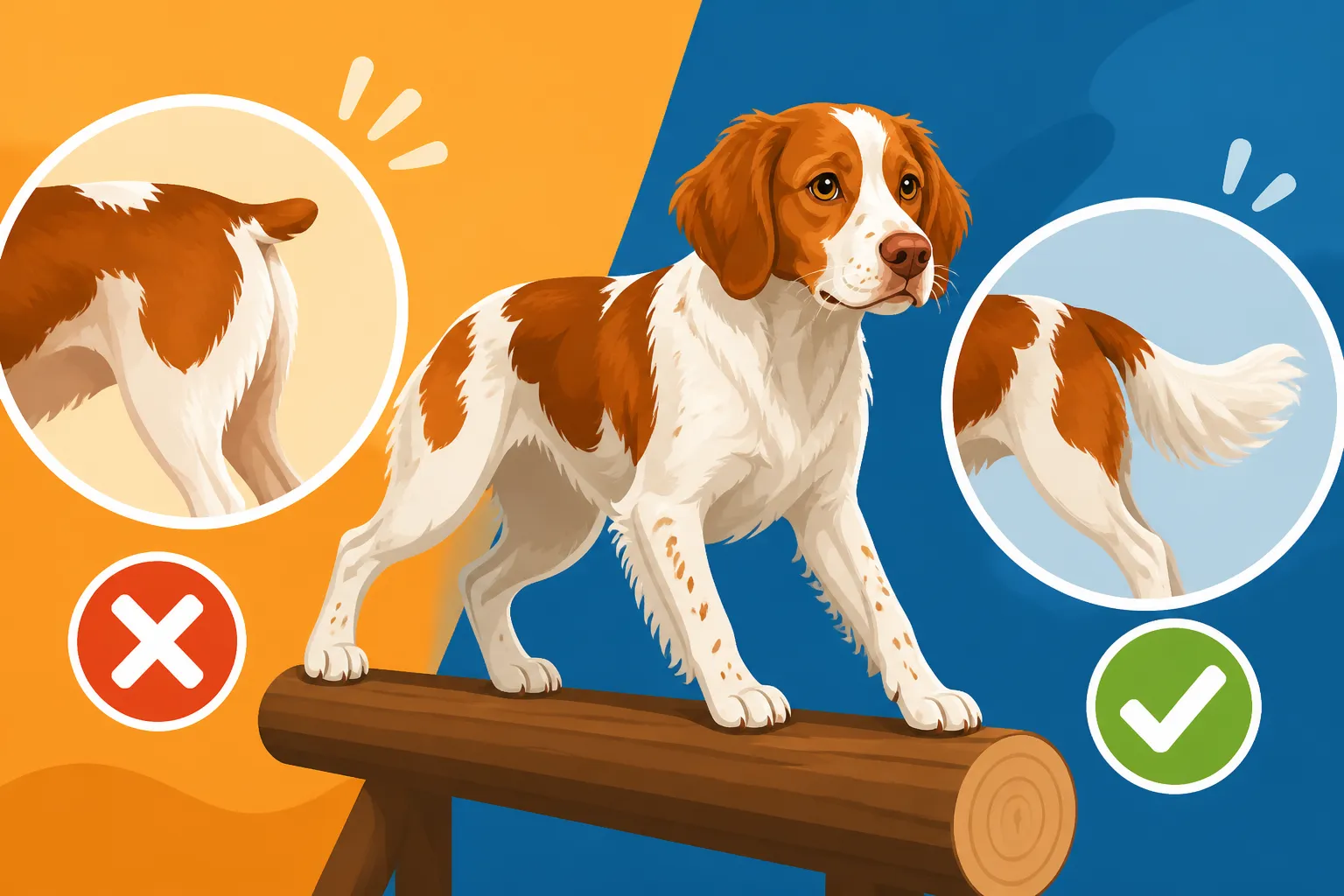
The tail can contribute to that coordination, especially during motion. A dog may shift or swing its tail as it turns, changes direction, or adjusts its position. But that movement is one part of a complex response—not a single mechanism that keeps the dog from falling.
That distinction matters when thinking about Brittanys with short tails. A dog born with a natural bobtail or one that has a docked tail can still learn to move, run, and play using the rest of its body. Tail length alone does not tell you whether a dog has good coordination, and a short tail does not automatically mean a Brittany will be unsteady.
What the tail may do during a turn or quick movement
When a Brittany makes a fast turn across a field, its legs, trunk, head, and tail all move as part of the same action. The tail may help with small adjustments to the body’s position, much as a person may shift their arms while turning or stepping over uneven ground. This can be more noticeable during energetic movement than during a relaxed walk around the house.
A long tail may provide a dog with more ability to move that part of its body. A short tail provides less tail movement, but the dog can still adjust through its shoulders, spine, hips, and legs. The difference should not be confused with a guarantee that one dog will be more agile or athletic than another. Fitness, confidence, experience, footing, and health all matter.
For example, imagine two Brittanys running through the same open field. One has a long tail and one has a naturally short tail. Both may navigate turns well, but their individual speed, training, and comfort on the ground are likely to matter much more than tail length. If either dog suddenly begins stumbling or struggling to turn, that change deserves attention regardless of its tail.
Tail shape is not the same as a balance problem
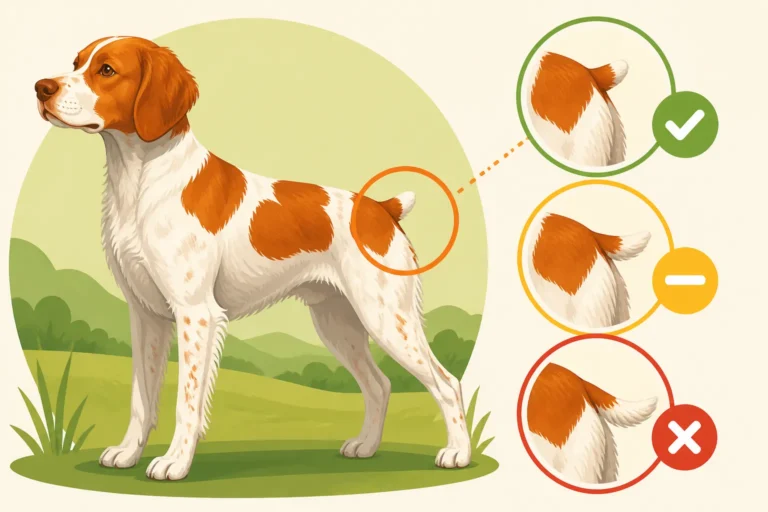
Brittanys may have different tail lengths because of natural variation, breeding, or docking. If you are trying to understand why a particular dog has a short tail, Some Brittanys Are Born Without a Tail explains the natural bobtail trait, while Whether a Brittany's Tail Is Docked looks at docking and how it may affect appearance.
A short tail can make tail movements less obvious to a person watching the dog. That does not mean the dog has poor balance. Likewise, a long or expressive tail does not prove that a dog’s coordination is normal. Look at the whole dog: how it places its feet, moves across different surfaces, rises from rest, and responds to ordinary play.
What a short-tailed Brittany can do comfortably
Running, turning, and playing
Most Brittanys with short tails can take part in ordinary dog activities, including walks, play, and running, assuming they are otherwise healthy and appropriately conditioned. A Brittany’s ability to handle activity depends on many things besides its tail: strength, stamina, age, surface conditions, previous experience, and the pace of the activity.
It is sensible to build exercise gradually, particularly with a young dog or one returning to activity after a break. A tired dog may become less coordinated simply because its muscles are fatigued. Slippery floors, loose gravel, deep snow, and uneven ground can also challenge any dog, whether its tail is long, short, or absent.
If your Brittany runs in cover or hunts, assess its comfort over the whole outing rather than focusing only on tail carriage. Watch for changes in stride, reluctance to turn, repeated stumbling, or difficulty getting up. For practical context about Brittany tail shapes and inheritance, Which Gene Makes a Brittany Tailless and Whether a Natural Bobtail Runs in Brittany Lines explore how natural bobtails occur.
Jumping and stepping over obstacles
A tail may move as a dog jumps or lands, but the dog’s ability to perform the movement also depends on its legs, joints, trunk strength, coordination, and confidence. A Brittany with a short tail is not automatically unable to jump safely. On the other hand, a dog that is suddenly hesitant to jump onto a familiar surface may be dealing with discomfort, fear, weakness, or another issue that deserves attention.
At home, avoid asking a dog to make repeated high jumps simply to test whether its tail affects its balance. If your Brittany is older, recovering from an injury, or unsure on slick flooring, make the environment easier instead. A nonslip runner, a lower step, or a stable ramp can help reduce the challenge. If you are comparing home-access products, retailers such as Chewy may offer options, but choose equipment that is secure, appropriately sized, and suitable for your dog’s needs.
A Brittany that confidently steps over a low obstacle is not necessarily ready for strenuous field work, and a dog that declines a jump is not necessarily unbalanced. The context matters: Is the surface slippery? Is the dog tired? Has the movement changed recently? Does the dog seem painful? Those details are more useful than tail length alone.
Everyday movement and body language
In ordinary household movement, a Brittany with a short tail can walk, turn, sit, and lie down without needing a long tail to perform those tasks. Dogs also use body posture, ears, facial expression, and movement to communicate. Tail signals are one piece of that picture, and a shorter tail may simply make that particular signal harder to read.
Owners sometimes interpret a still or low tail as a sign of poor balance, but tail position can reflect many things, including mood, attention, discomfort, or the dog’s natural shape. Compare your dog’s behavior with its usual pattern rather than judging it against a long-tailed dog. A short tail may limit how much visible movement there is, but it does not by itself indicate a problem with the dog’s coordination.
How to assess your Brittany’s movement
Notice patterns instead of testing the tail
The most useful observation is how your Brittany moves in familiar, low-pressure situations. Watch the dog walk on a safe, nonslip surface, turn in both directions, rise from resting, and step over an ordinary low threshold. You do not need to provoke a fall or ask the dog to sprint, jump, or navigate a difficult obstacle.
Look for changes from your dog’s normal movement. Does it seem less sure when turning? Is it placing one paw differently? Does it repeatedly slip on a surface it used to manage? Is it reluctant to play, climb steps, or get into the car? A single awkward step can happen to any dog, but a repeated or worsening pattern is more informative.
You can keep a brief note of when the issue occurs. For example, record whether it happens after long exercise, on a particular surface, or when the dog first gets up. A short video of naturally occurring movement may also help your veterinarian understand what you are seeing. Do not make the dog repeat a movement that appears painful or unsafe just to capture footage.
| What you notice | What it may mean | A practical next step |
|---|---|---|
| Your dog moves normally, but has a short tail | Tail length alone may not be affecting everyday movement | Continue ordinary exercise and routine observation |
| Occasional slipping on a smooth floor | The surface may be difficult to grip | Add traction and see whether movement improves |
| Repeated stumbling or a new change in coordination | Could have several causes beyond tail length | Contact your veterinarian for guidance |
| Pain, weakness, or reluctance to use a leg | May indicate an injury or other health concern | Stop strenuous activity and arrange veterinary advice |
| Tail swelling, a wound, or marked sensitivity | May be a tail injury or another painful condition | Prevent further irritation and contact a veterinarian |
When a veterinary check is sensible
A veterinarian should assess a Brittany that develops a persistent or sudden change in balance, coordination, gait, or willingness to move. Balance changes can have many possible causes, including pain, weakness, injury, or problems involving systems other than the tail. Tail shape cannot identify the cause, and it is not a reason to dismiss a new symptom.
Seek prompt veterinary advice if your dog is repeatedly falling, cannot stand normally, seems disoriented, has significant pain, or has a serious injury. If the dog has a tail, also pay attention to swelling, bleeding, a visible wound, or unusual sensitivity around it. Avoid manipulating a painful tail to see how far it moves.
If the concern is mild and appears only on a slippery surface, improving traction may be a reasonable first adjustment. But if the dog continues to slip on secure footing, or the pattern becomes more frequent, contact your veterinarian. It can help to explain when the change began, whether it followed exercise or an incident, and whether it occurs in all settings or only in one place.
Keep exercise appropriate to the individual dog
A Brittany’s energy and athletic ability can make it tempting to assume that every dog is ready for the same amount of activity. In practice, exercise should match the individual dog’s age, conditioning, health, and experience. A short-tailed Brittany that is comfortable on ordinary walks may still need a gradual build-up before longer or more demanding outings.
For a dog that struggles with home surfaces, consider practical changes before asking for more effort: improve grip, clear clutter from walking routes, and make access to favorite resting places easier. Chewy is one place owners may compare nonslip mats or ramps, but stability and fit matter more than appearance. Check that any ramp stays firmly in place and that the dog can use it without being hurried.
If a tail-related question is really about appearance, breeding, or show expectations, those are separate issues from physical balance. How Many Brittanys Are Born Tailless gives additional context about natural short tails, and How Long a Docked Brittany Tail Should Be addresses a different question about docked-tail length. Neither topic, by itself, determines whether an individual dog moves comfortably.
What tail length does and does not tell you
A short tail does not automatically mean poor balance
A Brittany can have a short tail and move confidently because balance depends on the whole body and its sensory systems. Tail movement can contribute to adjustments during activity, but it is not the only way a dog controls posture or direction. Many short-tailed dogs manage everyday movement without difficulty.
That does not mean tail function is irrelevant in every circumstance. The tail can move during turns and other dynamic actions, and a tail injury may be painful or affect how a dog behaves. The sensible distinction is between saying “the tail can play a role” and assuming “a short tail causes a balance disorder.” The first is reasonable; the second is too broad.
A long tail is not proof of better athletic ability
A long tail may be more visible when a dog communicates or adjusts its body during movement, but it does not guarantee speed, coordination, or strength. Two Brittanys with different tail lengths can have very different athletic ability for reasons unrelated to their tails. Training, conditioning, temperament, health, and experience all contribute.
For owners, this means there is no need to judge a Brittany’s fitness by tail length or compare its tail movement with another dog’s. Pay attention to how your own dog performs familiar activities and whether anything has changed. If a concern persists, a veterinary assessment is more useful than guessing from appearance.
The practical answer for owners
For most owners, the everyday answer is straightforward: a Brittany’s tail may assist with small adjustments during movement, but tail length alone is not a reliable measure of balance. A naturally bobtailed or docked Brittany can often manage ordinary activity comfortably, while a dog with a long tail can still have a movement problem.
Focus on your dog’s normal gait, confidence, comfort, and ability to move across safe surfaces. Make sensible changes at home if footing or access is difficult, build activity gradually, and seek veterinary advice for new or persistent coordination changes. That approach keeps the attention on the dog’s actual function rather than on tail length alone.
Disclaimer
This article is for general informational purposes only and does not constitute professional advice. Laws, prices and regulations vary by location and change over time. Consult a qualified professional for guidance on your specific situation.