Whether a Long Tailed Brittany Is Penalized
A Brittany with a full-length tail can leave owners wondering whether they can enter a conformation show, whether a judge will mark the dog down, or whether the tail makes the dog ineligible. The short answer depends on the event: the breed standard sets a short-tail expectation, but that does not mean every long-tailed Brittany is automatically barred from every competition.
What the Brittany breed standard says about tail length
The standard describes a short tail
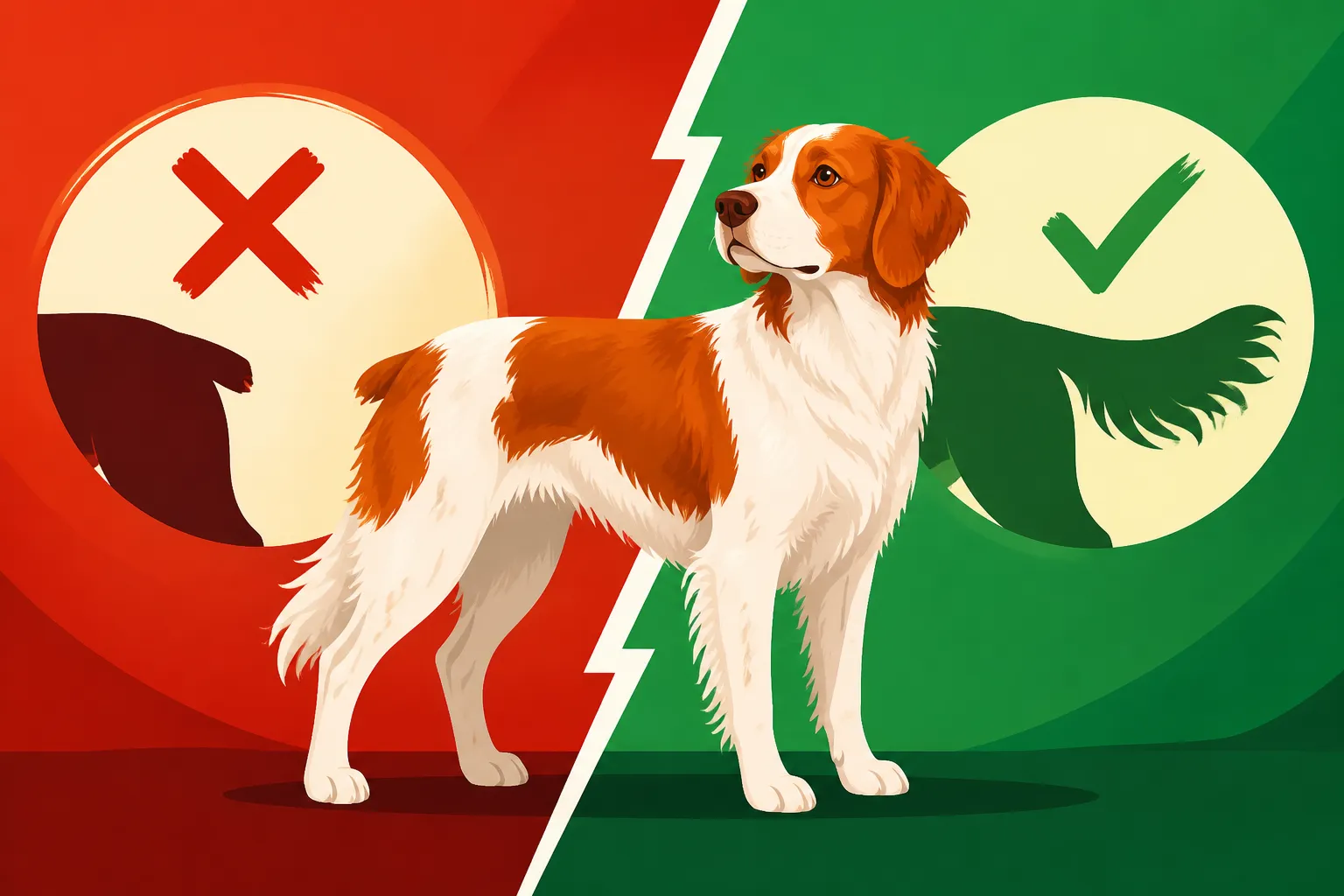
The American Kennel Club breed standard describes the Brittany’s tail as no more than four inches long, whether naturally short or docked. That wording explains why many Brittanys have a short tail: some are born with a naturally short tail, and others have had a longer tail docked.
A dog with an undocked tail that extends well beyond that length does not match the standard’s description. In a conformation show, where judges compare a dog’s structure and appearance with the breed standard, that difference may count against the dog. How much it matters can depend on the dog, the judging context, and the rules that apply to that specific event.
The standard’s wording is one reason it helps to distinguish a long tail from a tail that is merely visible. A tail may look longer in a photograph because of its position, feathering, or the dog’s proportions. If you are unsure, measure the tail itself rather than judging from a picture. You can also ask the breeder, club, or show organizer which standard and rulebook apply.
A long tail does not automatically mean a dog is not a Brittany
Tail length is one feature of a Brittany’s appearance, not a complete measure of the dog’s breed identity, health, or ability. A long-tailed dog can still be registered and may be entirely suitable for life as a companion, hunting dog, or participant in activities that do not judge conformation against the breed standard.
Owners often use “long-tailed Brittany” to mean a dog whose tail was left undocked. That is different from a dog whose tail is unusually long relative to the standard, or from a naturally bobtailed dog whose tail is longer than a few inches. The details matter when you are deciding whether to enter a conformation class.
If you are still sorting out why Brittany tails vary, see Some Brittanys Are Born Without a Tail and Whether a Brittany's Tail Is Docked. For a closer look at the standard’s expected tail length, How Long a Docked Brittany Tail Should Be may also help.
Will a long-tailed Brittany be penalized in a conformation show
Judges may consider the tail as a departure from the standard
In conformation, a judge assesses how closely a dog fits the breed standard. Since the Brittany standard describes a tail no longer than four inches, a noticeably longer tail may be considered a fault or a departure from that description. That can affect a dog’s evaluation, especially if the tail is a prominent difference from the standard.
There is no useful universal rule that says every judge will respond to every long tail in exactly the same way. Conformation judging involves an assessment of the whole dog, and the applicable standard and show rules matter. A dog’s tail is not the only factor in the evaluation, but owners should not assume it will be ignored simply because the dog is otherwise well built or performs beautifully in the field.
It is also important to separate a possible penalty in judging from automatic disqualification. A standard’s description of a feature and its list of disqualifications are not always the same thing. Before entering, check the current rules for the organization and class you plan to attend, and ask the show secretary or the relevant breed club if the wording is unclear. That is a more reliable approach than relying on a social-media comment or another exhibitor’s experience at a different event.
Other kinds of competition may judge different things
A conformation show is not the same as a hunt test, field trial, obedience event, or other performance competition. Conformation evaluates a dog’s structure and appearance against a breed standard. A performance event generally evaluates skills and conduct under that event’s rules, rather than whether the dog’s tail matches the conformation standard.
That does not mean every performance event has identical entry rules. Organizers can have eligibility requirements of their own, and the rules may differ between organizations. But the presence of a long tail, by itself, should not lead you to assume that your Brittany is excluded from all dog activities.
If you plan to show your dog, it may help to read Whether an Undocked Brittany Can Be Shown alongside the event’s rules. For a broader look at how the tail relates to the dog’s movement and function, see Whether a Brittany's Tail Affects Its Balance. The questions are related, but showing and performance activities do not necessarily assess a dog in the same way.
| Situation | What to expect | What to check |
|---|---|---|
| Conformation show | A tail longer than the standard describes may be viewed as a departure from the standard | The organization’s breed standard and disqualification rules |
| Hunt test or field trial | The event may focus on performance rather than conformation | The specific event’s eligibility and equipment rules |
| Companion dog activities | Tail length is generally not the central measure of participation | The organizer’s rules for the activity |
| Breed registration | Tail length alone should not be treated as proof that a dog is not a Brittany | Registration requirements and the dog’s records |
What owners should do before entering a show
Confirm the rules for the exact event
Start by identifying the type of event and the organization running it. A conformation show asks a different question from a field event, and a local club’s event may have requirements that are not identical to another club’s. Look for the organization’s current standard and the specific event rules, rather than relying on a general claim that “long tails are allowed” or “long tails are disqualified.”
If the rules do not clearly answer your question, contact the event secretary before paying an entry fee or making travel plans. Describe your dog plainly: explain that the tail is undocked and give an approximate measurement. Ask whether the dog is eligible to enter and whether a tail exceeding the standard’s stated length is treated as a fault, a disqualification, or neither under that event’s rules.
This step can save a frustrating day. It is disappointing to drive to a show, arrange care, and prepare your dog only to discover that you misunderstood an entry requirement. A brief question in advance is far easier than trying to resolve uncertainty at check-in.
Measure and document the tail carefully
Measure from where the tail joins the body to its tip, without pulling or stretching it. If the tail has long feathering, measure the tail itself rather than the longest hair. Take a clear photograph that shows the tail in a natural position, and keep the measurement for reference when speaking with the event organizer or breeder.
Measurements can be less straightforward than they sound. A dog may be excited, wagging, or holding its tail at an angle, which makes a quick estimate unreliable. If the question matters for a planned entry, take the measurement when the dog is relaxed and ask someone familiar with dog conformation to check your method.
Do not trim or alter the tail to try to make it fit the standard. Grooming cannot change the underlying length, and any alteration made to misrepresent the dog could create a separate rules or ethics problem. If you are considering a show career, get guidance from the event’s officials and a knowledgeable Brittany club member before making plans.
Tail length, docking, and everyday care
An undocked tail is not a problem to solve
A long tail does not need to be docked simply because it differs from the conformation standard. Decisions about docking are affected by local laws, veterinary guidance, timing, and the dog’s circumstances. If you are considering a procedure, discuss it with a veterinarian and check the rules where you live; do not make the decision solely to improve a possible show result.
Tail length also does not define a Brittany’s temperament, working drive, or suitability as a family dog. A long-tailed Brittany can still be an active hunting companion or a much-loved house dog. Owners choosing a puppy can ask the breeder whether the puppy is naturally bobtailed or expected to have a longer tail, then consider that information alongside health, temperament, and the intended activities.
For legal and regional considerations, see Whether Docking Is Banned Where a Brittany Owner Lives. It is also useful to understand that tail type is only one part of the breed’s physical picture; What a Brittany Weighs and How Tall It Stands offers context on another set of standard-related traits.
Keep the tail comfortable and check it after activity
A longer tail may need occasional attention after a day in brush, tall grass, or rough cover. Check for burrs, small cuts, irritation, and tangles in the feathering. If your dog works in dense cover, make the tail part of the same routine inspection as the feet, ears, and coat. A dog that suddenly guards its tail, reacts when you touch it, or has swelling or bleeding should be assessed by a veterinarian.
For routine grooming, use tools and products intended for dogs, and avoid cutting close to the skin when removing a knot. If you are putting together a grooming kit, Chewy is one retailer where owners may look for basic dog brushes and grooming supplies; choose products suited to your dog’s coat and follow the label. Chewy may also be a convenient place to browse for a detangling comb, though a severe mat or painful skin issue is better handled with professional help.
Some owners find it useful to keep a small grooming kit in the car after field outings. Chewy can be one option for finding everyday supplies, but a retailer cannot determine whether a tail injury needs treatment. If you notice a wound, persistent licking, a painful lump, or a change in how your dog carries its tail, contact your veterinary clinic rather than trying to manage a significant problem with grooming products.
A full-length tail may affect how a Brittany is assessed in conformation, because the breed standard describes a short tail. It does not, on its own, tell you whether the dog can take part in every other activity or whether the dog is healthy and capable. The practical next step is to identify the event, check its rules, and ask the organizer directly if the tail requirement is unclear.
Disclaimer
This article is for general informational purposes only and does not constitute professional advice. Laws, prices and regulations vary by location and change over time. Consult a qualified professional for guidance on your specific situation.