Whether a French Brittany’s Muzzle Is Shorter
A French Brittany may look as though it has a shorter muzzle than an American Brittany, especially in photos or beside a taller, longer-headed dog. But “French” does not guarantee one fixed muzzle shape, and perspective can exaggerate small differences. This guide explains what people mean by a shorter muzzle, how to compare dogs fairly, and when muzzle shape matters for health or equipment fit.
What “shorter muzzle” means in a French Brittany
The muzzle is only one part of the head
A dog’s muzzle is the section of the head in front of the eyes, including the nose and upper jaw. When someone says a French Brittany has a shorter muzzle, they may mean the nose-to-stop section looks shorter relative to the skull, or simply that the whole head appears more compact.
Those are related but not identical observations. A dog can have a compact head without having an unusually short muzzle. The muzzle might also look short because the skull is broad, the stop between the forehead and muzzle is pronounced, or the dog is photographed from an angle that foreshortens the face.
In the Brittany, the muzzle should still look like a functional sporting-dog muzzle. It is not meant to be flat or pushed in like the face of a brachycephalic breed. A balanced Brittany head has a defined muzzle that tapers toward the nose without looking pinched, blunt, or disproportionately short.
French and American lines are not two completely separate breeds
In the United States, “French Brittany” commonly refers to an Epagneul Breton with French ancestry or type. The distinction from an American Brittany is often discussed in terms of overall build, style, and hunting range, but the labels do not create two perfectly uniform groups. Dogs vary within each population, and breeders may emphasize different traits.
That means a French-bred dog may have a more compact-looking head, but you should not assume every French Brittany has a shorter muzzle than every American Brittany. Individual dogs can overlap substantially. A particular American Brittany may have a compact face, while a French-line dog may have a longer-looking muzzle.
For a fuller explanation of the differences people commonly notice, see How a French Brittany Differs From an American One. The name itself can also cause confusion: What Epagneul Breton Means explains why you may see the French name used alongside “French Brittany.”
A shorter-looking muzzle does not necessarily mean a problem
A muzzle that appears a little shorter than another Brittany’s is usually a matter of individual conformation, not a diagnosis. What matters is whether the dog’s head is balanced and whether the dog breathes, eats, retrieves, and works comfortably.
Be more cautious if a dog has a very compressed-looking face, noisy or labored breathing, repeated overheating, or difficulty recovering after ordinary exercise. Those signs deserve veterinary attention rather than an attempt to explain them away as a breed-type difference. A Brittany is an active pointing dog, and its face should suit normal movement and work.
How to compare French and American Brittany muzzles fairly
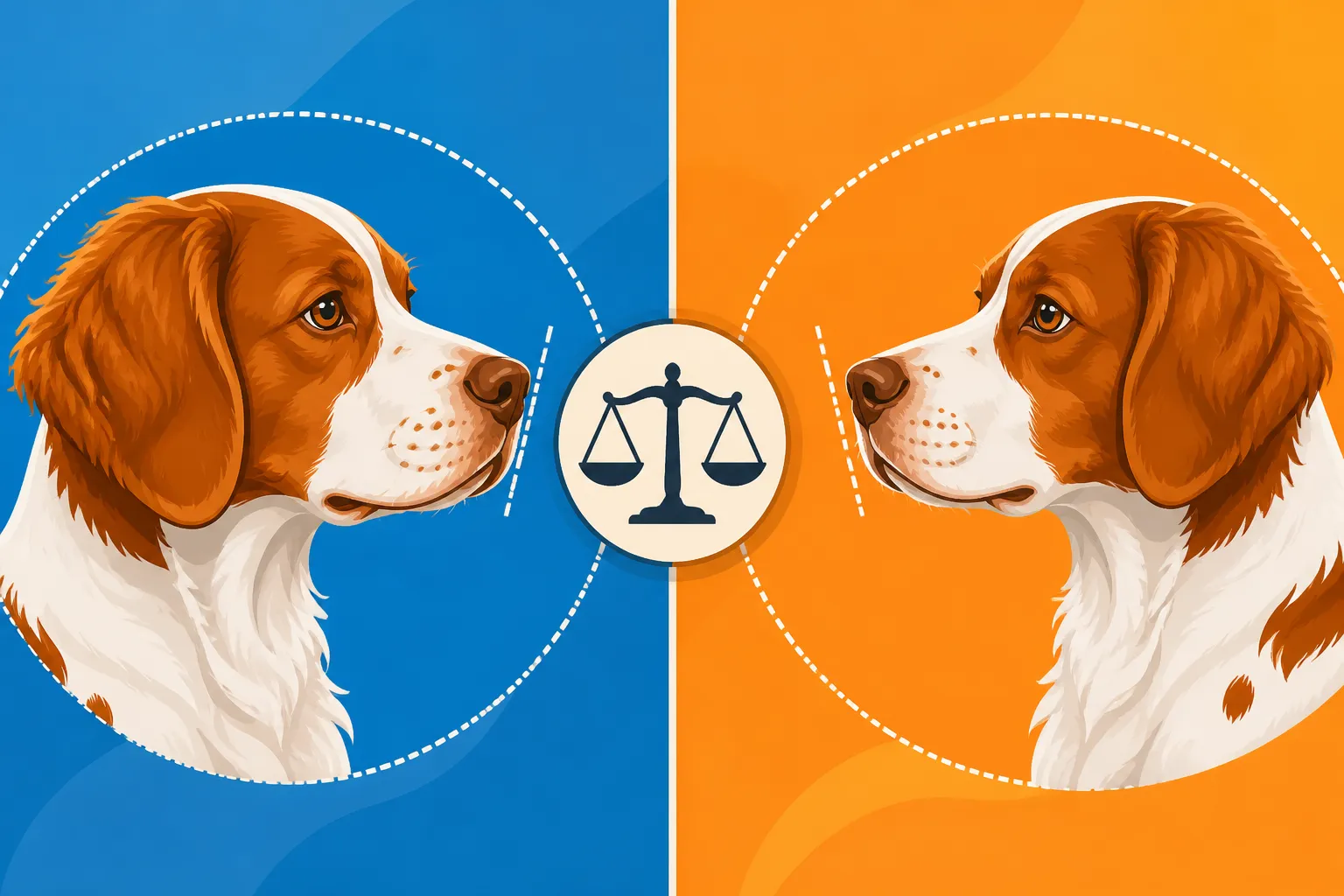
Compare proportions, not just the nose-to-eye distance
A useful comparison looks at the muzzle in relation to the rest of the head. Consider the skull length, the shape of the stop, the width and taper of the muzzle, and the position of the nose. Looking only at how far the nose sits from the eyes can be misleading, especially when one dog has a broader skull or a different expression.
Try to compare dogs in similar conditions: standing naturally, with their heads level, photographed from the side, and at a similar distance. A close-up taken with a phone’s wide-angle lens can make the part nearest the camera look larger and the part farther away look smaller. A head turned slightly toward the camera can also make the muzzle appear shorter than it is.
| What you are comparing | What can make the muzzle look shorter | A fairer way to check |
|---|---|---|
| Side profile | The head is turned toward the camera | Look for a true side view with the head level |
| Muzzle-to-skull proportion | A broad or rounded-looking skull | Compare the whole head, not just the nose |
| Photos from different sources | Camera distance or lens distortion | Use images taken from similar angles and distances |
| Overall breed type | Differences in height, coat, and expression | Compare individual dogs as well as line tendencies |
| A dog’s working ability | Appearance alone | Observe breathing, movement, retrieving, and recovery |
Even careful visual comparison has limits. A photograph cannot tell you how a dog breathes during a run, and a single head shot cannot establish whether a dog is typical of its line. If you are evaluating a puppy or considering a breeder, ask to see the parents in person or in clear, ordinary side-profile photos. Ask about health and function as well as appearance.
Avoid treating “French” as a guarantee of a specific head shape
A breed label is not a measuring tool. Breeding choices, family lines, and individual inheritance all affect a dog’s proportions. Two puppies from the same litter can develop different-looking heads as they mature, and coat, expression, and camera angle can make those differences seem larger or smaller.
If you are choosing between lines, think about the dog you want to live and hunt with rather than fixating on one facial feature. Consider temperament, health screening, energy, hunting style, and how the breeder raises and evaluates the dogs. The question Whether a French Brittany Is a Separate Breed may help clarify why the terms can sound more definitive than they are.
Likewise, a shorter muzzle does not tell you whether a Brittany will hunt close or range wide. That depends on more than the shape of the face. If hunting style is part of your decision, Which Brittany Type Suits a Foot Hunter Better is a more relevant comparison than muzzle length alone.
When muzzle shape matters for health and everyday function
Watch the dog, not just the profile
A Brittany’s muzzle is part of its working equipment: the dog uses its face to scent, carry birds, drink, pant, and interact with the environment. A modest difference in muzzle length between two healthy dogs does not automatically change any of those abilities. Comfort and function are more useful clues than a visual comparison with another dog.
Notice whether the dog can breathe quietly at rest and recover normally after exercise. Pay attention to persistent snoring or noisy breathing, excessive effort in warm weather, or a sudden change in stamina. These signs can have causes unrelated to muzzle length, so a veterinarian should assess them rather than relying on a breed-type explanation.
The nose also has its own appearance and health considerations. A nose that looks lighter or darker is not proof that the muzzle is shorter. If you are comparing facial features, keep those questions separate; Whether a French Brittany's Nose Is Darker addresses nose color, while Whether a French Brittany Has Amber Eyes covers another feature often discussed alongside head type.
Muzzle length alone is not a reliable measure of retrieving ability
A shorter-looking muzzle does not automatically mean a weaker retrieve, a poor mouth, or less ability to carry game. Retrieving behavior is shaped by the individual dog, training, experience, and natural inclination. If a Brittany carries birds comfortably and can breathe and pant normally, a small difference in facial proportions may have little practical significance.
For a working dog, observe the whole picture. Does the dog pick up and carry objects comfortably? Does it seem distressed after ordinary exercise? Does its face or jaw appear asymmetric, painful, or unusually restricted? A persistent functional problem is worth discussing with a veterinarian, but a cosmetic difference between two healthy Brittanys is not, on its own, evidence of a problem.
What owners should do with the “shorter muzzle” question
If you are choosing a puppy or evaluating a breeder
Ask the breeder to describe the parents’ size, build, and working style, then look at them in relaxed, clear views. If possible, see the dogs move and recover after activity. A breeder should be able to talk about the dogs as individuals rather than promising that all French Brittanys have one exact head shape.
Keep your questions specific. You might ask how the breeder describes the parents’ heads, whether either dog has breathing or dental concerns, and what the dogs are like in the field and at home. A responsible conversation should include health, temperament, and function—not just whether a puppy’s muzzle is shorter than an American Brittany’s.
Do not make a decision from a single social-media photo. Head angle, coat, lighting, and lens distortion can all alter the impression. If the breeder’s photos are unclear, ask for a natural side view or a short video of the dog standing and moving. You are looking for a sensible, functional dog, not a perfect silhouette.
If you meant a wearable dog muzzle
Sometimes “muzzle” means a piece of equipment worn over a dog’s nose and mouth. A French Brittany label does not provide enough information to choose one. Measure the individual dog according to the product maker’s instructions, and make sure the design allows comfortable panting and drinking when appropriate. A wearable muzzle should not be used to force exercise or prevent panting.
If you are comparing options through a retailer such as Chewy, use the product’s measurement guide rather than choosing by breed name. Chewy can be one place to review available styles, but the key is the fit on your particular dog—not whether the listing mentions Brittanys. For medical, grooming, or safety needs, ask your veterinarian what style is suitable before buying.
A poorly fitted muzzle can rub, restrict normal jaw movement, or interfere with panting. Chewy listings and other retail descriptions may help you compare designs, but they cannot replace measuring your dog and checking the fit carefully. If the dog shows distress, remove the equipment and seek professional guidance. The facial feature discussed in breed descriptions and the wearable device are different topics, so make sure you are comparing the right one.
Disclaimer
This article is for general informational purposes only and does not constitute professional advice. Laws, prices and regulations vary by location and change over time. Consult a qualified professional for guidance on your specific situation.