How Short a Brittany’s Nails Should Be for Running
As a Brittany owner who's spent countless hours in the field, I know the sheer joy—and sometimes, the sheer frustration—of keeping these energetic dogs in prime condition. One often overlooked but absolutely critical aspect of their care, especially for a running dog like a Brittany, is nail length. Too long, and you're inviting discomfort, injury, and a decline in performance. This guide will walk you through exactly how short your Brittany's nails need to be for optimal health and how to achieve it, saving you from unnecessary vet visits and ensuring your bird dog can fly across the terrain without a hitch.
The Critical Importance of Short Nails for an Active Brittany
When you have a dog bred to cover ground with boundless energy, every part of its anatomy plays a role in its performance and longevity. The nails are no exception. It might seem like a small detail, but long nails can lead to a cascade of problems for a Brittany, impacting everything from its gait to its joint health. We're not just talking about aesthetics here; this is about function and preventing pain for your beloved companion.
How Long Nails Impact Gait and Balance
Imagine trying to run a marathon in shoes that are a few sizes too small, or with pebbles constantly digging into your toes. That's a bit like what a Brittany experiences with overly long nails. When the nails are too long, they push up into the nail bed, making each step uncomfortable. To compensate for this, your Brittany will subtly shift its weight and alter its natural stride. Instead of landing squarely on its pads, the dog might shift its weight back onto its heels, or splay its toes to avoid pressure on the quick. Over time, this unnatural gait can put undue stress on the toes, pasterns, and even the higher joints like the elbows and shoulders. It throws off their balance, making them less agile in dense cover and increasing the risk of slips and falls, which can lead to more serious The Injuries a Brittany Picks Up in the Field. A dog that isn't moving efficiently is also expending more energy, tiring out faster in the field.
Long-Term Effects on Joint Health and Pasterns
The cumulative effect of a constantly altered gait is not pretty. The repeated strain on the joints, particularly the small joints of the paws, can accelerate the onset of arthritis. Think about it: every time your Brittany takes a step, if its nails are too long, they are essentially pushing against the ground and forcing the toe bone back up into the joint. This constant, repetitive micro-trauma inflames the joint capsules and wears down cartilage over time. The pasterns – the area just above the foot – are also vulnerable. They are designed to be strong and flexible shock absorbers. When long nails force the toes to splay or change angle, the pasterns bear an uneven load, leading to weakness, inflammation, and pain. For a hunting dog, this can significantly shorten their active career and lead to chronic discomfort later in life, making even simple walks painful. The Age a Brittany Gets Arthritis is certainly something we want to push back as much as possible for our dogs.
Increased Risk of Injury in the Field
Beyond the internal skeletal issues, long nails are a huge liability in the field. They are far more prone to snagging on roots, rocks, barbed wire, or thick brush, leading to painful tears or even avulsion (the nail being ripped off completely). These injuries are not only excruciating for your dog but can also bleed profusely, get infected, and sideline your hunting partner for weeks while they heal. Imagine having to cut short a prime hunting day because your Brittany tore a nail on a patch of briars—a frustrating scenario that's entirely preventable. Additionally, excessively long nails can hinder traction, especially on slippery surfaces like wet grass, muddy inclines, or frozen ground. A dog with poor traction is more likely to fall, sprain a joint, or pull a muscle, further compounding the risks for an active Brittany. You need their feet to be able to grip.
Understanding the Ideal Nail Length for Running
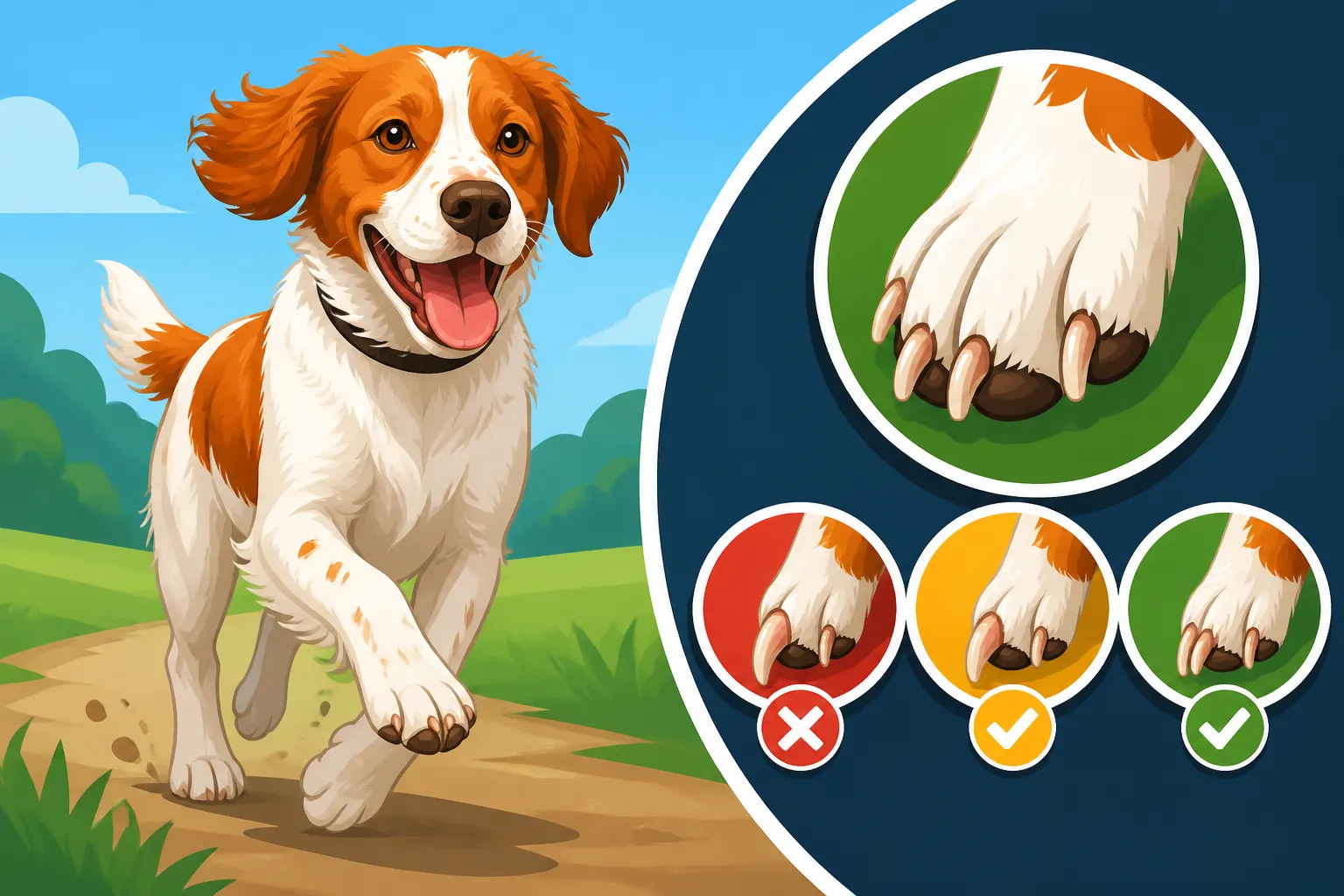
So, how short is short enough? The goal is to have your Brittany's nails trimmed to a length where they do not touch the ground when the dog is standing naturally on a flat, hard surface. This might sound obvious, but for many dogs, even those regularly trimmed, the nails still make contact. Achieving this ideal length requires understanding the anatomy of the nail and being consistent with your trimming routine.
The "Quick" and Why It Matters
Every dog's nail contains a blood vessel and nerve called the "quick." This quick grows with the nail. If nails are left long, the quick extends further down the nail, making it impossible to trim them short enough without causing pain and bleeding. This is a common frustration for owners: you try to trim, hit the quick, and your dog associates nail trims with pain, making future sessions a battle. The good news is that if you trim nails regularly, the quick will gradually recede, allowing you to get the nails shorter over time. It's a slow process that requires patience and consistency, but it's absolutely worth it for your Brittany's comfort.
The Sound Check: When Nails Are Too Long
A simple, audible test can tell you if your Brittany's nails are too long: if you can hear them clicking on hard floors as your dog walks, they are definitely too long. When a dog stands still, the nails should ideally not make contact with the floor. If they do, they are constantly pushing the toe back, putting pressure on the joints, and affecting their natural foot placement. This clicking sound is a clear signal from your Brittany that it's time for a trim. It's an easy and quick way to monitor nail length between scheduled trims.
Visual Guide: What a Properly Trimmed Nail Looks Like
Visually, a properly trimmed Brittany nail will appear relatively short, with only the hard keratin visible past the toe pad. You should be able to see daylight between the tip of the nail and the floor when your dog is standing. The nail should be flush with the paw pad, or just slightly shorter. For white or clear nails, you can often see the pink quick through the nail, making it easier to gauge where to cut. For dark nails, it's trickier. You'll typically look for the point where the nail starts to curl downwards, or where the exposed underside of the nail shows a distinct, dry, powdery appearance before transitioning to a more solid, waxy core (which is close to the quick). When in doubt, take small cuts more frequently, rather than one large cut that risks hitting the quick.
Effective Methods for Keeping Nails Short
Keeping a Brittany's nails at the ideal length isn't a one-and-done task; it's an ongoing commitment. There are various tools and techniques you can use, and the best approach often involves a combination tailored to your dog's temperament and your comfort level. Remember, consistency is your best friend here.
Traditional Clippers vs. Grinders
There are two main types of tools for nail trimming, each with its pros and cons:
| Tool Type | Pros | Cons | Best For |
|---|---|---|---|
| Nail Clippers | Fast and efficient, widely available (e.g., on Amazon or Chewy) | Risk of cutting the quick if not careful, can splinter nails if dull | Confident owners, dogs with lighter nails, quick trims |
| Nail Grinders | Less risk of cutting the quick, smooths nails, quick recedes faster | Can be noisy/vibrating (scares some dogs), takes longer, dusty | Nervous dogs, owners new to trimming, dark-nailed dogs, precise shaping |
If you use clippers, invest in a good quality, sharp pair specific to your dog's size. Dull clippers can crush or splinter the nail, causing pain and damage. For grinders, choose a quiet model if your Brittany is sensitive to noise. Many owners find success using a grinder for dark nails where the quick isn't visible, as it allows for more gradual removal of the nail without sudden cuts.
Building Positive Associations and Desensitization
Many Brittanys are not thrilled about nail trims. It’s crucial to build positive associations from puppyhood. Start by simply handling their paws regularly, giving treats and praise. Gradually introduce the clippers or grinder without actually trimming—let them sniff it, touch their paws with it, and give treats. Turn on the grinder nearby, then touch it to their nail for a second, always followed by high-value rewards. The goal is to make them associate the tools and the process with good things. If your dog is already fearful, go slow. A few seconds of positive interaction a day is better than a traumatic, prolonged struggle once a month. You can even break it down to one nail a day if needed. Patience here prevents a lifetime of battles.
Trimming Frequency: More Often Is Better
For an active Brittany, especially if their nails are currently a bit long, aim for trimming every 1-2 weeks. This frequency allows you to take off small amounts, encouraging the quick to recede, and prevents the nails from ever reaching problematic lengths. If you're using a grinder, you might even do a quick touch-up every few days. The more consistently you trim, the shorter the quick will become, making it easier to maintain the ideal length without stress. Don't wait until the nails are clicking on the floor to trim them; by then, they've already started to impact your dog's gait. Regular maintenance is key, much like How Often a Brittany's Ears Need Cleaning.
Addressing Common Problems with Brittany Nail Care
Even with the best intentions, you might run into some roadblocks when it comes to keeping your Brittany's nails short. From overgrown quicks to field injuries, being prepared can make all the difference.
Dealing with Overgrown Quicks
If your Brittany's nails are very long, their quicks will likely be long too. This means you can't get them to the ideal length in one go. The solution is consistent, frequent trims. Take off just the very tip of the nail, being careful not to hit the quick. Even if it's only a millimeter or two, doing this every few days (with a grinder) or once a week (with clippers) will encourage the quick to recede. It might take several weeks or even months to get the nails as short as they need to be, but persistence pays off. Have styptic powder (like Kwik Stop) on hand, available from retailers like Chewy or Amazon, in case you accidentally nick the quick. A tiny nick is not the end of the world, but it's important to stop the bleeding quickly and reassure your dog.
The Challenge of Dark Nails
Dark nails are notoriously difficult because you can't see the quick. This is where a grinder really shines, as it allows for precise, gradual removal. If using clippers on dark nails, trim in very small increments. Look at the cross-section of the nail after each tiny cut. You'll see a white or grayish outer ring, and then a darker, more waxy center. Stop when you see the beginning of the dark center, as the quick is very close. If you see a tiny black dot appear in the center, you're at the quick. Again, frequent, small trims are safer than trying to take off too much at once.
Field Injuries and Nail Care
Brittanys are adventurous, and even with perfectly trimmed nails, accidents can happen. A torn, broken, or completely ripped-off nail is a common field injury. If this happens, your immediate priorities are to stop the bleeding, clean the wound, and assess the severity. Minor tears might just need cleaning and a bandage, but a completely avulsed nail, or one with a deep tear, warrants a vet visit. Your vet can properly clean the wound, prescribe antibiotics if necessary, and ensure proper healing. Having a small first-aid kit, including antiseptic wipes and self-adhesive bandages, is crucial for any hunter with a dog in the field. This is part of the reality of What a Brittany's Field Injuries Cost in a Season. Keeping nails short reduces the risk, but doesn't eliminate it entirely, especially when your dog is working hard in challenging terrain. Regular checks of your dog's pads and nails after every outing, as described in What a Brittany's Feet Over a Long Season, are also non-negotiable.
The Role of Nutrition in Nail Health
While not directly about length, strong, healthy nails are less prone to breaking and splitting. A high-quality diet, like those offered by brands such as Ollie, can contribute to overall nail health. Look for dog foods rich in omega fatty acids, biotin, and other essential nutrients that support healthy skin and coat, which extends to the nails as well. If your Brittany frequently experiences brittle or splitting nails despite regular trimming and good general health, a discussion with your vet about nutritional supplements might be warranted.
Ultimately, keeping your Brittany's nails appropriately short is an act of love and responsible ownership. It prevents discomfort, promotes healthy movement, reduces the risk of painful injuries, and allows your magnificent bird dog to perform at its peak, whether it's chasing pheasants in the prairie or romping through your backyard.
Disclaimer
This article is for general informational purposes only and does not constitute professional advice. Laws, prices and regulations vary by location and change over time. Consult a qualified professional for guidance on your specific situation.