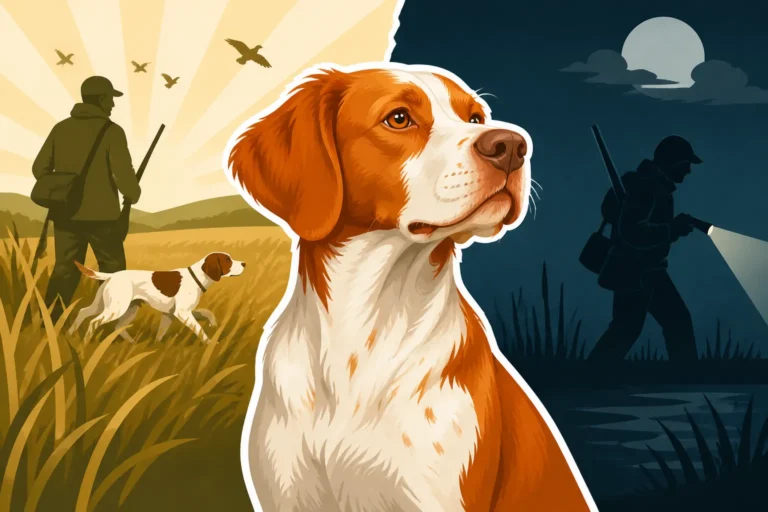
What People Get Wrong About the Brittany
A Brittany can look like an easygoing, medium-sized house dog and still have the energy, instincts, and sensitivity of a serious hunting breed. That mismatch is behind many disappointed owners: the dog is not “too much” or “bad,” but its needs were misunderstood. This guide untangles common myths about Brittanys so you can better understand their name, behavior, exercise needs, and fit for your home.
People get the Brittany’s name and job wrong
A Brittany is not simply a spaniel that flushes birds
The word “Spaniel” still appears in everyday conversation and in the breed’s former name, so it is understandable that people assume a Brittany works like a flushing spaniel. But Brittanys are pointing dogs. They use scent to locate birds and may hold a point while the hunter approaches, rather than routinely rushing in to flush the bird from cover.
That difference affects more than terminology. A Brittany’s natural inclination to search, range, and point can shape how it behaves on walks and in the yard. A dog that suddenly freezes and stares into a clump of grass may be responding to a scent or movement that you have not noticed. It is not necessarily being stubborn or ignoring you on purpose.
If you are comparing sporting breeds, it helps to start with the job each was bred to do, rather than assuming that similar size or coat means similar behavior. The distinction is explained in The Brittany Points, It Does Not Flush and Whether the Brittany Is a Spaniel at All.
“Brittany” does not describe one identical hunting style
People sometimes talk as though every Brittany has the same range, pace, and working style. In reality, breeding goals and individual temperament matter. Some American-bred Brittanys may range farther when hunting, while French Brittanys, also known as Epagneul Bretons, are often associated with a closer-working style. Those are tendencies, not guarantees about any particular dog.
Even littermates can differ. One may be bold and quick to explore; another may check in often and prefer staying near its handler. Training, experience, confidence, and the cover being hunted can all influence how a dog works. A puppy’s early behavior gives clues, but it cannot promise a precise adult range or finished hunting style.
If you are choosing a dog for a specific kind of hunting, ask breeders or rescue volunteers about the parents’ behavior and the dog’s actual history—not just the label “field line” or “French.” For a broader comparison, see How a French Brittany Differs From an American One. And remember that a Brittany is versatile in its abilities, but that does not mean every dog automatically has polished skills in every setting; Whether a Brittany Is a Versatile Breed offers more context.
People mistake high energy for a need to run nonstop
A Brittany needs purposeful activity, not just a big yard
A common misconception is that a Brittany will be fine as long as it has a yard. A fenced space can be helpful, but it does not automatically provide exercise, training, exploration, or companionship. A dog may spend much of the day in a yard without getting the kind of engagement that leaves it content.
For example, imagine a young Brittany sent outside between work calls. It may trot around, bark at squirrels, and come back indoors with energy to spare. A sniff-focused walk, short training session, retrieve game, or safe opportunity to explore with you can be more satisfying than simply adding more time alone outdoors. The right routine depends on the individual dog’s age, health, fitness, and temperament.
Exercise also needs to be built sensibly. A puppy should not be pushed into long, strenuous runs just because the breed is athletic, and an adult dog returning to activity after a quiet period may need gradual conditioning. The goal is not to exhaust the dog every day. It is to offer consistent physical activity and mental work while allowing enough recovery.
| What people assume | A more useful way to think about it |
|---|---|
| A yard is all the exercise a Brittany needs | A yard helps, but interaction and purposeful activity still matter |
| The dog must run for hours every day | Activity should suit the dog’s age, health, fitness, and training |
| More exercise always fixes difficult behavior | Boredom, stress, lack of training, or unmet social needs may also be involved |
| A Brittany can entertain itself outdoors | Many need regular companionship and engagement with their people |
For practical expectations, read How Much Exercise a Brittany Needs Off Season. If a Brittany is under-stimulated, the result may be barking, chewing, pacing, or persistent attention-seeking rather than a calm dog that simply naps. What an Under Exercised Brittany Does at Home explores those signs.
A Brittany can live in a smaller home, but lifestyle matters
Another oversimplification is that Brittanys either “need acreage” or are automatically unsuitable for apartments. Housing size matters less than the daily routine, access to safe exercise, and the owner’s willingness to provide interaction. A spacious home will not solve a lack of engagement, while a smaller home can work for some dogs when their needs are met consistently.
An apartment-dwelling owner, for instance, may build in several purposeful walks, training games, and planned outdoor time. A person with a large yard may still have a restless dog if the dog is left alone for long stretches. Neighbors, stairs, nearby walking routes, safe off-leash areas, and the dog’s ability to settle indoors are all part of the real picture.
Do not treat breed reputation as a guarantee. Some Brittanys are lively indoors; others settle well after activity and routine. Ask about the individual dog’s behavior at home, how it handles being alone, and what daily schedule it has already experienced. For more on the housing question, see Whether a Brittany Can Live in an Apartment.
People call the Brittany “easy” or “too sensitive”
A soft temperament is not the same as a fragile dog
Brittanys are often described as soft, meaning many are responsive to their handler’s tone and may be discouraged by harsh or confusing correction. That does not mean every Brittany is timid, nor does it mean the dog cannot handle normal life, training, or outdoor activity. It means that clear, consistent teaching is usually a better starting point than intimidation.
Picture a dog that makes a mistake during recall practice. If the handler shouts after the dog finally returns, the dog may connect coming back with an unpleasant outcome. The next time, it may hesitate or avoid approaching. A calmer response, followed by rewarding the behavior you want, gives the dog a clearer lesson: returning to you is worthwhile.
This is not a claim that positive reinforcement solves every challenge instantly. A Brittany still needs boundaries, practice, and safe management. But if a dog seems worried, shuts down, or becomes less willing after a correction, it is worth changing the training approach and seeking qualified help rather than assuming the dog is being defiant. What a Brittany's Temperament Is Really Like and Why a Brittany Is Called Soft provide more detail.
Friendly does not mean automatically trained
A Brittany may be affectionate and eager to be with people, but those traits do not replace training. A dog can adore its family and still pull on leash, chase wildlife, jump up when excited, or struggle to come when called around an enticing scent. Warmth and cooperation are not the same as reliability.
Training is especially important for recall and safe handling outdoors. A dog that has learned to return in a quiet yard may find it much harder to respond near birds, rabbits, or unfamiliar dogs. Practice in gradual steps, use a leash or long line where needed, and avoid giving the dog chances to rehearse dangerous behavior. For puppies, a well-run class can also help build confidence and teach owners how to communicate consistently. Whether a Brittany Needs Puppy Class is a useful starting point.
A retailer such as Chewy may be one option for replenishing everyday training treats, food, or basic walking supplies, but the useful choice is the item that fits your dog and your training plan. If your veterinarian has recommended a particular diet or product, follow that guidance rather than changing it because packaging makes a broader promise.
People assume every Brittany is a ready-made family or hunting dog
Breed traits are possibilities, not guarantees
Brittanys are often presented as natural hunting partners and devoted family dogs. Both descriptions can be true, but neither guarantees that a puppy will arrive ready to hunt or that any dog will fit every household. Instinct may give a dog a strong interest in birds, but steadiness, recall, retrieving, and cooperation around gunfire require careful development.
Likewise, affection toward adults does not automatically mean a dog is comfortable with toddlers, cats, or small pets. A high-energy dog may knock over a young child by accident, and a bird dog’s interest in movement can make household animals a management concern. Introductions should be gradual and supervised, and children need age-appropriate guidance on how to interact respectfully.
If hunting ability is a priority, talk through the dog’s background, exposure, and training needs with someone experienced in the work. If companionship is the priority, ask about the dog’s ability to settle, cope with alone time, and share space with the people and animals in your home. A thoughtful match is more dependable than buying into a broad promise about what all Brittanys are like.
The best match depends on the life you can offer
Before bringing home a Brittany, picture an ordinary Tuesday—not only a perfect Saturday in the field. Who will exercise the dog when the weather is miserable? What happens during a busy workweek? Is there a plan for training, safe outdoor access, grooming, veterinary care, and the dog’s need for company? These questions reveal more than a breed description can.
It is also worth preparing for ordinary upkeep. A field outing may mean checking paws, coat, ears, and skin for debris or irritation. A wet or muddy dog may need a rinse and a place to dry. If you are assembling basic supplies, Chewy is one place owners may look for routine items, while a local pet shop can be useful when you want to check fit in person. Either way, choose equipment suited to the dog’s size and activities rather than buying a long list of gear before you know what the dog actually needs.
No single checklist can predict the personality of an individual dog. What it can do is help you avoid expecting a Brittany to be a low-effort pet simply because it is a manageable size, or assuming that a bird-focused breed cannot be a close companion. The most realistic picture includes both sides: an affectionate dog that may settle beautifully at home, and an athletic, scent-driven dog whose needs deserve planning. For basic food and supply restocking, Chewy may be convenient for some households; for questions about nutrition or health, your veterinarian is the better guide.
Disclaimer
This article is for general informational purposes only and does not constitute professional advice. Laws, prices and regulations vary by location and change over time. Consult a qualified professional for guidance on your specific situation.