How Much Smaller a Brittany Is Than a Setter
A Brittany can look noticeably smaller beside a Setter, but the difference depends on which Setter you mean. English, Irish, and Gordon Setters are all taller than the typical Brittany, though not by the same amount. This guide compares their adult size, build, and everyday footprint so you can picture what those inches mean in a home, on a walk, or in the field.
How much smaller is a Brittany than a Setter
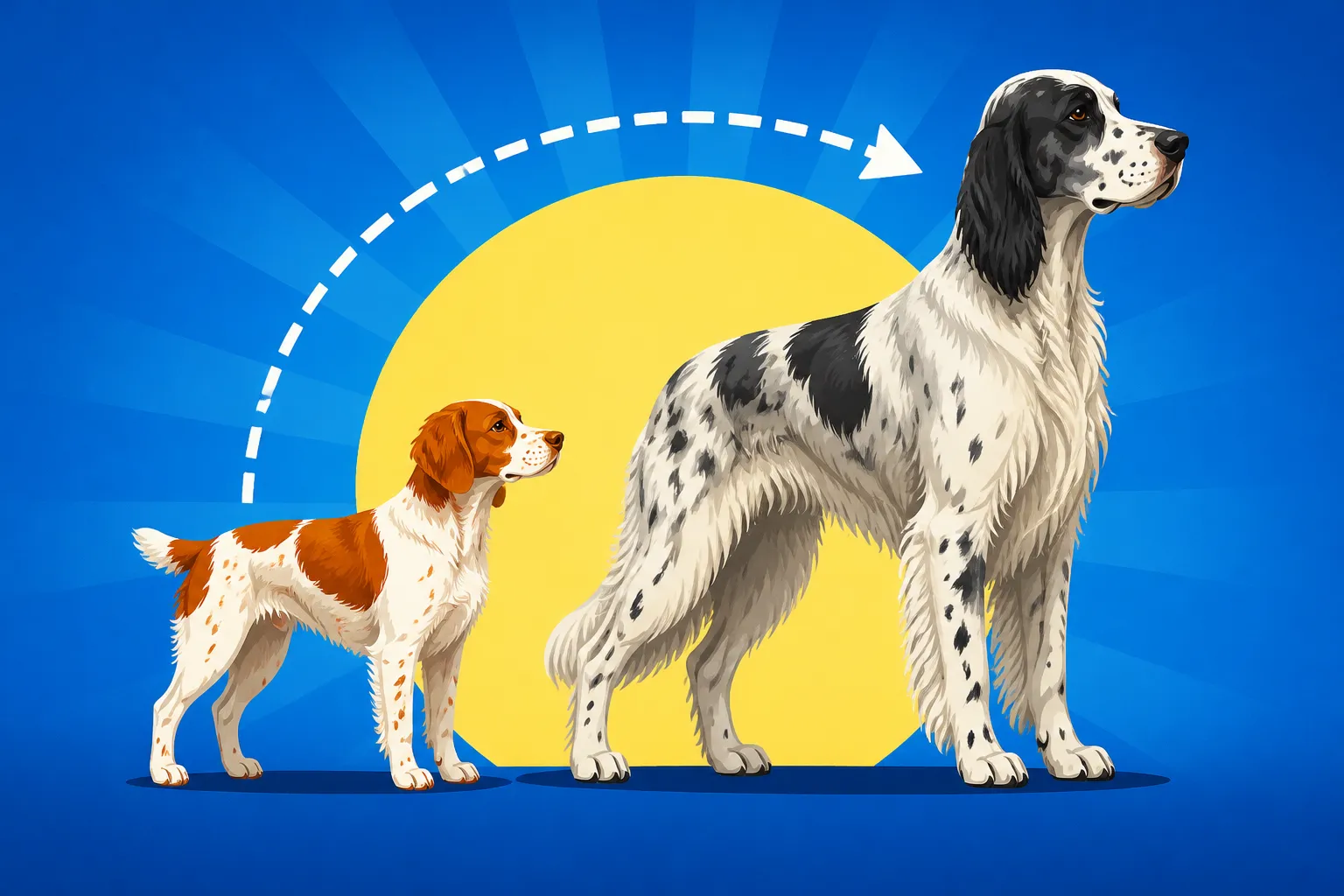
The short answer: a Brittany is usually several inches shorter than an English or Gordon Setter and often close to a foot shorter than an Irish Setter. Height gives a useful first comparison, but it doesn’t tell the whole story. A Setter’s longer legs, larger frame, and greater overall reach can make the size difference feel even more pronounced in person.
“Setter” also refers to more than one breed. If someone says a Brittany is smaller than a Setter without naming the type, they may be comparing it with an English Setter, an Irish Setter, or a Gordon Setter. Each has its own typical height and build.
Typical adult heights at a glance
A mature Brittany generally stands about 17.5 to 20.5 inches at the shoulder. The shoulder is the top of the dog’s back, just above the front legs, and it’s the standard point used for measuring canine height. Many adult Brittanys fall around the middle of that range, though individual dogs vary.
English Setters typically stand around 23 to 25 inches, depending on sex and the breed standard being followed. Gordon Setters are generally around 23 to 27 inches, while Irish Setters are often around 25 to 30 inches. These ranges are approximate breed-level comparisons, not a promise that every dog will match them. A small Setter and a tall Brittany may be closer in height than you’d expect.
| Breed | Approximate adult shoulder height | Usual comparison with a Brittany |
|---|---|---|
| Brittany | 17.5 to 20.5 inches | Baseline |
| English Setter | About 23 to 25 inches | Often several inches taller |
| Gordon Setter | About 23 to 27 inches | Commonly several inches taller |
| Irish Setter | About 25 to 30 inches | Often the biggest height difference |
These figures are intended to help you visualize typical adult dogs, not assess a puppy’s future size from a quick glance. Growth rate, sex, family lines, and individual development all play a part. If you’re comparing a particular dog, measure from the floor to the top of the shoulder while the dog is standing naturally.
For more background on the Brittany’s proportions, see How Tall a Brittany Stands. It also helps to keep in mind that What a Brittany Weighs and How Tall It Stands covers both height and weight, while this comparison focuses on the difference between the Brittany and Setter types.
The size gap depends on which Setter you mean
Compared with an English Setter, a Brittany is often around three to seven inches shorter at the shoulder. The exact gap depends on the dogs being compared: a large Brittany and a smaller English Setter may be relatively close, while a small Brittany beside a tall Setter will look much more compact.
A Gordon Setter can be similar in height to an English Setter or taller, especially toward the upper end of its typical range. So the Brittany may be several inches shorter, but it isn’t always an entirely different scale of dog. A sturdy, mature Brittany can still look substantial next to a smaller Setter.
The largest average height difference is often with an Irish Setter. Since Irish Setters tend to stand taller, the gap between an average Brittany and an average Irish Setter can approach a foot. That’s a noticeable difference when the dogs stand side by side, though it doesn’t mean the Irish Setter is automatically more energetic, more capable, or harder to manage.
Height isn’t the same as overall size
A taller dog doesn’t always weigh dramatically more, and two dogs of similar height can have very different builds. Brittanys are compact, athletic pointing dogs. Setters tend to have longer legs and a more elongated outline, so they may look bigger even when the measured height difference is modest.
Weight ranges can overlap, especially across individual dogs and Setter types. A lean Setter may weigh less than a heavier Brittany, while a large Setter may be far heavier. Conditioning matters, too: an athletic dog with a healthy body condition may look quite different from a dog carrying excess weight.
This is why comparing only the number on a scale can be misleading. If you’re deciding whether a dog will fit your home or travel setup, consider shoulder height, body length, weight, and how easily the dog can move through your space. Breed comparisons such as how a Brittany differs from an English Setter can help make those differences clearer.
What the size difference looks like in everyday life
A few inches on paper can change the way a dog fits into a car, moves through a doorway, or curls up beside the sofa. The Brittany’s smaller frame may be easier to accommodate in some situations, but that doesn’t make it a low-energy or low-maintenance dog. Setters are also active sporting dogs, and the right match depends on daily routine as much as dimensions.
At home and in the car
A Brittany may take up less floor space than a Setter, especially when resting in a bed or lying beside a chair. In a smaller home, that can make everyday movement feel easier: there may be more room to pass in a hallway, and a dog bed may fit without rearranging the furniture. Still, a Brittany needs room to stretch out and a routine that meets its exercise and enrichment needs.
In a vehicle, the practical difference is often less about whether the dog physically fits and more about whether the dog can ride safely and comfortably. A crate or vehicle restraint should be selected using the dog’s actual measurements and the equipment maker’s guidance—not just the breed name. A Setter’s longer body and taller frame may call for a roomier setup, while a Brittany may fit in a smaller one. Both should have enough space to rest without being crammed in.
If you’re comparing crates, beds, or travel accessories, measure the individual dog and check the product’s sizing instructions. Retailers such as Chewy may list dimensions and size guidance, but the dog’s measurements should decide which option is suitable. A puppy will also outgrow equipment, so consider its expected adult build when planning purchases.
On walks and in the field
Brittanys and Setters are sporting dogs, so a smaller body doesn’t necessarily mean a slower or less active companion. A Brittany can cover ground quickly, and a Setter’s longer stride can make its movement look especially effortless. How far either dog ranges depends on the individual, training, environment, and breeding—not simply height.
For a person who hunts on foot, a compact dog may be easier to lift over an obstacle or help into a vehicle after a long day. That practical advantage is worth considering if you regularly travel alone or hunt in rough terrain. But stamina and soundness depend on conditioning, health, and workload, so size alone shouldn’t determine how long a dog can work.
When choosing between breeds for hunting, consider working style as well as size. The Brittany Points, It Does Not Flush explains an important part of the Brittany’s role, while How a Brittany Differs From a German Shorthaired Pointer offers another useful comparison of sporting-dog builds and traits. A Setter may suit a different pace or style than a Brittany, but individual dogs vary widely within each breed.
With children and other pets
A smaller dog can be easier for some households to manage physically, but it is not automatically safer or calmer around children. A lively Brittany can knock into a small child during play, just as a larger Setter can. Supervision, training, space to retreat, and teaching children how to interact respectfully matter more than a few inches of height.
Likewise, a larger dog may be more likely to bump into fragile items or crowd a narrow walkway, but dogs of every size need boundaries indoors. If you have a cat or small pet, prey drive and careful introductions deserve more attention than the difference between a Brittany and a Setter. Size doesn’t reliably predict whether a dog will coexist peacefully with another animal.
For a broader look at family fit, A Brittany With Children and Other Animals explores the considerations that matter beyond a dog’s measurements. It’s sensible to evaluate each dog’s temperament and history rather than assume that a smaller breed will automatically be easier for your household.
How to compare a Brittany and Setter fairly
If you’re choosing between a Brittany and a Setter, compare mature, healthy adults where possible. Puppies can be misleading: a young Setter may look only slightly larger than a Brittany puppy, then continue growing for months. A puppy’s paws and current weight are not dependable ways to predict exact adult size.
Measure the dogs, not just the breed averages
To measure height, have the dog stand squarely on a level surface. Measure from the ground to the highest point of the shoulder, not the top of the head. If the dog is wiggly, take the measurement more than once, or ask a groomer, veterinarian, or experienced handler to help.
For a practical comparison, also note body length, chest width, and weight. These details matter if you’re choosing a crate, car restraint, dog bed, or outdoor kennel. A long-bodied Setter may need more floor length than its height suggests, while a broad or muscular Brittany may need more room than a narrow dog of similar height.
When shopping for supplies, use the manufacturer’s measurements and fitting instructions. For example, product listings on Chewy can help you compare item dimensions, but a generic label such as “medium” or “large” won’t fit every dog the same way. Measuring the actual dog is a better way to avoid the frustrating cycle of ordering, discovering the item is too small, and starting over.
Consider adult size alongside energy and training
It’s tempting to pick a breed based on the dog that seems easier to fit into a home. That can be part of the decision, but the Brittany’s compact size doesn’t erase its sporting-dog needs. A Brittany that doesn’t get enough activity and engagement may still become restless indoors. Setters also need exercise and thoughtful training, regardless of their height.
If size is your main concern, ask yourself what problem you’re trying to solve. Is it car space? Handling a dog on stairs? Choosing a crate? Sharing a smaller home? Each concern has a practical answer, and the breed’s height may be only one part of it. For example, a well-fitted crate can solve a travel issue, while a steady training routine matters more for indoor manners.
A Brittany may be the more compact choice, while a Setter generally brings a taller, longer outline. Neither is universally easier to live with. The Brittany Is the Smallest of the Versatile Pointing Breeds offers added context about the Brittany’s size among sporting dogs, and Whether a Brittany Suits a First Time Owner can help you think through the responsibilities that go well beyond height.
Common questions about Brittany and Setter size
Is every Setter bigger than every Brittany
No. Breed averages show that Setters are generally taller, but individual dogs vary. A small Setter may be close in height to a large Brittany, especially when comparing dogs near opposite ends of their typical ranges. Weight and body shape can vary just as much, so a side-by-side comparison is more informative than assuming every dog fits the average.
Is a Brittany a small dog
A Brittany is usually considered a medium-sized sporting dog rather than a toy or small companion breed. Its compact build can make it seem small beside a tall Setter, but it is still a capable, athletic dog that needs suitable space, exercise, and training. In other words, “smaller than a Setter” doesn’t necessarily mean “small” in everyday ownership.
Which Setter is biggest next to a Brittany
Irish Setters are often the tallest of the three Setter types discussed here, so they commonly show the greatest height contrast with a Brittany. Gordon Setters can also be tall and substantial. Individual dogs differ, so compare the specific dog you have in mind rather than relying on breed labels alone.
Does a smaller Brittany need a smaller crate than a Setter
Often, but not always. The crate should fit the individual dog, allow comfortable standing and turning, and follow the manufacturer’s sizing guidance. A tall, long-legged Brittany may need more room than a smaller dog of the same breed, while a compact Setter may not need as much space as a larger one. Measure before buying and consider adult size if you’re shopping for a puppy.
Disclaimer
This article is for general informational purposes only and does not constitute professional advice. Laws, prices and regulations vary by location and change over time. Consult a qualified professional for guidance on your specific situation.